The Best Drawdown-to-Profit-Target Ratio on a 50K Futures Evaluation
Every futures prop firm sells you the same fantasy: a five-figure account, a “realistic” target, and just enough rope to hang yourself with. The number that actually decides whether you pass isn’t the account size on the dashboard — it’s how much room you get to lose relative to how much you have to make. Here’s which 50K evaluation gives you the most cushion per dollar of target, and why the firm with the prettiest ratio on paper isn’t automatically the easiest to pass.
What “drawdown-to-profit-target” actually means
The ratio is simple arithmetic: take the maximum drawdown (your loss buffer) and divide it by the profit target (what you must earn to pass). A 50K account with a $2,500 drawdown and a $3,000 target is a 0.83 ratio — you can lose 83 cents for every dollar you need to make. The higher that number, the more variance your strategy can survive before the evaluation kills you. Almost every futures firm runs a one-step evaluation where you hit a profit target while staying inside the drawdown, so the ratio is the single cleanest way to compare difficulty across firms that otherwise look identical.
Drawdown ÷ Profit target = buffer ratio. Higher is more forgiving. On a 50K account, $2,500 buffer ÷ $3,000 target = 0.83. That same target against a $1,750 buffer = 0.44 — nearly half the breathing room for the identical payday.
If that were the whole story, you’d just sort by ratio and buy the top one. It isn’t, because a buffer is only worth its face value if it stops moving. The mechanic underneath the number — trailing versus end-of-day, intraday versus locked — decides how much of that cushion you actually get to use. A $2,500 trailing buffer that chases your equity peak can be worth less in practice than a $2,000 buffer that only updates at the close. Before you commit a fee, run your strategy’s real risk-per-trade through our free trading calculators so you’re sizing against the buffer you actually have, not the one on the marketing page.
The trailing-drawdown trap
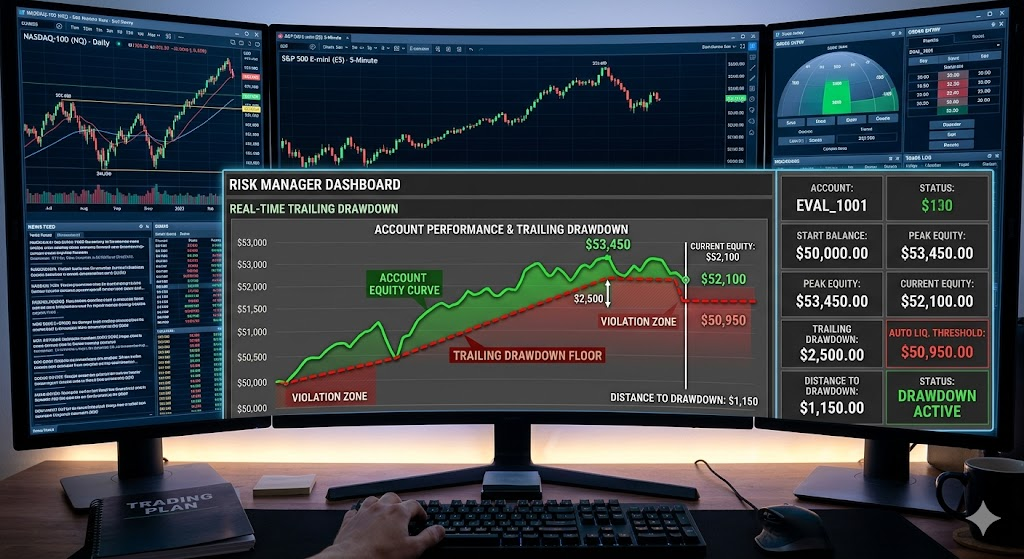
Trailing drawdown is where the ratio lies to you. On an intraday-trailing account, your loss floor ratchets up in real time with your unrealized peak and never comes back down — so a winning move that prints to a high and then retraces permanently tightens your leash from the new peak. Apex’s intraday model is the textbook example: the threshold follows peak equity tick by tick and only stops trailing once it converts to a static ceiling at Starting Balance + $100 ($50,100 on a 50K), after which the buffer finally locks. Until you reach that lock, your “$2,500 buffer” is a moving target that shrinks every time you give back an open gain, per Apex Trader Funding.
End-of-day (EOD) trailing is the gentler cousin: the floor only recalculates on the closing balance, so intraday spikes and retraces don’t permanently cost you room. You can be down $1,500 mid-session, claw back to down $200 by the close, and only the $200 counts against tomorrow’s floor. That’s why a 0.67 EOD account can be easier to pass than a 0.83 intraday account for anyone who lets trades breathe — the smaller number is fully usable. The diagram below shows exactly how the intraday floor eats your cushion when an unrealized run reverses, mechanics confirmed by Tradeify Help Center.
50K futures evaluation drawdown-to-target, ranked
Below are the current 50K evaluation numbers for the firms worth comparing, sorted by raw buffer ratio. The two rows tied at the top (0.83) both carry the trailing-drawdown caveat above; the 0.67 rows trade a smaller headline buffer for the more forgiving EOD mechanic. “Consistency rule” is the one that applies during the evaluation — a generous ratio paired with a tight consistency rule is not as easy as it looks, because no single day can carry your whole pass.
| Firm (50K eval) | Target | Max drawdown | Max contracts | Drawdown type | DD ÷ Target | Consistency (eval) | Partner |
|---|---|---|---|---|---|---|---|
| Apex (Intraday) | $3,000 | $2,500 | 6 | Real-time trailing → locks at $50,100 | 0.83 | None | No |
| Bulenox — Option 1 | $3,000 | $2,500 | 6 | Intraday trailing, no daily loss limit | 0.83 | None | Yes |
| Bulenox — Option 2 | $3,000 | $2,500 | 6 | EOD trailing + $1,100 daily loss limit | 0.83 | None | Yes |
| Apex (EOD) | $3,000 | $2,000 | 6 | EOD trailing → locks at $50,100 | 0.67 | None | No |
| Alpha Futures — Standard / Zero | $3,000 | $2,000 | 4 | EOD trailing (4%) | 0.67 | 50% (Std) / None (Zero) | Yes |
| Topstep — Trading Combine | $3,000 | $2,000 | 5 | Trailing in Combine → EOD when funded | 0.67 | None | No |
| Tradeify — Select / Growth | $3,000 | $2,000 | 4 | EOD trailing, conditional lock at 6% | 0.67 | 40% | No |
| Alpha Futures — Advanced | $4,000 | $1,750 | 4 | EOD trailing (3.5%) | 0.44 | 50% | Yes |
Max contracts shown are the cap during the evaluation (minis; roughly 10× that in micros). Funded/PA caps are usually lower, and Bulenox Option 2 plus Tradeify’s funded plan scale up from a smaller start as you bank profit.
The takeaway most traders miss: the headline ratio and the pass-ability ratio aren’t the same column. Apex and Bulenox win the arithmetic at 0.83, but they win it with intraday trailing, which only fully rewards traders who don’t sit on unrealized profit. The EOD pack at 0.67 hands you a smaller number you can actually spend. And the firms that pair their buffer with an evaluation-stage consistency rule — Alpha, Tradeify — quietly raise the real difficulty without touching the ratio at all. If you want to see how those evaluation fees stack up against the funded-account costs you’ll pay after you pass, our futures prop firm true-cost breakdown has the all-in numbers.
The ratio winners, rule by rule
Bulenox — the partner that actually ties for the top ratio
Bulenox’s 50K evaluation runs a $3,000 target against a $2,500 trailing drawdown — the same 0.83 buffer ratio as Apex’s intraday account — and it lets you pick your poison at signup. Option 1 is pure intraday trailing with no daily loss limit, which suits a disciplined scalper who’s in and out before an unrealized run can turn into a liability; Option 2 swaps to EOD trailing but bolts on a daily loss limit (~$1,100 on the 50K), which is the calmer fork for anyone using wider stops. There’s no consistency rule during the evaluation itself — the 40% best-day rule only bites at payout on the funded Master account, according to Bulenox.
The one thing to price in is the activation fee on the funded side (roughly $148 on a 50K), which is where the cheap evaluation gets its margin back — a pattern we break down across the industry in our prop firm true-cost hub. For a scalper who wants the maximum raw buffer and the no-daily-loss-limit fork, Option 1 is the cleanest expression of a top ratio you’ll find from a firm we’ll actually stand behind.
Start a Bulenox 50K evaluation →
Apex Trader Funding — the ratio king (no, we don’t get paid for this one)
Apex’s intraday 50K matches the best ratio in the table at 0.83, and its evaluation rules are about as clean as the category gets: a $3,000 target, no daily loss limit on the intraday account, and no consistency rule during the evaluation. The catch is the mechanic — the intraday floor trails your peak equity in real time and doesn’t stop until it converts to a static ceiling at $50,100, so the full buffer is only “real” once you’ve locked it. Apex also ships an EOD variant that drops the buffer to $2,000 (a 0.67 ratio) in exchange for the friendlier close-only calculation, per Apex Trader Funding. We don’t partner with Apex, which is exactly why it’s sitting at the top of this list — the numbers put it there, not a commission.
Alpha Futures — the best EOD ride, if you respect the consistency rule
If you’d rather trade a buffer you can fully use, Alpha Futures’ Standard and Zero 50K accounts run a $2,000 EOD trailing drawdown against the same $3,000 target — a 0.67 ratio where every dollar of cushion survives intraday noise because the floor only updates at the close. The loss limit trails only at the close and locks at your starting balance once you’re in profit, and the Standard evaluation carries no daily loss guard. Worth knowing if you’re weighing account sizes: that 4% drawdown tightens to 3% at 100K, so this same 0.67 ratio erodes to 0.50 once you scale up — we break that down in our 100K drawdown-to-target guide. The asterisk is the consistency rule: the Standard evaluation requires you to satisfy a 50% best-day rule on top of the target, so you can’t pass on one heroic session, per the Alpha Futures Help Center.
Alpha’s Advanced plan is the trap to avoid if you’re optimizing for ratio — it strips the consistency rule and restrictions on the funded side but tightens the evaluation to a $4,000 target on a $1,750 buffer, a brutal 0.44 ratio that nearly halves your margin for error versus the Standard, as documented by Alpha Futures. For the evaluation stage specifically, Standard or Zero is the smarter buy. At a confirmed $79 entry it’s also one of the better-value EOD evaluations on the board.
If you want a fixed (non-trailing) buffer instead
Trailing drawdown — intraday or EOD — is the futures default, but it isn’t the only model. If the whole ratchet mechanic gives you hives, Earn2Trade’s Trader Career Path uses a static-style drawdown that doesn’t chase your equity peak at all, which changes the math entirely: a fixed floor means the buffer on the page is the buffer you keep, start to finish. It’s a different shape of evaluation (and a slower, education-flavored path), but for traders who keep blowing up on trailing-floor shifts it can be the more honest structure, and it’s a partner we’re comfortable pointing you to.
The best ratio in the world is worthless if the firm doesn’t pay. Drawdown-to-target tells you how hard the evaluation is — it tells you nothing about payout reliability on the funded side. We maintain an exclusion list for a reason, and we’ve watched a firm we used to cover collapse mid-stream. Treat a generous ratio as a reason to look closer, never as a substitute for checking the firm’s payout track record first.
See Earn2Trade’s fixed-drawdown path → Browse Elite Trader Funding evals →
The verdict
For the raw drawdown-to-profit-target ratio on a 50K evaluation, two firms tie at the top with 0.83: Apex (intraday) and Bulenox Option 1. Of those, Bulenox Option 1 is the one we’d actually hand a disciplined scalper — same buffer ratio, no daily loss limit, no evaluation-stage consistency rule, and a firm we partner with rather than just tolerate. Apex earns its co-#1 spot on the numbers alone, partnership or not. But if you let trades breathe and want a buffer you can fully spend without the trailing floor punishing every retrace, the smarter “best” is an EOD account — Alpha Futures Standard at 0.67, as long as you trade around its 50% consistency rule. Pick the ratio that matches your mechanic, not the biggest number on the page.
Frequently asked questions
What is a good drawdown-to-profit-target ratio on a 50K futures evaluation?
Anything at or above 0.67 (a $2,000 buffer on a $3,000 target) is competitive, and 0.83 ($2,500 buffer) is the top of the current market. Below roughly 0.5 — like a $4,000 target on a $1,750 buffer — you’re paying for a much thinner margin of error for the same payday.
Which 50K futures firm has the highest drawdown-to-target ratio?
Apex’s intraday account and Bulenox’s Option 1 both run a $2,500 drawdown against a $3,000 target, a 0.83 ratio that leads the category. Both use intraday trailing, so the buffer is only fully usable if you don’t sit on unrealized profit.
Is trailing or end-of-day drawdown better for passing a 50K evaluation?
EOD is more forgiving because the floor only recalculates at the close, so intraday spikes and retraces don’t permanently shrink your buffer. A 0.67 EOD account can be easier to pass than a 0.83 intraday account for traders who let positions breathe; intraday only fully rewards fast, in-and-out scalpers.
Does a consistency rule change the evaluation difficulty?
Yes. A consistency rule during the evaluation (for example, no single day exceeding 40–50% of total profit) means you can’t pass on one outsized session, which raises real difficulty without changing the headline ratio. Apex, Bulenox, and Topstep have no consistency rule on the evaluation itself; Alpha and Tradeify do.
What is the profit target on a 50K futures evaluation?
The standard one-step target is $3,000, or 6% of the 50K account, at Apex, Bulenox, Topstep, Tradeify, and Alpha’s Standard plan. Some tougher tiers, like Alpha Advanced, raise it to $4,000 (8%) while also tightening the drawdown.