▸ Trading Psychology
You Don’t Have to Trade Every Day
It’s 11 a.m. Nothing on your chart matches a single line of your trading plan. And yet there’s a voice — quiet, insistent, a little smug — telling you to find something. You start zooming into lower timeframes, redrawing levels, hunting for a setup that isn’t there. That itch to always be in a trade, even when the market is offering you nothing, is one of the most expensive habits in trading. And the fix isn’t a better indicator. It’s learning that doing nothing is often the trade.
The myth of the daily trade
Somewhere along the way, traders absorbed the idea that a “real” trader is always active — that a day without a position is a day wasted. It’s a lie, and an expensive one. The market doesn’t hand out A+ setups on a schedule to suit your boredom; some days it’s a coiled, directionless mess, and the correct response is to close the laptop. Mastering the market isn’t about mastering charts — it’s about the discipline to sit on your hands when there’s no clear setup rather than forcing a trade because you feel you “have to.” (Traders Circuit: the daily battle for discipline)
Overtrading — taking trades outside your plan — is a discipline failure, not a strategy one, and it’s a leading cause of blown accounts. You can own the best system on the planet, but if you can’t stop yourself from clicking when the system says “wait,” the edge never gets a chance to work. The “if only I hadn’t taken that trade” trades almost always come from this exact impulse. (Traders Mastermind: overtrading is a discipline failure)
Cash is a position
Here’s the reframe that changes everything: being in cash is not “doing nothing.” It’s an active, strategic position that protects three things you actually trade with — your risk capacity, your focus, and your future opportunity. Professional traders understand that sitting out is a position, and a deliberate one. The pressure to be in a trade at all times, even when there’s nothing valid to trade, is the feeling to unlearn. (TradesViz: sitting out is a position)
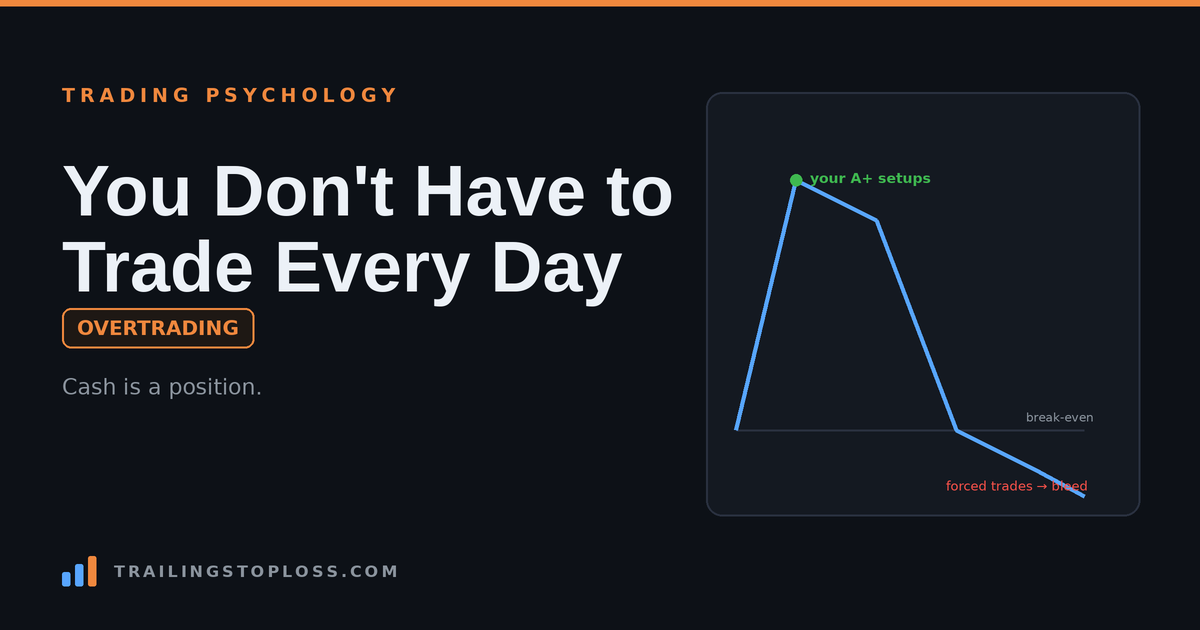
Every weak trade you take while waiting doesn’t just risk a small loss — it ties up your capital and attention so that when the real A+ setup finally shows, you’re already committed to garbage. Money parked in poor ideas is money that can’t take the good one. “No trade” isn’t the absence of a decision; it’s frequently the best decision on the board. (FBS: weak trades crowd out the good ones)
Why your brain screams for a trade
The compulsion isn’t a character flaw — it’s wiring. The core driver is action bias: the human tendency to do something, anything, just to relieve tension. Waiting feels emotionally painful; clicking feels like relief. So your brain manufactures a “setup” to make the discomfort stop, and dresses up constant engagement as productivity. It isn’t productive. It’s just busy. (The Trading Reset: action bias & the illusion of productivity)
Stacked on top of action bias is FOMO — a comparison-driven anxiety that everyone else is printing money while you sit there. It’s not really about the chart in front of you; it’s about the imaginary trader on your feed who’s up 20R today. FOMO also fires a genuine stress response, lighting up the amygdala and overriding the logical part of your brain, which is why it hijacks decisions in seconds rather than minutes. (Warrior Trading: FOMO triggers the amygdala) (TradesViz: FOMO is comparison-driven)
Then there are the quieter culprits. Confirmation bias: once you’ve decided price “has to” bounce, you’ll hunt lower timeframes until you find a vague pattern that agrees — and if you have to struggle that hard to justify a trade, the market is telling you it isn’t there. Ego and identity: when “I’m a trader” means “I trade,” a quiet day feels like an existential threat rather than a Tuesday. And the sunk-cost of screen time: three hours of watching makes people feel owed a trade, as if the market reimburses attention. It doesn’t. (Chart Champions: struggling to justify a trade means it isn’t there) (HolaPrime: ego attaches identity to activity)
And if you’re on a funded or evaluation account, add one more: the manufactured urgency to “use” the account, as though the drawdown limit expires if you don’t feed it. It doesn’t. A prop firm doesn’t pay you for volume; it pays you for the handful of trades where your edge actually showed up. (PrimeX: manufactured urgency & sunk-cost)
The math nobody wants to hear
Your edge doesn’t live evenly across every hour of the session. It’s concentrated in a small number of high-quality setups, and everything you take outside those setups drags your average trade toward zero and then past it. More trades mean more spread, more commissions, and more risk exposure — and each low-quality loss chips away at profits that were earned through discipline. Activity and profitability are not the same axis. (Chart Champions: more trades, more cost, less edge)
This is why patient traders so often look “inactive” right before they outperform. Every time you reject a weak trade, you’re not missing out — you’re banking what one framework calls patience equity, an edge that compounds financially and mentally. The rejected trades don’t show up in your P&L, which is exactly why they feel like nothing and are actually everything. (The Trading Reset: patience equity compounds)
Sniper, not machine gunner
The cleanest mental model for this is two archetypes. The machine gunner sprays trades to escape the discomfort of waiting; the sniper does the analysis, marks the levels, sets alerts, and steps away until the shot is worth taking. Same market, opposite relationship with the trigger. (The Trading Reset: sniper vs machine gunner)
Trades to feel better
Fires at anything that moves to relieve tension. Confuses activity with progress, lowers standards to avoid missing out, and burns mental capital and commissions all day. Occasionally wins — and reads that as proof the habit works.
Trades to make money
Waits for the one high-probability setup, then commits fully. Uses alerts instead of staring, keeps focus intact, and is comfortable ending a session flat. Looks lazy right up until the scoreboard says otherwise.
Notice the machine gunner isn’t dumb — they’re often working harder than the sniper. That’s the trap. Effort feels virtuous, so a day of forcing twelve trades feels more legitimate than a day of taking zero, even when zero was the correct, professional call. The market pays for being right, not for being busy. (Trademetria: quality over quantity)
How to actually sit on your hands
Willpower alone won’t hold against action bias — you outgrow the urge with a routine that makes waiting the default and trading the exception. Here’s the protocol that works. (FBS: beat FOMO with routine, not willpower)
- Pre-define your A+ setup in writing. Write the exact conditions that must be present to enter. If the current move doesn’t match, it’s a no. Pre-defined entries alone eliminate the large majority of impulse trades, because “it’s kind of close” stops being an option.
- Set alerts and walk away. Do the analysis, mark your levels, place price alerts, and physically leave the screen. Staring at charts manufactures trades; alerts let the setup come to you and starve the dopamine-driven clicking.
- Cap your trades and your losses. A hard maximum number of trades per day plus a daily loss limit interrupts the spree before it starts. If you hit either, you’re done — the account will still be there tomorrow.
- Use the “there’s always another setup” rule. When a move has already run without you, let it go. Chasing a train that left the station is how small missed gains become oversized losses. Missed money is cheaper than lost money.
- Score no-trade days as wins. Track the days you correctly stayed out as a discipline metric, not a blank. A green “no-trade” day is a rep, and reps are what rewire the compulsion.
- Judge trades in R, not activity. Measure performance in R-multiples relative to risk, so you compare a forced trade and an A+ trade honestly instead of by raw dollars or how busy you felt. The scoreboard should reward process, not motion.
One structural tip underneath all of it: do your review away from the trading desk. Running your stats while sitting in front of live charts keeps you in a reactive, itchy mindset; stepping away from the screens is how you break the loop between “I’m looking” and “I’m clicking.” (Chart Champions: separate review from the trading screen)
🧠 The one-line reframeYou are not paid to trade. You are paid to be right when it counts — and most of the time, the market is not offering you a chance to be right. On those days, the highest-skill move on the board is to close the laptop and keep your capital, your focus, and your discipline fully loaded for when it is.
The bottom line
The compulsion to always be in a trade is normal, human, and beatable — but not by white-knuckling it. It’s beaten by accepting that cash is a position, that your edge lives in a few trades rather than many, and that a flat, boring, rule-abiding day is a professional result, not a failure. The traders who last aren’t the ones who trade the most. They’re the ones who learned to want the setup more than they want the action. (CrossTrade: pre-defined entries kill impulse trades)
Build the discipline on purpose: try the One Trade a Day challenge, track your no-trade and rule-following streak with the Hold Tracker, and log every session — including the ones you sat out — on the P&L Calendar. If the itch to always be in is your recurring leak, that’s a discipline problem, and it’s fixable.
FAQ
Do you have to trade every day to be profitable?
No. Profitability comes from taking a small number of high-quality setups, not from daily activity. Your edge is concentrated in specific conditions that don’t appear every day, so forcing a trade on a flat day usually subtracts from your results rather than adding to them. Many consistently profitable traders sit out frequently.
Why do I feel the need to always be in a trade?
Mostly action bias — the human urge to do something to relieve the discomfort of waiting — combined with FOMO, boredom-driven dopamine, ego tied to being “a trader,” and the sunk-cost feeling that hours of screen time owe you a trade. On funded accounts, a manufactured urgency to “use” the account piles on top.
Is not trading actually a position?
Yes. Being in cash is an active, strategic choice that protects your risk capacity, focus, and future opportunity. Professional traders treat sitting out as a deliberate position, not laziness — especially because capital tied up in a weak trade can’t take the strong one when it appears.
How do I stop forcing trades and overtrading?
Pre-define your exact entry conditions in writing, set price alerts and step away from the screen, cap your daily trades and losses, and refuse to chase moves that already ran. Track no-trade days as wins and measure results in R-multiples relative to risk, so the scoreboard rewards discipline instead of activity.
How many trades should I take per day?
There’s no universal number — it’s however many A+ setups the market actually offers, which is often zero, one, or two for a discretionary day trader. The goal isn’t a target count; it’s only trading when conditions match your plan and comfortably taking none when they don’t.
TrailingStopLoss publishes independent, funded-trader analysis of prop firms, strategy, and trading psychology. Educational content only — not financial advice. Trading futures involves substantial risk of loss.