You can have a genuinely good strategy and still hand your account back to the market. Most traders do. The uncomfortable thing buried in the data is that the edge you’re missing usually isn’t a sharper setup — it’s the discipline to trade the one you already have. Bookmap
First, how bad it actually is
Start with the scoreboard. A landmark study of nearly 1,600 Brazilian day traders found that 97% of everyone who traded for more than 300 days lost money, and barely 1% out-earned a bank teller — while taking on far more risk. CNBC
It isn’t a fluke of one market, either. Brad Barber and Terrance Odean’s fifteen-year study of Taiwanese day traders reached the same verdict: the overwhelming majority lose, and fewer than 1% can predictably beat the market after costs. Barber & Odean
And people don’t gradually wise up, either. Roughly 80% of day traders quit within two years, and losing traders place about four times more trades than winning ones — which tells you the problem is rarely too few good ideas. It’s too little restraint. Tradeciety
The blow-up isn’t the setup. It’s what you do next.
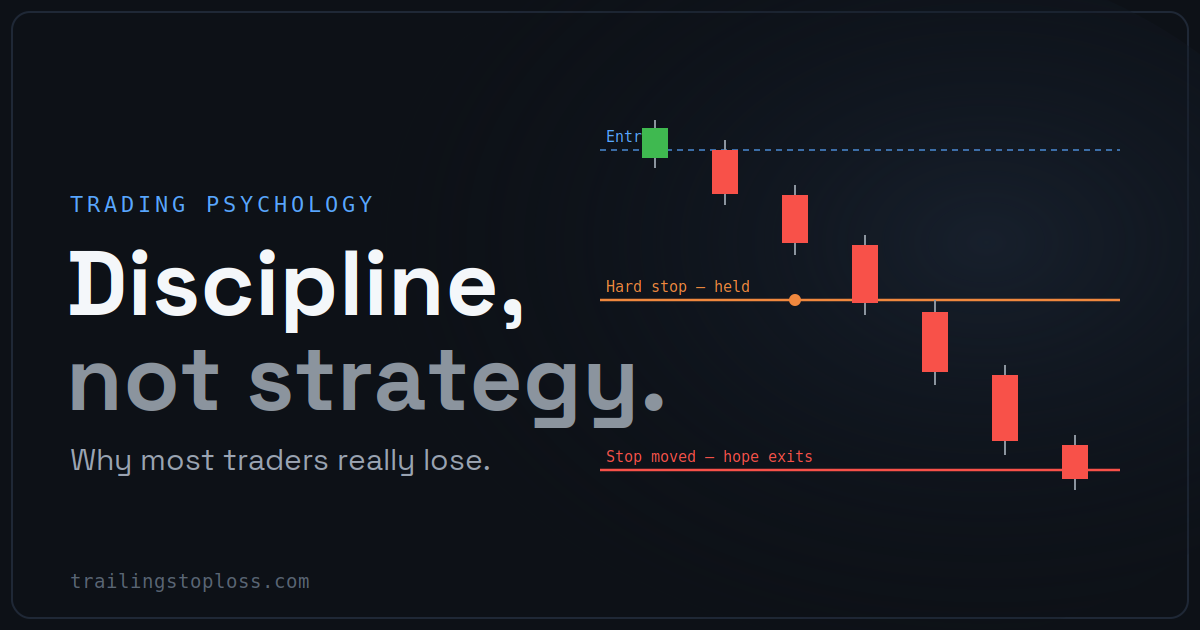
Here’s the part the strategy-sellers won’t put in the sales page: the account-killers almost never come from the entry. They come from what happens after the entry goes against you. You take the loss, you get that hot flush of “I’ll make it back,” and thirty seconds later you’re revenge-trading, doubling down, and doing the classic — quietly widening the stop you swore on your life you’d honor. Bookmap
None of that is a knowledge gap. You already know you shouldn’t move the stop. You’ve read the same forty threads I have. Knowing was never the problem, which is exactly why “read more trading psychology” hasn’t fixed it — and why the real cost of trading is usually measured in the fees and blown challenges nobody budgets for, not the strategy course.
Why “just be more disciplined” is useless advice
The standard fix — be more disciplined — is worthless, because it asks you to summon willpower at the precise moment you have the least of it. You’re down, you’re tilted, the rational part of your brain has left the building, and that is when you’re deciding whether to honor your stop. Deciding the important thing in the heat of the moment is the whole mistake. Willpower is a terrible plan because it always shows up last.
What actually works: decide the rule before the moment
Psychology has a genuinely robust answer here, and it is not “want it more.” It’s called an implementation intention — a pre-committed “if X, then Y” plan. Across a meta-analysis of hundreds of studies, Peter Gollwitzer and Paschal Sheeran found that people who convert a vague goal into a specific if-then plan follow through at roughly three times the rate of people running on good intentions alone. Gollwitzer & Sheeran
The mechanism is the useful bit. Once you’ve pre-decided the response, the trigger situation itself becomes a cue that fires the action almost automatically — the “when” gains salience and the “then” runs on rails. You stop having to out-argue yourself in real time, which, as established, is a fight you lose. Gollwitzer
Turning it into a system you can actually run
On a trading desk, this stops being a personality trait and becomes three concrete moves. One: set the hard stop before you enter, in writing, and treat it as non-negotiable — the decision gets made while you’re calm, not while you’re bleeding. Two: map your triggers, the specific moments you break (down on the day, the last hour, revenge after a stop-out), and pre-load an interrupt for each one. Three: run a daily review that scores you on whether you held the line, not whether you won — because process is the only part you actually control, and a good process survives a red day.
If you want the harsh version of why this matters, run your own numbers through a risk-of-ruin lens: small, repeated breaks in discipline don’t add up, they compound, and compounding is exactly as unforgiving on the way down as it is generous on the way up.
Full disclosure
Because that’s how this site operates: I built a separate project around this exact problem, called Hold the Stop, and I’m linking it because it’s mine — not because anyone paid me to. It came directly out of losing five funded accounts in a prop-firm collapse and finally admitting the hole in my game was never the strategy. It was the eight inches between my ears at the moment of the trade.
If you want the free, no-email version of the idea, there’s a $27 starter kit that’s basically the hard-stop plan and trigger map in one place, and a full 30-day system if you’d rather drill it than read about it. And if “decide the rule in advance and drill it until it’s automatic” sounds like the boring answer — good. The boring answer is usually the one that quietly works while the exciting ones blow up accounts.
FAQ
Is discipline really more important than strategy?
For most traders, yes — because most already have a strategy with a real edge and still lose, which means the edge is leaking out through execution. A mediocre strategy traded with iron discipline beats a great strategy traded on tilt. That’s not motivational fluff; it’s what the loss statistics keep pointing at.
What’s an “implementation intention” in trading terms?
It’s a pre-committed if-then rule: “If price hits my stop, then I’m out, no exceptions.” You decide it when you’re calm, in writing, so that in the moment your brain runs the pre-loaded response instead of negotiating. Research shows this roughly triples follow-through versus a vague intention to “be disciplined.”
Why do I keep moving my stop even when I know better?
Because knowing and doing are separated by a moment of acute emotional pressure — the loss, the flush of hope, the fear of being wrong. Willpower is weakest exactly then. The fix isn’t more knowledge or more willpower; it’s removing the in-the-moment decision entirely by having already made it.
Isn’t this just “be more disciplined” repackaged?
The opposite, actually. “Be more disciplined” tells you to try harder in the moment. This tells you to stop relying on the moment at all — pre-decide the rule, pre-plan the interrupt, and drill it until the trigger fires the response for you. It’s a system, not a pep talk.