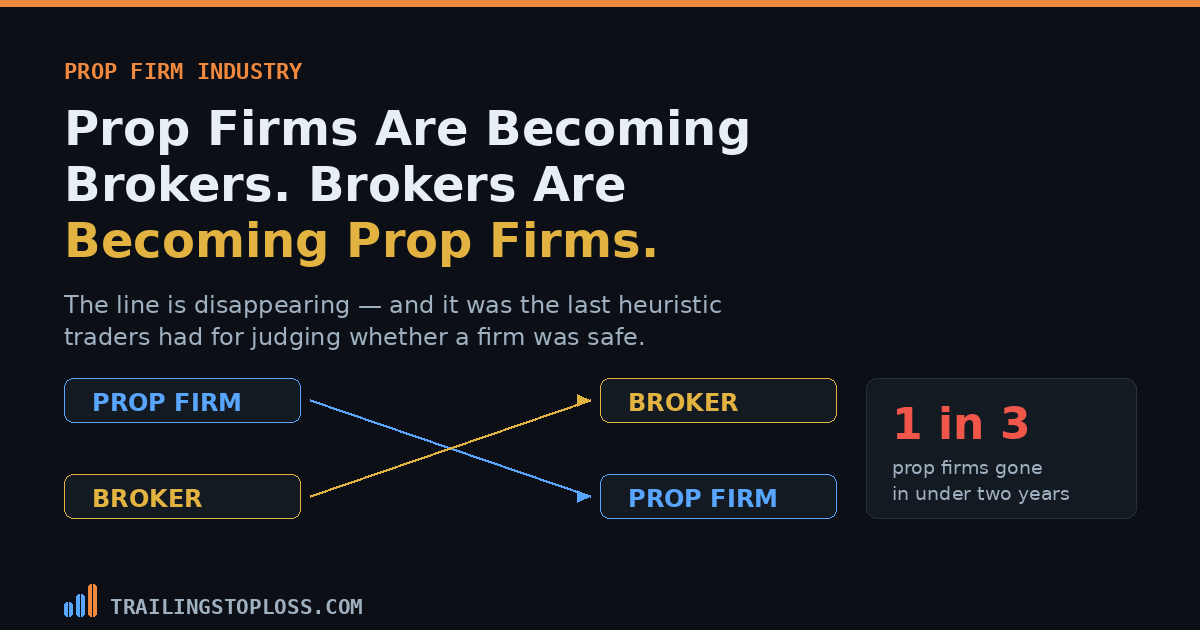
Prop Firms Are Becoming Brokers, Brokers Are Becoming Prop Firms
An industry panel said the distinction may disappear entirely. That’s not a neutral structural observation — it means the last simple heuristic traders had for judging whether a firm is safe has stopped working. Here is every example, and what actually happened to the firms on both sides of the trade.
“Backed by a real broker” was the safety signal everyone recommended. The firm that best fit that description is no longer operating.
What was said, and by whom
At the Finance Magnates Singapore Summit in July 2026, Lubomir Marasi, Commercial Director at Axcera, put it plainly: prop firms are now becoming brokers, and brokers are entering the prop firm space. He attributed the shift partly to infrastructure needs — access to platforms like MetaTrader. Both panelists suggested the distinction may eventually disappear altogether. (Finance Magnates)
The reasoning behind it is worth reading carefully, because it describes what a prop firm is for from the operator’s side. Prop firms are increasingly seen as acquisition funnels for younger traders, particularly the 18-to-25 bracket, who may later convert into fully funded brokerage clients. In Marasi’s words, it could be a great lead generation tool — a way to build relationships with traders before they accumulate significant capital. (CoinSpectator)
The other panelist was blunter about the product itself. Jakub Roz, CEO of For Traders, described the model as pure demo trading — more like a trading simulator than real trading — which is precisely what allows firms to operate across jurisdictions more freely than traditional brokers can. (CoinSpectator)
Two industry executives, on a public panel, describing the sector as a lead-generation funnel running on a trading simulator. Not critics. Operators. That is the clearest statement of the business model anyone has put on record this year, and it explains far more about firm behavior than any rulebook does.
Direction one: brokers building prop arms
ATFX → ATFunded
The cleanest example, and the one that should end the “backed by a real broker” heuristic. ATFX is a genuine regulated CFD broker, not a shell. Its prop arm ATFunded launched in October 2024 and, less than two years later, halted operations for a full review of the business — saying the industry had evolved and it needed to assess whether its models were sustainable long term. Active accounts were refunded, funded traders with eligible profits were paid, and MT5 went close-only. (Finance Magnates)
There’s a detail that makes the timeline sharper. At the Finance Magnates Africa Summit in 2025, a panel titled “Prop Trading is Here to Eat Your Lunch!” featured Siju Daniel, Chief Commercial Officer at ATFX, alongside Antreas Pilavakis, Operations Manager at FunderPro. Within roughly a year, ATFX’s prop arm had paused and FunderPro had been demoted on this site’s own flagged list. Two of the three firms represented on a panel about prop trading’s rise are now cautionary entries. (Finance Magnates, via TradingView)
The infrastructure motive
Marasi’s stated reason for convergence was platform access, and that’s the part most coverage skips. A prop firm doesn’t own the rails it runs on. In futures it routes through Tradovate, Rithmic, NinjaTrader or ProjectX; in FX and CFDs it needs MetaTrader. Owning or becoming a broker is how a firm stops renting its own execution layer. (Finance Magnates)
Direction two: prop firms becoming brokers
Seacrest Funding (formerly MyFundedFX)
The mirror image, and it’s unambiguous. Seacrest closed its entire prop trading division as of February 2026 — all prop accounts shut on 6 February, traders instructed to request refunds or final payouts — and redirected the business entirely to CFD brokerage. The stated reasons were a strategic shift to a brokerage model, rising costs and industry-wide pressure. It didn’t collapse; it chose the other side of the trade. (OFP Funding)
Alpha Futures → AlphaTrader
The most instructive case, because it shows what happens when you try to cross the line and the infrastructure owner objects. Alpha built its own platform, AlphaTrader. On 12 July 2026, NinjaTrader — which owns Tradovate — terminated its agreement with Alpha effective immediately, a split Alpha attributed to NinjaTrader viewing AlphaTrader as a competing product. In a single day Alpha lost both of the most widely used platforms in futures prop trading. (MondoTraders)
The same announcement closed the Premium plan. Alpha cited more than $25 million paid out in two months, and pending payouts beyond that were not honoured — traders receiving a refund of their active account fee instead. Prop Firm Match delisted the firm the same day. Alpha’s own wording folds pending and unpaid payouts into the account refund, so an owed payout could become a refund of what the account cost. (Phidias)
A prop firm that doesn’t own its platform can lose its entire business in one afternoon, by decision of a company it doesn’t control. That’s not a rule you can read in a rulebook or a risk you can size around. It’s structural, it applies to every futures firm that routes through someone else’s rails, and it is the single strongest argument for not concentrating your funded capital at one firm.
The5ers
A quieter version of the same move: the CFD brokerage unit backed by The5ers’ founders received a new Seychelles license this year. Same founders, brokerage entity, offshore jurisdiction — the prop-to-broker path taken deliberately rather than under duress. (FXVerify)
The scale of the shakeout
None of this is happening in a stable market. Up to 100 prop trading firms did not survive 2024, and the trend continued through 2025. One industry consultant tracking 376 firms found 84 no longer active and a further 30 showing no signs of operation — roughly a third of the market gone in under two years. (Finance Magnates)
| Firm | Direction | What happened | When |
|---|---|---|---|
| ATFunded (ATFX) | Broker → prop | Paused operations for business review; accounts refunded | June 2026 |
| Seacrest (ex-MyFundedFX) | Prop → broker | Closed entire prop division, pivoted to CFD brokerage | Feb 2026 |
| Alpha Futures | Prop → platform | Lost NinjaTrader/Tradovate; Premium closed; delisted | July 2026 |
| The5ers (founders) | Prop → broker | New Seychelles license for CFD brokerage unit | 2026 |
| FundingTicks (FundingPips) | Prop → exit | Futures arm wound down | 2026 |
| MyForexFunds | Prop → return | CFTC case dismissed; 2026 relaunch announced | 2026 |
Why the line existed in the first place
The distinction was never cosmetic — it was regulatory, and that’s exactly why it’s being dissolved. Prop trading remains largely unregulated globally, and the demo-trading framing is what enables firms to operate across jurisdictions more freely than brokers can. Where leveraged retail trading is restricted, prop firms have filled the gap: in India, where CFDs are banned, they effectively stepped in. (CoinSpectator)
And the regulatory reckoning people keep predicting isn’t visibly on the way. Asked about it, CySEC’s chairman — who also chairs ESMA’s Risk Standing Committee — said that to the best of his knowledge ESMA is not currently engaged in any substantive discussions regarding retail prop trading. Anyone telling you regulation is imminent is guessing. (FXVerify)
Movement is happening at the edges rather than the centre. US retail prop firms have been quietly revising onboarding policies to stop offering cTrader accounts to new clients in that jurisdiction, and in the EU event contracts are being treated as binary options. Those are jurisdictional squeezes on specific products, not a framework for the sector. (FXVerify)
What this actually means for your account
The convergence story matters to traders for one reason: it kills a heuristic that most of the industry still recommends. “Backed by a real broker” was the standard advice for telling a solid firm from a shell — and the firm that best satisfied it, ATFX’s prop arm, is the one that stopped operating. Corporate structure is not a safety signal. (Finance Magnates)
What replaces it isn’t another category test. It’s evidence: verified payout history, how long the firm has actually been paying, whether it owns or rents its execution platform, and what happened the last time it changed a rule that cost traders money. Those are checkable. “Regulated broker behind it” is checkable too — it just turned out not to predict anything.
Spread funded capital across at least two firms, and prefer firms whose platform relationship isn’t a single point of failure. Alpha’s traders didn’t lose access because they broke a rule or because the firm ran out of money — they lost it because a third party ended a contract. No amount of disciplined trading protects against that; only diversification does.
The short version
Industry executives now describe prop firms as lead-generation funnels for brokerages, running a product one of them called closer to a trading simulator than real trading — and they expect the distinction between the two business types to disappear. Both directions of that convergence already have casualties: ATFX’s prop arm paused operations in June, Seacrest closed its entire prop division in February to become a CFD broker, and Alpha Futures lost both major futures platforms in a day after building a competing one. Roughly a third of prop firms have disappeared in under two years, regulation is not visibly coming, and the “backed by a real broker” test that everyone recommends failed its clearest live case. Judge firms on payout evidence and platform dependency, and don’t keep all your funded capital in one place. (Finance Magnates)
Frequently asked questions
Why are prop firms turning into brokers?
Two reasons given by operators themselves. Infrastructure — a prop firm doesn’t own the platforms it routes through, so becoming or owning a broker stops it renting its own execution layer. And economics: prop firms are increasingly seen as acquisition funnels for younger traders, particularly 18 to 25, who may later convert into brokerage clients. One executive described it directly as a lead generation tool.
Is a prop firm backed by a regulated broker safer?
The evidence says no. ATFX is a genuine regulated CFD broker, and its prop arm ATFunded paused operations less than two years after launch, refunding accounts and paying out eligible funded traders. Meanwhile several thinly capitalised independents are still running. Corporate structure turned out not to predict survival — payout history and platform dependency are the checkable signals that do more work.
What happened to Alpha Futures?
On 12 July 2026, NinjaTrader — which owns Tradovate — terminated its agreement with Alpha effective immediately, a split Alpha attributed to NinjaTrader viewing Alpha’s own platform, AlphaTrader, as a competing product. The same announcement closed the Premium plan, with pending payouts beyond the $25 million already paid not honoured and traders receiving refunds of their account fees instead. Prop Firm Match delisted the firm that day.
How many prop firms have shut down?
Up to 100 did not survive 2024, and the trend continued through 2025. One consultant tracking 376 firms found 84 no longer active with a further 30 showing no signs of operation — approximately a third of the market gone in under two years.
Is prop trading about to be regulated?
There’s no visible sign of it. CySEC’s chairman, who also chairs ESMA’s Risk Standing Committee, said that to the best of his knowledge ESMA is not currently engaged in any substantive discussions regarding retail prop trading. What is happening is narrower: US firms quietly dropping cTrader for new clients in that jurisdiction, and the EU treating event contracts as binary options. Those are product-level squeezes, not a sector framework.
How should I choose a firm if corporate structure doesn’t help?
Use evidence rather than categories. Verified payout history and how long the firm has been paying consistently. Whether it owns or rents its execution platform, since a terminated contract can end a business overnight. What the firm did the last time a rule change cost traders money. And regardless of what you conclude, spread funded capital across at least two firms — Alpha’s traders lost access through a third party’s decision, which no amount of firm selection at a single firm would have protected against.
Related on this site: firms to avoid · true cost rankings · firms that allow multiple challenges
Firm statuses and quotes were verified against published sources in August 2026. This sector changes weekly — confirm current status before acting on anything here. Nothing in this article is financial advice. Futures trading carries substantial risk of loss.