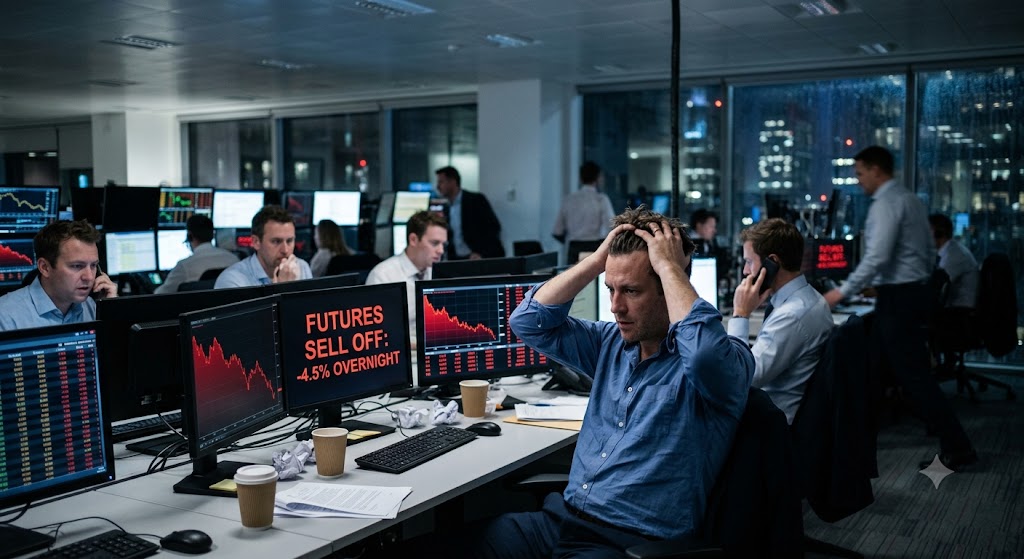
Pre-Market Brief: Futures Sell Off Overnight as Big Tech Rolls Over
Tuesday, June 23, 2026 · Pre-Market
The peace-deal melt-up has officially run into a wall, and that wall is megacap tech. After Monday’s brutal rotation gutted the Nasdaq while the Dow shrugged, the selling didn’t stop at the bell — it followed Asia overnight and left U.S. futures sharply lower this morning. Bonds are heavy, oil is sliding on an Iran license, metals are getting hammered, and the only thing holding the line is the chip trade. Here’s the damage and the levels that matter.
The Overnight Selloff: Tech Led, Asia Followed
This is the part you asked about, so let’s lead with it. After the close, the megacap unwind that hammered Monday’s session spilled into Asian trading and dragged U.S. index futures down hard. Nasdaq-100 futures are the epicenter, off roughly 2.5% and back below the 29,900 area, with S&P 500 futures down about 1.3% and Dow futures — the relative safe haven again — off just half a percent. The split tells the whole story: this is a tech problem, not a market-wide panic. TheStreet
Three things are driving it. First, SpaceX keeps imploding — the stock fell as much as 5% overnight toward $147, slipping below its first-day open and on track to lose its $2 trillion market cap, after announcing it will issue at least $20 billion in investment-grade bonds to fund its AI build-out. Second, the AI-capex anxiety that clipped Alphabet, Amazon, Meta and Microsoft on Monday hasn’t gone anywhere. Third, the VIX popped roughly 15% back toward 20, which is what happens when everyone reaches for hedges at the same time. TheStreet
The one green shoot: chips are diverging from the rest of tech. Micron is up nearly 7% ahead of Wednesday’s earnings, with AMD and Intel also higher. If the megacap unwind is rotation rather than de-risking, semis holding up is the tell. If Micron disappoints Wednesday, that last leg of support goes with it.
Monday’s Rotation: The Dow Won, the Nasdaq Lost
Monday wasn’t a crash — it was a violent reshuffle. The Dow actually gained 0.29% to 51,712 on strength in cyclicals and banks, and small caps did even better, with the Russell 2000 up 0.83%. But the S&P 500 slipped 0.37% to 7,472.79 and the Nasdaq Composite dropped 1.32% to 26,166.60, dragged down as Alphabet cratered around 5% (reportedly on news a Google DeepMind scientist is leaving for Anthropic) and the rest of the megacap complex followed. Yahoo Finance
The single-stock carnage was concentrated and severe. SpaceX plunged about 16% Monday — erasing roughly $400 billion in a single day, the second-largest one-day value loss on record — while Palantir fell nearly 7% to its lowest close in over a year. Offsetting that, Micron and Sandisk each added about 5%, and banks like BofA and JPMorgan rose around 2%. Translation: money didn’t leave the building, it just sprinted from crowded AI names into chips, value and small caps. Trading Economics
Levels: Nasdaq (NQ) and S&P (ES)
For the futures desk, last week’s gap-up is now last week’s problem. On the NQ, the overnight slide has erased most of Thursday’s rip and pushed price back under 30,000. The shelf that was support is now resistance: 30,089 (Friday’s low) and 30,406 (Thursday’s close) are the levels bulls need to reclaim. Below, the air gets thin — 29,300 is the next real support, and a loss of the round 29,000 would put the Fed-week lows back in play. Nasdaq
The S&P 500 is the cleaner read because of where it closed. Monday’s 7,472.79 finish already broke back below the 7,500 magnet, turning that round number into resistance, and with ES futures down 1.3% this morning the implied open sits right around 7,380–7,390 — essentially a retest of the early-June 7,383 low. That’s the line in the sand: hold it and the pullback is a healthy shakeout; lose it on a closing basis and the “uptrend intact” crowd has a real problem heading into Thursday’s inflation print. Yahoo Finance
The Macro: An Iran Oil License and a 4.5% Ten-Year
Oil is the quiet story under all of this. The U.S. Treasury issued a temporary 60-day license authorizing the production, sale and delivery of Iranian oil through August, with VP JD Vance leading talks in Switzerland — so supply is coming back online and crude is sliding, with WTI near $73.50 and Brent under $78. Lower oil is disinflationary, which is good news that the bond market is stubbornly refusing to celebrate. CNBC
That’s because yields are the real headwind. The 10-year Treasury briefly touched 4.5% overnight for the first time since June 12 and has effectively divorced itself from falling oil, while futures now price roughly a 70% chance of a Fed rate hike by September. A $69 billion 2-year note auction today will test whether buyers show up at these levels. Rising real yields are kryptonite for long-duration tech — which is a big reason the Nasdaq, not the Dow, is the one bleeding. Kiplinger
One more for the history books: former Fed Chair Alan Greenspan died at 100. No market impact, but the man who gave us “irrational exuberance” checking out during a megacap-tech valuation unwind is the kind of irony the tape doesn’t usually bother scripting. Yahoo Finance
Crypto: Risk-Off Bites
Crypto is trading exactly like the high-beta risk asset it is. Bitcoin slid another 2.8% to around $62,200, breaking down from the $64K shelf it had been defending, as the equity-tech selloff and a strong dollar drain speculative appetite. Ether and the majors fell in sympathy. This is the third straight session crypto has failed to catch a bid on risk-off days — the “digital gold” thesis is, once again, on hold whenever real gold and real stocks are both falling. CoinDesk
Metals: Gold Soft, Silver Slammed
The precious-metals tape is ugly. Gold fell about 1.6% toward $4,135 an ounce, but silver is the real victim — down roughly 4.5% to near $63, one of its worst sessions in weeks. The combination is textbook: the Iran oil license deflates the geopolitical premium, the one-year-high dollar raises the cost of holding non-yielding metal, and silver’s extra sensitivity to both growth and energy means it falls harder than gold on the way down. The $4,100 zone (gold’s rising 200-day) is the level that decides whether this is a dip or a trend change. Trading Economics
The Week Ahead: It Only Gets Bigger
The irony of today’s selloff is that the actual catalysts haven’t even hit yet. FedEx and Carnival report after the close, Micron delivers the AI-memory verdict Wednesday, and Thursday dumps PCE and GDP on an already-jumpy market at once. If the tape is this twitchy on a quiet Tuesday, size accordingly into the back half of the week. Kiplinger
| Day | Event | Why It Matters |
|---|---|---|
| Tue 6/23 | FedEx, Carnival, KB Home (AMC); $69B 2Y auction | FedEx’s first print as pure-play logistics; yields tell |
| Wed 6/24 | Micron earnings (AMC); New Home Sales | The chip trade’s last line of support gets tested |
| Thu 6/25 | May PCE, Final Q1 GDP, Durable Goods, Claims | The week’s main event — Fed’s preferred inflation gauge |
| Fri 6/26 | UoM Consumer Sentiment (final), Trade Balance | Sentiment and month-end positioning |
Thursday is still the trade. Consensus has May headline PCE near +0.5% month-over-month (lifting the annual rate toward ~4.1%) with core around +0.3%. A hot number hands Warsh his September hike and pours fuel on the yield-driven tech selloff; a soft one is the disinflation lifeline. Either way, today’s futures weakness is a warm-up, not the event.
Micron Wednesday is the one that matters for whether the chip floor holds. The stock is up triple digits in 2026 on high-bandwidth-memory demand, with sell-side targets stretched toward $1,500 and customers still unable to secure all the bits they need. With semis the lone group propping up an otherwise sickly Nasdaq, a strong print plus guidance could stop the bleeding — and a miss could turn this week’s rotation into something that looks a lot more like de-risking. Yahoo Finance
FAQ
Why did futures sell off overnight?
The megacap-tech unwind that hit Monday’s session continued into Asian trading, dragging Nasdaq-100 futures down about 2.5% and S&P 500 futures roughly 1.3%. Continued weakness in SpaceX (which announced a $20B bond sale), AI-capex worries across Alphabet/Amazon/Meta/Microsoft, and a 10-year yield back at 4.5% combined to push the VIX up around 15%.
What are the key Nasdaq and S&P levels for June 23?
On the NQ, 30,089 and 30,406 are now overhead resistance, with 29,300 and the round 29,000 as support below. On the S&P 500, 7,500 has flipped to resistance and the early-June low near 7,383 is the key support being retested with futures down 1.3%.
Was Monday a market-wide crash?
No — it was a rotation. The Dow rose 0.29% and small caps gained 0.83% even as the Nasdaq fell 1.32%. Money rotated out of crowded megacap AI names (Alphabet -5%, SpaceX -16%) and into chips, banks, value and small caps, rather than leaving equities altogether.
What’s the most important event this week?
Thursday’s May PCE inflation report, the Fed’s preferred gauge. With markets pricing a ~70% chance of a September hike, a hot print could extend the yield-driven tech selloff. Micron’s Wednesday earnings are the key single-stock risk, since chips are the only group currently supporting the Nasdaq.
Is this financial advice?
No. This brief is market commentary and education only. Levels are reference points drawn from prior-session and pre-market data, not trade recommendations. Manage your own risk and position sizing.