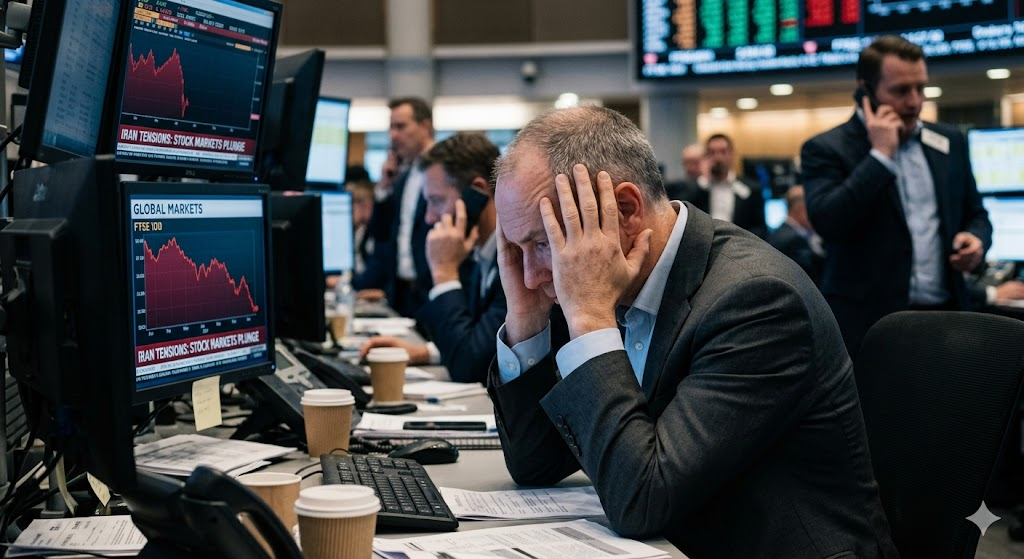
Wall Street wrapped up Thursday in a sour mood, even though the world's most valuable company just printed one of the biggest revenue beats in corporate history. Nvidia delivered another monster quarter Wednesday night, then watched traders shrug, sell, and pivot their attention to a Supreme Leader in Tehran who decided that "enriched uranium" and "exported" don't belong in the same sentence. Welcome to 2026, where geopolitics eats earnings for breakfast. For the broader context on how the Iran situation has whipsawed markets for weeks, see our running coverage in the Politics and Pre-Market categories.
The Closing Scoreboard
The major indices finished modestly lower across the board, with weakness concentrated in tech and consumer names. The S&P 500 slipped roughly 0.3% to 0.5%, the Nasdaq Composite gave back about 0.4% to 0.7%, and the Dow Jones Industrial Average shed roughly 80 points, with Walmart doing most of the heavy lifting on the downside. The Russell 2000 was the lone bright spot, eking out a small gain as small caps caught a defensive bid. This came after Wednesday's monster rally, where the Dow vaulted 645 points to reclaim 50,000 and the S&P printed 7,432.97 on optimism that the Iran conflict was nearing resolution. Apparently it isn't, per TheStreet's market coverage.
Futures: Crude Steals the Show
Energy futures were the entire story Thursday. West Texas Intermediate jumped roughly 2.9% to settle north of $101 per barrel, and Brent crude climbed about 2.3% to $107.36 after Reuters reported that Iran's Supreme Leader had directed the country to keep its enriched uranium stockpile within its borders — a direct rejection of one of Washington's core conditions for a ceasefire. That single Reuters dispatch unwound most of Wednesday's 5.6% crude crash in a single overnight session. The whiplash here is brutal: WTI was below $98 on Wednesday's close and above $101 by Thursday lunch, which is what happens when an entire asset class trades on whether one octogenarian theocrat says "yes" or "no" to a uranium export form, per Yahoo Finance reporting.
Equity index futures were uninspiring before the bell. S&P 500 futures inched up roughly 0.09% in the pre-market handoff, Nasdaq 100 futures lagged on Nvidia-driven semiconductor weakness, and Russell 2000 futures hovered near flat. Treasury futures sold off as the 10-year yield rebounded after Wednesday's relief rally — recall the 10-year hit its highest level since 2007 earlier this week, which is the kind of fact that should make any equity bull pour a stiff drink. For a primer on how rate moves like this propagate through index futures, our Futures coverage walks through the mechanics.
Energy & Index Futures — Thursday Snapshot
| Contract | Last | Change | Driver |
|---|---|---|---|
| WTI Crude (CL) | ~$101.04 | +2.9% | Iran uranium directive |
| Brent Crude (BZ) | ~$107.36 | +2.3% | Supply risk re-priced |
| E-mini S&P (ES) | ~7,413 | -0.3 to -0.5% | Oil + yields |
| E-mini Nasdaq (NQ) | ~26,178 | -0.4 to -0.7% | NVDA + semis weak |
| Russell 2000 (RTY) | ~2,817 | +0.01 to +2.5% | Defensive rotation |
| 10Y Treasury Yield | ~4.55%+ | Higher | Risk-off into duration reversed |
Equities: Nvidia Beat, Nobody Cared
Let's address the elephant in the room. Nvidia reported Wednesday night and delivered numbers that, in any normal market, would have triggered a victory lap. Adjusted EPS came in at $1.87 versus the $1.75 expected, revenue exploded 85% year-over-year to $81.61 billion against $79.19 billion expected, and data center revenue clocked $75.2 billion versus the $73.48 billion consensus. Adjusted gross margin was 75%, right in line. The company also hiked its dividend. Shares responded by going approximately nowhere — flat to modestly down — because forward guidance didn't crush the upper end of the analyst range, and because at 8% of the S&P 500's weight, Nvidia now lives in a world where "outstanding" no longer qualifies as a positive catalyst, per 24/7 Wall St.'s market wrap.
Walmart was the day's notable disaster on the Dow, falling more than 6% after issuing FY2027 adjusted EPS guidance of $2.75 to $2.85 against the $2.91 Street estimate. The current-quarter guide of 72 to 74 cents also missed the 75-cent consensus. Headline EPS of 66 cents and revenue of $177.75 billion (+7.3% YoY) actually beat, but the mix matters: growth is being driven by groceries and household essentials, not discretionary categories. Translation — the American consumer is trading down, which is exactly the warning sign that hits hardest when oil is screaming higher and 10-year yields are at multi-year highs. Salesforce dropped roughly 4%, Sherwin-Williams shed 2%, and Intuit cratered 15% after announcing a 17% workforce reduction (about 3,000 jobs) in its pivot toward AI. On the green side, IBM gained nearly 4%, and reports that Goldman Sachs will lead the long-awaited SpaceX IPO sent Goldman shares to a record high, per Trading Economics.
Crypto: Quietly Holding the Line
Crypto put in a surprisingly composed session given the macro chaos. Bitcoin opened at $77,472 on Thursday, up about 0.9% from Wednesday's open, and Ethereum opened at $2,127, up roughly 0.8%. Both have been carving out a base this week, opening lower every day before reversing higher intraday — a pattern that, depending on whether you're feeling generous, either suggests accumulation or just exhausted sellers taking a breather. Bitcoin remains well off its all-time high of $126,198 (October 6, 2025), and the market structure is being shaped by the looming May 29 options expiry on Deribit, where roughly $6 billion in open interest is creating a tug-of-war between $75,000 max pain and aggressive $80,000 call positioning, per Yahoo Finance crypto coverage.
The interesting tell here is that crypto isn't behaving like a "risk-on" asset right now. When stocks fell and oil ripped on a fresh war headline, BTC and ETH essentially shrugged. That decoupling — admittedly only meaningful if it persists for more than 48 hours — is what bulls have been waiting on for a year. Deeper dives on derivatives positioning live in our Crypto section.
Metals: Gold Catches a Safe-Haven Bid (Sort Of)
Gold and silver have been trading like they're in two different conversations all year. The yellow metal hovered near $4,510 per ounce intraday, down about 0.5% on the session despite the war escalation — a textbook case of "safe haven gets sold when yields rip higher because nobody wants a zero-coupon asset competing against 4.5% Treasuries." Silver has been the stealth winner of 2026, breaking and holding above $75 to $80+ per ounce on a combination of industrial demand, critical-mineral classification by the U.S. Geological Survey, and supply constraints that look structural rather than transitory. Platinum and palladium have decoupled from gold this cycle entirely, with platinum hitting record highs as the entire complex repriced through 2025 and into 2026, per CME Group research.
If you're keeping score: gold up 65%+ off the start-of-2025 base, silver up roughly 170% over the same window, palladium up 95%, platinum up 150%. None of these are line-chart anomalies — they're the visible result of central bank de-dollarization, persistent fiscal deficits in the U.S./EU/Japan, and a Federal Reserve that's expected to cut later this year. For traders watching this complex, our Day Trading coverage frequently revisits silver's setup since the volatility is unmatched anywhere outside crypto.
The War: Why Today Mattered
Here's the short version of why Thursday felt heavier than the index moves suggest. The U.S.-Iran war has been in a "ceasefire" for several weeks, with both sides exchanging blows even during what's supposed to be a pause. Trump told reporters Wednesday that negotiations were in the "final stages" and that Iran "cannot keep their highly enriched uranium." Iran's Supreme Leader responded Thursday with the equivalent of "watch us" — issuing a directive to retain the enriched stockpile domestically. Israeli officials separately told Reuters they believe sending the material abroad would actually leave Iran more vulnerable to future strikes, which is a deeply ironic position for Israel to be taking right now. Reuters carried both sides of the diplomatic mess.
The market is essentially priced for a deal that hasn't happened and may not happen on the timeline anyone wants. Every Iran "deal close" headline lifts equities and crushes oil; every counter-headline does the reverse. This is what traders call headline-driven tape, and it's a meat grinder for anyone trying to hold positions overnight. Risk management notes for environments like this are covered in Trading Psychology.
Other Stuff Worth Knowing
A few items that didn't make the front page but matter. First, the SpaceX IPO is real — Goldman Sachs reportedly leading the deal sent GS to a record high, and this will be one of the largest tech listings ever when it prices. Second, Intuit's 17% workforce reduction is part of a broader pattern of "AI restructuring" announcements, and it almost certainly isn't the last we'll see this quarter. Third, the 10-year Treasury yield's run to multi-year highs is the quiet story under everything — at some point, those yields either break equity multiples or break the housing market, and right now nobody knows which goes first. The TheStreet wrap caught most of these threads.
Looking Ahead to Friday
Friday brings no major U.S. economic releases of consequence, which means the tape will trade entirely on Iran headlines and any late-breaking corporate news. Watch for any Fed speakers crossing the wires given how close the 10-year is to breaking out, and keep an eye on the Strait of Hormuz tanker traffic data — if shipping rates spike, oil goes with them. The May 29 crypto options expiry is now eight days out, so expect Bitcoin volatility to start ramping into next week. For end-of-day prep, our Post-Market archive has the standing checklist.
FAQ
Why did stocks fall on May 21, 2026 despite Nvidia's strong earnings?
Nvidia did beat — adjusted EPS of $1.87 versus $1.75 expected, with revenue up 85% year-over-year — but forward guidance didn't crush the upper end of analyst expectations. Combined with crude oil jumping nearly 3% on Iran headlines and Treasury yields rebounding, the macro overwhelmed the earnings beat. When the largest single component of the S&P 500 fails to ignite a rally, the rest of the tape tends to follow.
What did Iran's Supreme Leader do that moved oil prices?
Per Reuters reporting on May 21, 2026, Iran's Supreme Leader issued a directive that the country's enriched uranium stockpile must remain inside Iran. Removing that stockpile abroad is a core U.S. condition for ending the war, so the directive complicates negotiations significantly. WTI crude jumped roughly 2.9% to above $101 per barrel and Brent climbed about 2.3% to $107.36.
How did Walmart impact the Dow on May 21?
Walmart was the worst-performing Dow component, falling more than 6%. While the company beat on headline EPS (66 cents) and revenue ($177.75 billion, +7.3% YoY), it guided FY2027 adjusted EPS to $2.75-$2.85 versus the $2.91 expected, and current-quarter EPS to 72-74 cents versus 75 cents expected. The company also warned that sustained higher fuel costs could pressure the business — a direct link back to the Iran oil spike.
Where did Bitcoin and Ethereum close on May 21, 2026?
Bitcoin opened at $77,472 on Thursday, up 0.9% from Wednesday's open, and Ethereum opened at $2,127, up 0.8%. Both pairs followed a similar intraday pattern of opening lower then reversing higher, suggesting modest buying interest at these levels despite the broader risk-off tone in equities. The May 29 options expiry on Deribit, with roughly $6 billion in open interest, is shaping near-term positioning.
What happened with gold and silver on May 21?
Gold drifted lower by about 0.5% to around $4,510 per ounce despite the war escalation, weighed down by the rebound in Treasury yields. Silver has been the stronger performer of 2026, trading above $75-$80 per ounce on industrial demand, supply tightness, and its new classification as a critical mineral by the U.S. Geological Survey. Platinum and palladium have decoupled from gold entirely this cycle.
Why is the 10-year Treasury yield important right now?
The 10-year Treasury yield hit its highest level since 2007 earlier this week before pulling back Wednesday and reversing higher again Thursday. High yields compete with equities for capital flows, pressure equity multiples (especially for long-duration tech names), and tighten financial conditions for the housing market. At current levels, the bond market is essentially saying it doesn't believe the Fed can cut as much as equity bulls want.