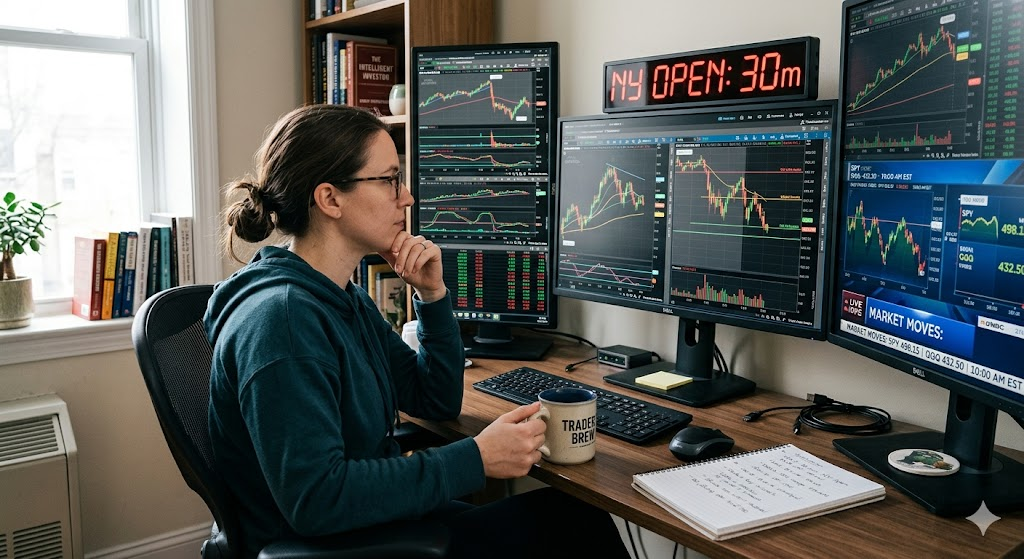
There's an old Wall Street nickname for the first hour of trading: amateur hour. Specifically, the 9:30–10:30 AM ET window, with the first 30 minutes being the meanest of the bunch. The phrase is unflattering on purpose — the idea is that retail traders, overnight order flow, and emotionally-charged news reactions all collide in that window, while the so-called "smart money" sits back and waits for the smoke to clear. Whether that's actually true or just a convenient story professional traders tell themselves is a separate question. But the volatility is real, the velocity is real, and the question of whether you specifically should be trading it isn't as simple as the slogan makes it sound.
Where the "Amateur Hour" Nickname Comes From
The phrase has been kicking around Wall Street for decades, but it got a wider audience after a 2012 CNBC segment in which Rosecliff Capital hedge fund manager Michael Murphy bluntly summarized the conventional wisdom: "Amateur hour is 9:30 to 10:30. Smart money trades later in the day." The market that week happened to bottom near 10:30 AM three days in a row, which made for great copy and reinforced the maxim that "dumb money trades early and smart money comes in later" (CNBC).
The framing stuck because it sounds intuitive. Overnight news has just been dropped into the market, retail traders are slamming in orders they staged the night before, brokers are clearing those orders against thin pre-market liquidity, and stop losses left over from yesterday are sitting like landmines around obvious technical levels. By the time 10:00 AM rolls around, most of that mechanical chaos has cleared and you can finally see what the market actually wants to do. That's the theory, anyway. Like a lot of trading folklore, it survives because it's roughly directionally correct — not because every part of it holds up under scrutiny.
What Actually Happens During Amateur Hour
The 9:30–10:00 AM ET window isn't just slightly spicier than the rest of the day — it's statistically the most violent stretch of the entire session. Academic research on intraday seasonality has documented this U-shape pattern in equity markets for decades, with volume and volatility peaking at the open and close while the middle of the session drifts. The largest absolute price moves of the day typically occur in the first 45 minutes, and after roughly 10:15 AM ET the action calms down noticeably relative to that opening flurry (NCBI / PMC academic research).
A few specific mechanical forces drive the chaos. Retail traders place limit and market orders overnight that all hit the tape simultaneously at 9:30, creating instant imbalances. Traders who refuse to hold positions overnight pile in at the bell, magnifying volatility well beyond what the same volume would produce if spread across the day. Overnight stops cluster near obvious technical levels — yesterday's high, yesterday's low — and when the market sweeps through them, the cascade of triggered orders adds fuel to the move before it exhausts itself and reverses. Meanwhile, institutional desks use the deepest liquidity of the day to rebalance, hedge, and roll positions, throwing another layer of order flow into the mix (CI Volatility).
So far, the conventional wisdom checks out. The open is the most chaotic time of day. But "chaotic" and "unprofitable" are different words, and that's where the amateur hour rule starts to get interesting.
The Case For Sitting Out Amateur Hour
If you're getting chopped up at the open, waiting isn't weakness — it's risk management. Several specific things make the first 30 minutes genuinely treacherous:
- Wider spreads. Market makers price in uncertainty with wider bid/ask quotes. Your fills are worse, and slippage on stops can be brutal.
- Gap reactions. Premarket positioning and news can produce gaps that reverse violently in the first 5–10 minutes as the market re-prices.
- Algorithmic stop hunts. Overnight orders sitting near obvious levels are easy targets for opening-drive algorithms.
- False breakouts. The opening range hasn't formed yet, so what looks like a breakout at 9:32 is often just noise — the bull traps and bear traps that give amateur hour its reputation.
- 10:00 AM economic data. Reports like Consumer Sentiment, ISM, and Pending Home Sales hit at 10:00 AM ET and routinely reverse the morning trend, leaving traders who entered at 9:35 holding the wrong side of the move.
By 10:00 to 10:30, the initial frenzy usually cools. The opening range — the high and low of the first 30 minutes — is established, which means you finally have a meaningful structure to trade off of. Spreads tighten, trends become more readable, and you've let other people pay the cost of price discovery. For prop traders working under hard daily drawdown limits, one bad amateur hour decision can wipe out a challenge or kill a funded account, which is why sitting out from 9:30 to 10:00 is the default for a lot of disciplined funded traders (Investing.com). Plenty of strategies in our trading education library work better with this discipline baked in.
The honest version: A lot of traders who say "I avoid amateur hour" really mean "I keep getting destroyed at the open and I don't know why." That's a fine reason to wait. But if you don't understand why the open is breaking your strategy, you'll just bring the same mistakes to 10:00 AM with you.
The Case Against the Amateur Hour Rule
Here's the part nobody puts on a motivational trading poster: the "amateur hour" framing has been called out as folklore for years, even by professionals who've spent decades around it. In a Seeking Alpha piece bluntly titled "The Myth Of 'Amateur Hour'," former William O'Neil portfolio manager Dr. Chris Kacher walked through several real-world examples of strong-trending stocks where waiting 45 to 60 minutes after the open would have caused traders to buy several percentage points higher than necessary, calling the rule a "lazily-derived axiom" not supported by empirical evidence (Seeking Alpha).
The opening 30 minutes also contains some of the highest-probability, highest-volume setups of the entire day. Gap-and-go's, opening drives, VWAP rejections off premarket levels — these are bread-and-butter plays for experienced day traders. Volume in the first 30 minutes regularly accounts for 15–25% of the entire session's volume, which means liquidity is actually better at the open for size, not worse — a counterintuitive point that gets lost when people confuse volatility with risk (arXiv intraday volume study).
Volatility ≠ danger. Volatility = opportunity, if you have an edge in reading it. Mean reversion, momentum, VWAP fades, gap fills — these strategies don't just survive amateur hour, they require it. Trade the boring midday chop instead and you'll get death by a thousand stops as setups go nowhere and you nickel-and-dime your account into oblivion. Plenty of experienced traders only trade the first 30 to 60 minutes of the session and walk away once the action dies down (Trade That Swing).
What the Opening Range Breakout Research Actually Shows
The amateur hour debate gets really interesting when you realize there's an entire well-studied strategy built around using the opening range rather than avoiding it: the Opening Range Breakout (ORB). The setup is straightforward — define the high and low of the opening window (commonly 5, 15, or 30 minutes), then enter when price breaks out of that range with defined risk back to the opposite side.
A 2024 paper by Zarattini, Barbon, and Aziz analyzed the 5-minute ORB strategy across more than 7,000 U.S. stocks from 2016 to 2023 — a period that included two bear markets and multiple volatility shocks. The strategy significantly outperformed passive investing, particularly when restricted to "Stocks in Play" (names with unusual volume driven by company-specific news or earnings). The active day trading portfolio generated an annualized alpha of 33% net of commissions on those names. Using leveraged products like TQQQ pushed total returns over the period to 1,484%, versus 169% for buy-and-hold QQQ (SSRN academic paper).
That's a real result on a real dataset, and it directly contradicts the idea that amateur hour is a no-fly zone. The opening range exists because of all that volatility, and the breakout from it is one of the cleanest directional signals of the morning. That said, a separate backtest analysis on the S&P 500 found ORB returns have degraded over time as the strategy has become more popular, suggesting it now works better when combined with additional filters and context rather than as a pure mechanical rule (Quantified Strategies backtest).
The takeaway isn't "ORB prints money." It's that the opening range is information, not noise — and the highest-quality intraday setups often depend on amateur hour existing.
So Who Should Sit Out Amateur Hour, And Who Shouldn't?
The honest answer is that "should I avoid amateur hour" is the wrong question. The right question is "do I have a defined edge during the opening 30 minutes?" If yes, get in there. If no, sit on your hands and let the dust settle. The rule is downstream of your strategy, not the other way around. Here's a rough breakdown:
| Trader Type | Sit Out Amateur Hour? | Why |
|---|---|---|
| New / part-time traders | Yes, wait | The open will eat you alive while you're still learning to read tape. Most blown accounts happen in the first 30 minutes. |
| Prop firm traders on a challenge | Usually wait | Hard daily drawdown limits make amateur hour math brutal. One bad decision can end the challenge or burn a funded account. |
| Opening Range Breakout traders | Yes — by definition | Waiting is literally part of the strategy. You need the range to form before you can trade the break. |
| Scalpers / momentum traders | No, get in there | The opening volatility is your edge. Skipping it means skipping your highest-EV trades of the day. |
| Gap-and-go traders | No, the open is the trade | By 10:00 AM the gap fade or continuation has already played out. You'd be showing up to an empty crime scene. |
| Swing traders using intraday entries | It depends | The open can give you emotional flushes that produce great entries on multi-day positions — but only if you're patient enough not to chase the first move. |
| Anyone who gets emotional at the open | Yes, absolutely wait | If amateur hour consistently triggers tilt, FOMO, or revenge trading, the cost of being there outweighs any edge. |
For futures traders, similar logic applies but the windows shift slightly based on the cash open and overnight session dynamics. The same principles around defining your edge before defining your hours apply across day trading strategies generally.
The Practical Compromise Most Traders End Up At
Most consistently profitable intraday traders don't actually pick "trade amateur hour" or "avoid amateur hour" — they pick specific setups that happen to occur in specific windows. They might trade gap-and-go's in the first 5 minutes, then sit out from 9:35 to 10:00 while the opening range forms, then take ORB breakouts after that. They're not avoiding amateur hour or embracing it; they're trading their specific setups whenever those setups appear.
If you want a default that's safer than "send it at 9:30:01," try this: watch amateur hour, don't trade it. Mark the high and low of the first 15 to 30 minutes. Note where premarket levels held or broke. See where volume came in. Then trade what you observed, not what you predicted. You'll be surprised how often the right play becomes obvious once you stop trying to be first.
The actual rule worth following: Half-measures are the worst of both worlds. If you "usually wait" but jump in when FOMO hits, you're not running a strategy — you're running a slot machine with extra steps. Pick a rule, write it down, and follow it for a full month before you change it.
Frequently Asked Questions
What is "amateur hour" in stock trading?
"Amateur hour" is Wall Street slang for the first hour of the regular trading session, 9:30–10:30 AM ET, with the first 30 minutes being the most volatile. The nickname comes from the idea that retail traders and overnight order flow dominate the open, while institutional "smart money" waits for the chaos to settle before establishing larger positions. The term was popularized in a 2012 CNBC segment quoting a hedge fund manager who said "amateur hour is 9:30 to 10:30. Smart money trades later in the day."
Is it always better to wait until amateur hour is over to trade?
No. Whether you should wait depends entirely on the strategy you're running. Opening Range Breakout traders need the range to form first, so they wait by definition. Scalpers and gap-and-go traders need the opening volatility and would lose their edge by waiting. The right answer is whichever one aligns with a setup you can execute consistently.
Why is the first 30 minutes after the market opens so volatile?
Overnight news and earnings get priced in at the open, the opening auction clears imbalances, algorithms hunt stops, and high participation from retail and institutional traders all compress into the same window. This produces the highest volume and largest price moves of the day, which is why the intraday volume curve famously forms a U-shape with peaks at open and close.
What is the Opening Range Breakout (ORB) strategy?
ORB defines the high and low of the first 5, 15, or 30 minutes of trading and then enters a position when price breaks above the range high (long) or below the range low (short). Stops are typically placed near the opposite side of the range. Academic research on a 5-minute ORB across U.S. stocks from 2016 to 2023 showed meaningful outperformance versus passive investing, particularly when limited to "Stocks in Play" with unusual news-driven volume.
Is the "amateur hour" rule actually true, or just folklore?
It's partly both. The underlying observation — that the first hour is the most volatile and noisiest part of the day — is well-documented in academic research on intraday market behavior. But the prescription that no one should trade it has been challenged by professional traders who point out that the opening hour also contains many of the day's highest-quality setups. Whether it's "amateur" or "smart" to trade amateur hour depends almost entirely on whether you have a defined edge in that window.
How long does amateur hour volatility typically last?
Volume and volatility are highest right after the 9:30 AM ET open and stay elevated for the first several minutes. After roughly 10:15 to 10:30 AM ET, the action generally calms down significantly compared to the opening flurry, with volume tapering through the rest of the morning before picking back up into the close.
If I'm a brand-new trader, should I trade amateur hour?
No. For new traders, the case for sitting out the first 30 minutes is overwhelming. The open is where most blown accounts happen because the speed and noise outpace your ability to process what's actually going on. Spend that window watching, taking notes on where price held and where it broke, and only trade once you've seen the structure form.