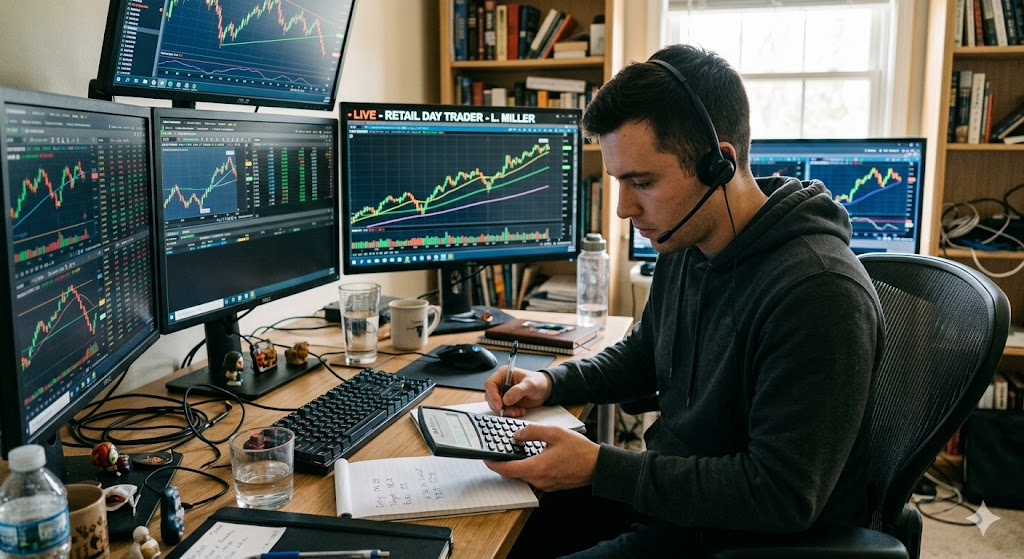
Most futures traders don't blow their accounts on bad strategies. They blow them by oversizing on an entirely normal losing trade — a trade their system was supposed to lose — because they never bothered to convert their stop distance and tick value into a real position size. The same is true in forex and crypto. The math behind position sizing is straightforward, but skipping it has ended more careers than every Fed announcement combined.
A position size calculator exists to remove that excuse. Plug in your account size, your risk per trade, and your stop distance — and the calculator tells you exactly how many contracts, lots, or coins to trade. No mental math at 9:30 a.m. when your hands are already shaking from the third coffee. No "I'll just round up" decisions that compound into a 6% drawdown by Friday.
This guide covers the formula, how to use it across futures, forex, and crypto, and the parts most calculators skip — like why prop firm sizing uses a completely different denominator than retail sizing, and why traders running 1% risk on Apex still blow accounts because they don't understand trailing drawdown.
The Only Position Sizing Formula You Need
Every position sizing calculation across every asset class is the same equation. The only thing that changes is what you call the "unit."
That's it. Whether you're trading the E-mini S&P, EUR/USD, or Bitcoin, you're dividing the dollars you're willing to lose by the dollars you'd lose on a single unit if your stop hits. The "unit" varies:
- Futures: the unit is a tick, and the dollar value depends on the contract (MES = $1.25/tick, ES = $12.50/tick)
- Forex: the unit is a pip, and the dollar value depends on the lot size and quote currency (~$10/pip per standard lot on USD-quoted pairs)
- Crypto: the unit is the price difference per coin, so the dollar value is just the price change itself
The formula doesn't care what you trade. It cares that you defined a stop, that you know the dollar value of price movement, and that you're not making the loss number up. The same math underpins every major futures sizing approach.
Futures Position Sizing
Futures contracts have fixed tick sizes and fixed tick values, which makes the math cleaner than any other asset class. The downside is that the smallest unit you can trade is one contract — there's no "0.4 of an ES contract." That's why micro contracts exist, and why anyone trading a small account who isn't using micros is essentially throwing darts.
Tick Values for Major Contracts
| Contract | Tick Size | Tick Value | 1-Point Move |
|---|---|---|---|
| ES — E-mini S&P 500 | 0.25 | $12.50 | $50 |
| MES — Micro E-mini S&P | 0.25 | $1.25 | $5 |
| NQ — E-mini Nasdaq | 0.25 | $5.00 | $20 |
| MNQ — Micro E-mini Nasdaq | 0.25 | $0.50 | $2 |
| CL — Crude Oil | 0.01 | $10.00 | $1,000 |
| MCL — Micro Crude | 0.01 | $1.00 | $100 |
| GC — Gold | 0.10 | $10.00 | $100 |
| MGC — Micro Gold | 0.10 | $1.00 | $10 |
Worked Example
Setup: $25,000 account. 1% risk per trade ($250 max loss). Trading MES with a 20-tick stop.
Math: $250 ÷ (20 ticks × $1.25/tick) = $250 ÷ $25 = 10 contracts
If your stop gets hit, you lose $250 — exactly your planned risk. Add round-trip commission of $4 per contract and your actual risk per contract becomes $29, so the safer call is 8 contracts to leave room for fees.
Now run the same math on full-size ES instead of micros: $250 ÷ (20 × $12.50) = 1 contract, with $0 left over. If the broker's $4 commission applies, you're already over budget on one contract. This is why micro futures exist — they let small accounts size correctly instead of being forced into binary all-or-nothing decisions.
Forex Position Sizing
Forex sizing is the same formula with two wrinkles: lots come in standard (100,000 units), mini (10,000), and micro (1,000) sizes, and the dollar-per-pip value depends on the quote currency. For USD-quoted pairs like EUR/USD, GBP/USD, and AUD/USD, a standard lot is worth $10 per pip. For JPY pairs, it's roughly $9 per pip and varies slightly with the USD/JPY exchange rate.
Worked Example
Setup: $10,000 account. 1% risk ($100 max loss). EUR/USD with a 25-pip stop.
Math: $100 ÷ (25 × $10) = $100 ÷ $250 = 0.4 standard lots (4 mini lots / 40 micro lots)
If price runs 25 pips against you, you lose $100. Brokers like OANDA and IG let you size in any unit count, so 40,000 units of EUR/USD works exactly the same as 0.4 lots.
Most retail forex traders fail not because they ignore position sizing, but because they ignore spread. A 1.5-pip spread on EUR/USD doesn't sound like much, but on a tight 10-pip stop you're paying 15% of your risk budget just to enter and exit. The calculator linked above bakes spread into the breakeven distance so you can see what you're actually paying. For more on this dynamic, see the classic lot-size breakdown at For Traders.
Crypto Position Sizing
Crypto is the easiest math because there are no tick sizes or lot conventions — you're just buying or shorting a quantity of coins at a dollar price. The formula collapses to:
Worked Example
Setup: $10,000 account. 1% risk ($100 max loss). Long BTC at $60,000, stop at $58,500.
Math: $100 ÷ ($60,000 − $58,500) = $100 ÷ $1,500 = 0.0667 BTC
Position notional = 0.0667 × $60,000 = $4,000. At 1x leverage (spot), you'd need $4,000 in margin. At 5x perp leverage, you'd need $800 — but liquidation moves a lot closer.
The leverage trap kills more crypto traders than bad entries. At 10x leverage, your liquidation price is roughly 10% from entry (minus maintenance margin). If you set a 4% stop with 10x, you're fine. If you set a 12% stop with 10x, the exchange will close your position before your stop ever triggers — and you'll eat the full margin loss. The calculator flags this when stop distance gets close to liquidation range.
Prop Firm Position Sizing Is Completely Different
This is the section most calculator articles skip, and it's the one most likely to save someone's evaluation. Prop firms like Apex Trader Funding and TopStep don't care about your "account size." They care about your distance to the trailing drawdown. The math has to follow.
The Core Issue
On a $50,000 Apex evaluation with a $2,500 trailing drawdown, your real account size for sizing purposes is $2,500 — not $50,000. Risking "1% of the account" means risking $500, which is 20% of your actual buffer. Two losing trades and you've failed.
The fix is to size as a percentage of your drawdown buffer, not your starting balance. The most common reason traders fail prop evaluations is hitting max drawdown — almost never poor win rate. That's a sizing problem dressed up as a strategy problem.
Sensible Sizing By Firm Type
| Firm Style | Drawdown Type | Risk-As-% Of | Reasonable % |
|---|---|---|---|
| Apex Trader Funding | Trailing (intraday) | Remaining buffer | 5–10% |
| TopStep | Trailing (EOD) + daily loss | Lesser of buffer or daily | 10–15% |
| FundedNext / Bulenox | Trailing | Remaining buffer | 5–10% |
| Static drawdown firms | Fixed floor | Buffer to floor | 8–12% |
The differences matter. Apex uses an intraday trailing drawdown that tracks unrealized P&L, so a deep open profit that gives back to your stop counts against you in real time. TopStep uses end-of-day trailing plus a daily loss limit, which means daily sizing has two ceilings to respect simultaneously.
Worked Example — Apex 50K
Setup: Apex 50K, currently at $50,500 balance (up $500). Trailing drawdown is $2,500. Trading MNQ with a 20-tick stop.
Buffer math: Drawdown floor = max balance − $2,500 = $48,000. You can lose $2,500 from current before failure.
Risk per trade: 8% of $2,500 = $200
Contracts: $200 ÷ (20 ticks × $0.50) = $200 ÷ $10 = 20 MNQ contracts
Now Apex caps contracts at 10 minis / 100 micros on the 50K, so 20 MNQ is within range. Take one loss and the drawdown stays $2,300, so the next trade sizes at 8% × $2,300 = $184. The position naturally shrinks as you lose — protecting the account from the death spiral that ends most evaluations.
The dirty secret of prop firms: cutting position size to roughly half of what the rules allow improves pass rates substantially, because it addresses the single biggest failure reason (drawdown hit) without changing strategy at all. The math doesn't care that you "feel hot."
Reward-To-Risk and R-Multiples
Once size is set, the next question is whether the trade is even worth taking. That's what R-multiples answer. R is just shorthand for "risk units" — a 2R trade is one where you're trying to make twice what you'd lose. A 3R trade is three times. Calculators express this as a ratio (2:1, 3:1) but the math is identical.
| R-Multiple | Breakeven Win Rate | Practical Read |
|---|---|---|
| 1R | 50% | Coin flip — needs edge elsewhere |
| 1.5R | 40% | Scalping comfort zone |
| 2R | 33.3% | The minimum most pros target |
| 3R | 25% | Trend-following sweet spot |
| 5R+ | 17% | Swing/breakout territory |
The math is unforgiving: if your average winner is 1R and your win rate is 45%, you lose money over time after costs. If your average winner is 2R and your win rate is 40%, you make money. Same trader, same strategy, different sizing of profits — entirely different P&L. The TP cards in the calculator flash orange when an R drops below 1.0 because that's a setup begging to be skipped.
The Most Common Position Sizing Mistakes
1. Sizing off "account size" instead of "buffer"
Covered above. Applies to prop firms and to anyone who's already drawn down — your starting balance is a memory, not a sizing input. Use what you have today.
2. Ignoring commission and spread in sizing
A "20-tick stop" on MES isn't 20 ticks of risk — it's 20 ticks plus $4 in round-trip commission, which is 3.2 more ticks of effective stop. On a $250 risk budget, that 3.2 ticks costs you a contract. The practical formula always includes costs; ignoring them is how traders end up risking 1.2% when they thought they were risking 1%.
3. Sizing the same on a 10-tick stop and a 40-tick stop
If you're trading the same number of contracts regardless of stop distance, you don't have a position sizing system. You have a contract count habit. Risk per trade should be constant; contract count should vary inversely with stop distance.
4. Increasing size after wins, decreasing after losses
This is gambler's logic dressed up as confidence management. Win or lose, the next trade gets the same percentage risk applied to your current balance. The position naturally grows during winning streaks (because balance is bigger) and shrinks during losing streaks (because balance is smaller). The math takes care of compounding without you having to "feel" it.
5. Crypto traders ignoring liquidation
Setting a 10% stop on a 10x leveraged position is mathematically incoherent — the exchange will liquidate you first, and the stop never triggers. Either reduce leverage or tighten the stop until it sits inside the liquidation distance with a buffer for funding fees and slippage.
How to Use the Calculator
- Pick your tab — Futures, Forex, or Crypto.
- Enter your account size and risk %. If you're on a prop account, toggle Prop Firm Mode and use trailing drawdown instead of account size.
- Select your contract (futures), pair type (forex), or enter entry/stop prices (crypto).
- Enter your stop distance in ticks, pips, or as a stop price.
- Add fees — round-trip commission for futures, spread for forex, taker fee for crypto. This is non-optional if you want the math to match your actual P&L.
- Optionally enter take profit targets to see R-multiples for each.
- Save your defaults so you're not re-entering account size every session.
Open the Position Size Calculator
Free, no signup, your inputs save locally to your browser.


