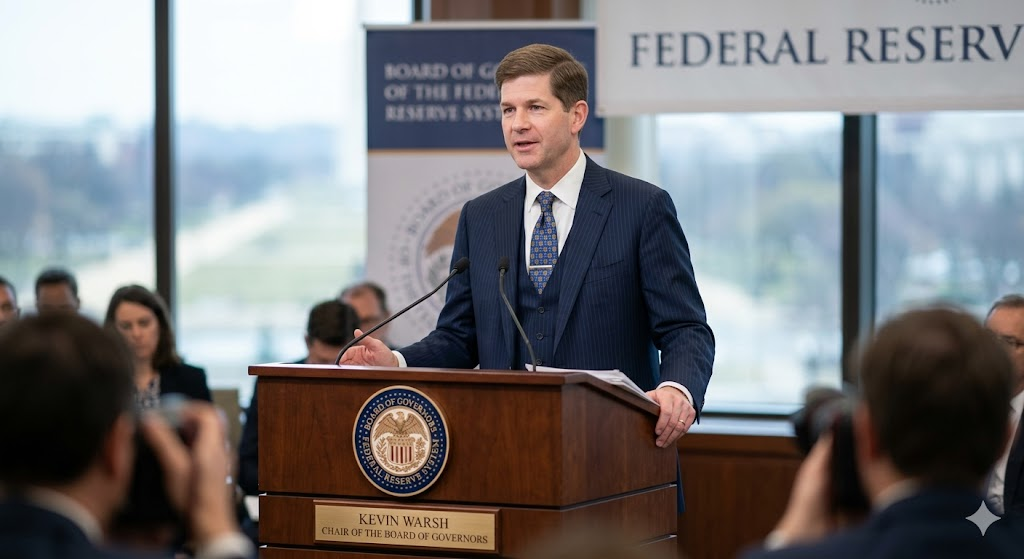
Kevin Warsh: The Hawk, the Dove, and the Trillion-Dollar Question Mark
Trump's pick to lead the Fed has spent two decades being a hawk, then a dove, then both at once. Markets are still trying to figure out which one shows up on May 15.
Who Is Kevin Warsh?
Kevin Maxwell Warsh, born April 13, 1970, is a Stanford undergrad and Harvard Law grad who did the resume tour every aspiring central banker dreams of: Morgan Stanley M&A in the late '90s, special assistant to President George W. Bush handling the post-Enron Sarbanes-Oxley fallout, and then — at age 35 — the youngest person ever appointed to the Federal Reserve Board of Governors. He served there from 2006 through 2011, which means yes, he had a front-row seat to the 2008 financial crisis and helped coordinate the emergency liquidity facilities that kept the global financial system from imploding.
Sources: Wikipedia — Kevin Warsh; Chatham Financial
After leaving the Fed in 2011 — reportedly in frustration over the second round of quantitative easing — Warsh landed at the Hoover Institution, a conservative think tank at Stanford. He has spent the intervening 15 years writing op-eds about how the Fed's balance sheet is "bloated," how monetary policy has gotten too cute, and how the central bank should generally do less of whatever it's currently doing. Trump nominated him on January 30, 2026, after a months-long bake-off that, per reporting, resembled an episode of The Apprentice more than a serious search for the world's most important economic policymaker.
Source: Wikipedia — Kevin Warsh
The Senate Banking Committee advanced his nomination on April 29 by a 13-11 party-line vote — the first fully partisan committee vote on a Fed chair in the panel's history. The full Senate is expected to confirm him the week of May 11, just in time for Powell's term to expire May 15.
Sources: CNBC; Al Jazeera
The Hawkish Past Versus the Dovish Present
Here's where things get fun. During his first Fed stint, Warsh was, by all accounts, a hawk. He wanted higher interest rates even during the financial crisis — a stance that, in hindsight, looks roughly as wise as bringing an umbrella to a tsunami. He resigned in 2011 specifically because he didn't like QE2, the Fed's second round of bond-buying. He has spent years arguing that the Fed's balance sheet expansion was a mistake that distorted asset prices and rewarded people who already owned assets at the expense of everyone else.
Sources: Yahoo Finance / Barron's; Scott Sumner on Substack
Then somewhere around 2024, the hawk apparently molted. Warsh started writing that the Fed was "slow to cut" interest rates, that AI-driven productivity would be a "significant disinflationary force" justifying lower rates, and that high rates were strangling growth and jobs. The cynical view — held by approximately everyone outside the Trump administration — is that the dovish conversion conveniently aligned with the political requirement to become Fed chair. The charitable view is that Warsh genuinely changed his mind. The realistic view is probably some mixture, with the proportions left as an exercise for the reader.
Sources: Man Group — The Warsh Paradox; Fortune
The "Rate Cuts and QT" Paradox
Warsh's signature idea is something he proposes with a straight face: cut interest rates while also aggressively shrinking the Fed's balance sheet. The pitch is that the balance sheet, in its current oversized form, props up asset prices and acts as a form of hidden accommodation. Shrink it, the argument goes, and you create room to cut the federal funds rate without overheating the economy. The Dispatch quoted him saying the Fed's two tools "should be working in concert, not across purposes."
Source: The Dispatch — The Math and Mechanics on Warsh's Smaller Fed
"If you want to create space for rate cuts by shrinking the balance sheet, it actually does nothing to push down long-term rates or improve mortgage affordability." — Mark Dowding, RBC BlueBay Asset Management
Source: TradingKey
The technical problem is that this is roughly like trying to drive with one foot on the gas and one foot on the brake. Shrinking the balance sheet — selling off the Fed's roughly $6.7 trillion stockpile of Treasuries and mortgage-backed securities — pushes long-term yields up, which raises mortgage rates and tightens financial conditions. So if Warsh cuts short-term rates while running aggressive quantitative tightening, mortgage borrowers may not see much relief at all. Which is awkward, because lower mortgage rates are pretty much exactly what Trump has been demanding.
Sources: The Motley Fool; Yahoo Finance
What Could This Mean for Interest Rates?
The honest answer is "it depends which Warsh shows up," but most analysts converge on a few likely scenarios for his first year.
Scenario 1: The Pragmatic Dove (most likely near-term)
JPMorgan's Michael Feroli expects Warsh to be dovish at the outset, with the other eleven FOMC members acting as a "brake on any quick shift in monetary policy." Translation: Warsh probably gets rate cuts, but not as fast or as deep as Trump wants. Claudia Sahm, the former Fed economist behind the Sahm recession indicator, noted that with inflation at 3.3% and his replacement of dove Stephen Miran shrinking — not growing — the rate-cut coalition, Warsh simply doesn't have the votes for the aggressive early cuts Trump is demanding. Expect 50–100 basis points of cuts in 2026, framed around weakening labor data rather than presidential pressure.
Sources: Fortune — Sahm interview; CNBC
Scenario 2: The Bear-Steepener
This is the trade markets started pricing in immediately after the nomination. Short-term rates come down as Warsh delivers cuts, but long-term yields rise because of balance sheet runoff plus inflation skepticism. The yield curve steepens dramatically, which is great for banks, awful for homebuilders, and confusing for everyone else. Bloomberg strategists were already calling this "the steepener trade" within hours of the announcement.
Sources: Bloomberg via Yahoo; FinancialContent
Scenario 3: The Independence Crisis
Warsh has floated the idea of a new "Treasury-Fed Accord" — a formal agreement giving Treasury input on what the Fed buys and how big its balance sheet gets. He frames this as restoring Fed independence by getting the central bank out of credit policy. Former Fed officials told CNBC that, taken to extremes, this could mean the Fed effectively losing control of its balance sheet — exactly the opposite of independence. If markets ever decide that's where this is headed, all bets are off, the dollar tanks, and gold returns from its current bear-market grave.
Source: CNBC — Warsh independence concerns
How Are Investors Reacting?
The market reaction has been split-personality, which is appropriate for a Warsh chairmanship. Here's the rough scorecard since the January 30 nomination:
| Asset Class | Reaction | Why |
|---|---|---|
| US Dollar | ▲ Stronger | Hawkish reputation; relief he's not a total Trump loyalist |
| 2-Year Treasury Yield | ▼ Lower | Front-end rate cuts now priced in |
| 10-Year / 30-Year Yields | ▲ Higher | Balance sheet runoff = bear steepener |
| S&P 500 | ▼ Initial dip, then recovery | End of "Fed put" priced in; later relief |
| Gold & Silver | ▼ Hammered | "Sound money" rhetoric kills the debasement trade |
| Big Banks (JPM, GS) | ▲ Higher | Steeper yield curve helps net interest margins |
| Homebuilders (DHI) | ▼ Lower | QT keeps mortgage rates elevated |
| Mega-cap Tech (NVDA, MSFT) | ▲ Higher | Warsh's AI-productivity thesis = bullish framing |
Sources: FinancialContent; Wedbush; Fortune
Probably the most telling reaction came from gold, which suffered its biggest one-day decline since the early 1980s after the nomination. For a year, gold had been catapulting higher on fears that Trump would install a "sock puppet" Fed chair who'd let inflation rip. Warsh's nomination broke that narrative — at least temporarily. The dollar rallied for the same reason: investors decided Warsh, for all his ambiguity, is more credible than the alternatives Trump was reportedly considering (including BlackRock's Rick Rieder and NEC director Kevin Hassett).
Sources: Fortune — Gold/silver crash; Bloomberg via Yahoo
By the time of his April 21 confirmation hearing, markets had largely settled into a "give him the benefit of the doubt" posture. Invesco's Brian Levitt summed up the institutional view: broadly dovish, pragmatic, respectful of Fed independence, supportive of stocks. Stocks hit all-time highs the week of the hearing. Inflation breakevens stayed well-anchored. The classic "we'll believe it when we see it, but for now, fine" reaction.
Source: Invesco
The Risks Nobody's Pricing In Yet
Three things keep showing up in analyst notes as the real wild cards:
1. The Trump Pressure Test. Trump has publicly said he wants rates as low as 1%. They're currently at 3.6%. Inflation is 3.3%. Warsh has promised "strict independence" on monetary policy. At some point — probably sooner than later — those things collide. Will Warsh stand up to Trump the way Powell did? The DOJ criminal investigation into Powell (recently dropped to clear Warsh's confirmation path) has established that the administration is willing to weaponize federal prosecutors against Fed chairs it dislikes. That's a precedent that doesn't disappear when the investigation does.
2. The Repo Market Trap. The last two times the Fed tried to aggressively shrink its balance sheet — 2019 and 2022 — it broke things. In 2019, short-term funding markets seized up so badly the Fed had to reverse course within months. In late 2025 it happened again. Warsh has acknowledged unwinding will take time. But his stated framework — "every $1 trillion of balance sheet reduction equals roughly 50 basis points of tightening" — sets up an awkward situation where he either moves slowly (disappointing Trump and the sound-money crowd) or moves fast and risks a 2019-style liquidity event.
Sources: The Motley Fool; FinancialContent
3. The Powell Problem. Powell's term as chair ends May 15, but his term as a Fed governor runs through 2028. He has reportedly told colleagues he intends to stay. That means Warsh inherits a divided FOMC with his predecessor still in the room, voting on every decision, presumably not thrilled about the way his last two years went. Wells Fargo's Porcelli noted that Powell was "one heck of a consensus builder" — a skill Warsh will need to develop fast on a more politically charged committee than any Fed chair has faced since Volcker.
Sources: Al Jazeera; Yahoo Finance
The Bottom Line
Kevin Warsh is walking into the Fed chair's office as one of the most ideologically slippery nominees in modern history — a former hawk who is now apparently a dove, a believer in Fed independence who wants to formally coordinate with the Treasury, a critic of low rates who has suddenly discovered he likes them. Investors have responded with a deeply hedged "okay, probably fine" — pricing in modest rate cuts at the short end, higher yields at the long end, a stronger dollar, weaker gold, and a stock market that quietly believes the Fed put isn't dead so much as relocated to companies with strong balance sheets and AI exposure.
Whether any of this survives contact with reality — Trump's demands for 1% rates, inflation that won't break below 3%, a balance sheet runoff that has never worked smoothly, and an FOMC that includes the guy Warsh is replacing — is the trillion-dollar question that will define his tenure. Markets are giving him the benefit of the doubt for now. Whether they keep giving it after his first FOMC meeting in June is a different problem entirely.


