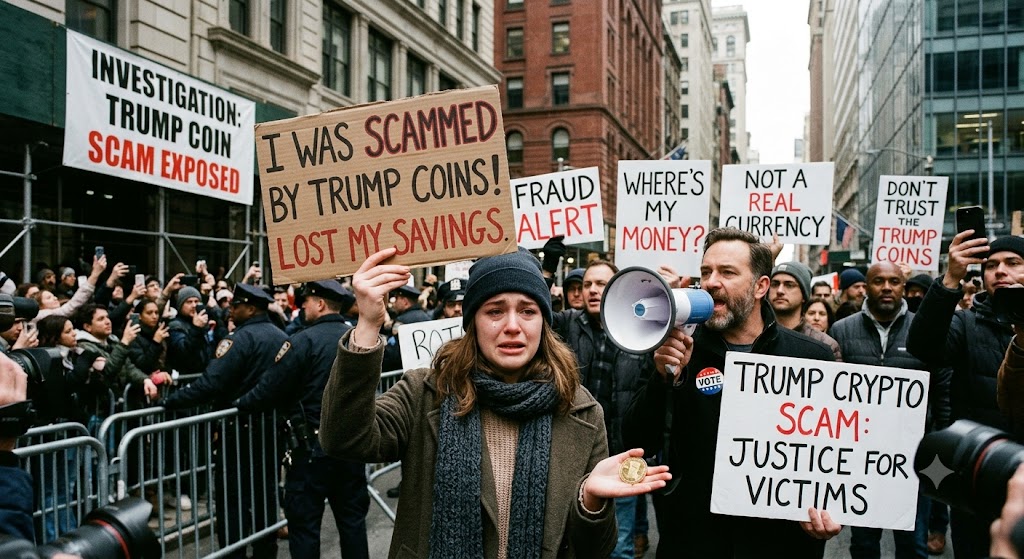
The Trump Coin “Scam,” Explained for Traders: Who Actually Wins When 800,000 Wallets Lose
Strip out the politics and $TRUMP is the cleanest live demonstration you’ll ever see of the only rule that matters in speculation: the house writes the odds, and you are not the house.
Every memecoin has two scoreboards. One tracks the price you obsess over. The other tracks who is quietly selling into your enthusiasm. With President Trump’s official memecoin, the gap between those two scoreboards is so wide it stopped being a political story and became a textbook. In the first 19 days alone, forensic analysis commissioned by The New York Times found that 813,294 wallets lost money on the token — roughly $2 billion — while the entities behind the coin banked about $100 million in trading fees. For every dollar the creators collected, buyers lost twenty. (Fortune)
Before anyone reaches for the lawyers: a memecoin being brutal to its buyers is not the same thing as it being illegal. The coin ships with disclaimers describing it as a collectible expression of support rather than an investment, its terms bar holders from class actions, and even a sober academic write-up concluded it was “not a fraudulent venture” so much as a case study in transparency, insider advantage, and manipulation. That is the honest-broker read, and it’s the useful one. The problem for retail was never that $TRUMP broke the rules. The problem is that it followed them, and the rules were written by the people holding 80% of the supply. (ResearchGate)
What $TRUMP actually is
$TRUMP launched on Solana on January 17, 2025 — three days before the inauguration — with a fixed supply of one billion tokens. Only about 20% hit the market at launch; the other 80% sits with two Trump-linked entities, CIC Digital and Fight Fight Fight LLC, on vesting schedules that drip out through 2028. Those same entities collect a fee on trading activity in both directions. Read that twice: the issuer earns whether you buy or sell, which means every hype cycle pays the team even when it vaporizes value for the buyers it just attracted. (Datawallet)
The price chart tells the story every memecoin chart tells, just louder. A vertical launch spike, a screaming all-time high in the first day, and then eighteen months of lower highs punctuated by little event-driven bounces — a dinner, a gala, a leaderboard — each one a fresh opportunity for volume, and therefore fees, on the way down. By June 2026 the token was roughly 97% off its peak. If you bought the excitement, you didn’t buy an asset; you bought someone else’s exit liquidity. (Reuters)
The shape of the trade: one vertical candle of genuine opportunity, then eighteen months of fee-generating bleed. Illustrative, not to scale.
The two scoreboards, side by side
Here is the asymmetry that matters more than any price target. A small cluster of early and sophisticated wallets captured the overwhelming majority of the gains, while the crowd — the people who saw the token trending and clicked buy — absorbed the losses. Across the $TRUMP and companion $MELANIA tokens, analysts put combined retail losses near $4 billion by early 2026, against roughly hundreds of millions in insider fees and sales. The token didn’t need to be a scam to redistribute wealth upward. It just needed you to show up late. (If $TRUMP was a stacked deck, the $MELANIA pump-and-dump lawsuit is the one a federal court is being asked to call rigged — we broke that case down separately.) (Datawallet)
| Metric | Insiders & early whales | Retail buyers |
|---|---|---|
| Position at launch | ~80% of supply, vesting to 2028 | Buying the top on hype |
| How they earn | Fees on every trade + timed sells | Price appreciation that never came |
| First 19 days | ~$100M in trading fees | 813,294 wallets down ~$2B |
| ~18-month ledger | Hundreds of millions collected | Billions in cumulative losses |
| Peak-to-date | Insulated by vesting & fees | ~97% drawdown from the high |
Notice the mechanism, because it’s the whole lesson. The issuer’s revenue is a function of volume, not direction. That is the same edge a casino has: it doesn’t care whether you win a hand, only that you keep playing. Every dinner-with-the-president leaderboard and celebrity gala was, in market terms, a re-engagement campaign to restart the volume the fees feed on. The reputational risk trailed the money instead of leading it. (Reuters)
Who owns the coin you’re “investing” in
If you ever want a two-second gut check on whether a token is built for you or for someone else, look at the supply distribution. Here’s $TRUMP’s. When four out of five tokens are held by the people who created it and will unlock them on a schedule that runs for years, you are not an investor. You are demand. (Wikipedia)
The red bar is the counterparty on the other side of your trade.
And then there’s the actual scam
Here’s where the word “scam” earns its keep without a lawyer flinching. During Super Bowl LX on February 9, 2026, an AI deepfake of Trump ran across unofficial livestreams — one of them mimicking Fox and NFL branding and pulling more than 200,000 concurrent viewers — directing people to a fake site that promised to double any crypto they sent. It was entirely fabricated and unaffiliated with him, the wallet addresses rotated to dodge tracing, and no returns were ever sent back. That is fraud, full stop, and it’s the exact opposite of the disclosed-but-brutal memecoin: no disclaimers, no vesting schedule, just a synthetic face and a “send now” button. (Meyer Wilson)
The two stories rhyme, and that’s the point. Chainalysis pegged crypto fraud losses at around $17 billion in 2025, and scam operations reportedly ramped up their use of AI tooling by roughly 500% over the year. Whether it’s a legal memecoin engineered to extract fees or an outright deepfake engineered to extract deposits, the psychology being exploited is identical: a famous name, a sense of urgency, and the fantasy of easy asymmetric upside. Your job at the desk is to recognize that the setup is the same regardless of which side of “legal” it lands on. (Meyer Wilson)
What this means for you at the desk
You trade NQ, not memecoins, so why should any of this land? Because the failure mode is portable. The retail buyer who chased $TRUMP into a 97% drawdown made the identical error a scalper makes revenge-trading a red morning: entering because something is moving and emotionally compelling, not because there’s a defined edge and a defined risk. The coin didn’t blow up those accounts — the absence of a plan did. Structure beats conviction every time, which is the entire premise behind trading one clean setup a day instead of chasing every candle that looks exciting. (Wikipedia)
So the practical takeaways are unglamorous, which is how you know they work. Know your counterparty before you size a position — if you can’t name who profits when you lose, don’t take the trade. Define your risk before you define your target, because the crowd holding $TRUMP had a beautiful target and no stop. And run the actual math on ruin rather than the vibes: our risk-of-ruin calculator and position-size calculator will tell you in ten seconds what a leaderboard never will. If you want to see how a real stop would have behaved on a chart like that, the stop-loss visualizer makes the point better than any lecture. (Datawallet)
The uncomfortable summary is that $TRUMP wasn’t a market anomaly — it was a market working exactly as designed, for the people who designed it. The 800,000 losing wallets weren’t unlucky. They were the product. Trade like someone who has read the tokenomics of their own life, keep the counterparty in view, and let the people who buy famous names at the top keep funding the fees. You’ve got a desk and a plan. That’s already a better edge than most of them ever had. (Fortune)
Frequently asked questions
Is the $TRUMP coin actually a scam?
Legally, no one has established that it is. The token carries disclaimers calling it a collectible rather than an investment, and at least one academic analysis explicitly called it “not a fraudulent venture.” The fair criticism isn’t that it broke rules — it’s that the structure (about 80% insider-held supply plus fees on all trading) is stacked so heavily toward the issuer that most retail buyers were mathematically likely to lose. The unambiguous scam is a separate event: the Super Bowl LX deepfake that impersonated Trump to steal crypto outright.
How much did people actually lose on it?
Forensic analysis commissioned by The New York Times found 813,294 wallets down roughly $2 billion in just the first 19 days, while the entities behind the coin collected around $100 million in fees. Later estimates covering the token’s first 18 months put cumulative retail losses in the billions, with the coin trading about 97% below its January 2025 peak.
How does the coin make money for insiders even as the price falls?
Two ways. First, the issuing entities collect a fee on trading volume in both directions, so they earn whether you buy or sell — the casino model. Second, they hold roughly 80% of supply on a vesting schedule running into 2028, letting them sell into strength over time. Price appreciation is optional for them; volume is not.
What’s the lesson for a futures or prop trader?
The same discipline failure that trapped memecoin buyers — entering because something is moving rather than because there’s a defined edge and defined risk — is what blows up funded accounts. Know who profits when you lose, set your stop before your target, and run the ruin math instead of trusting momentum. Structure beats conviction.
How do I avoid the deepfake “double your money” scams?
Treat any offer to multiply your crypto as fraud by default. Legitimate opportunities don’t rotate wallet addresses, don’t rely on a livestream of a celebrity, and don’t require urgency. If the upside is loud and the counterparty is invisible, you are the counterparty.
This article is educational and does not constitute investment or financial advice. Cryptocurrency and futures trading involve substantial risk of loss. Figures reflect third-party reporting available at the time of writing.