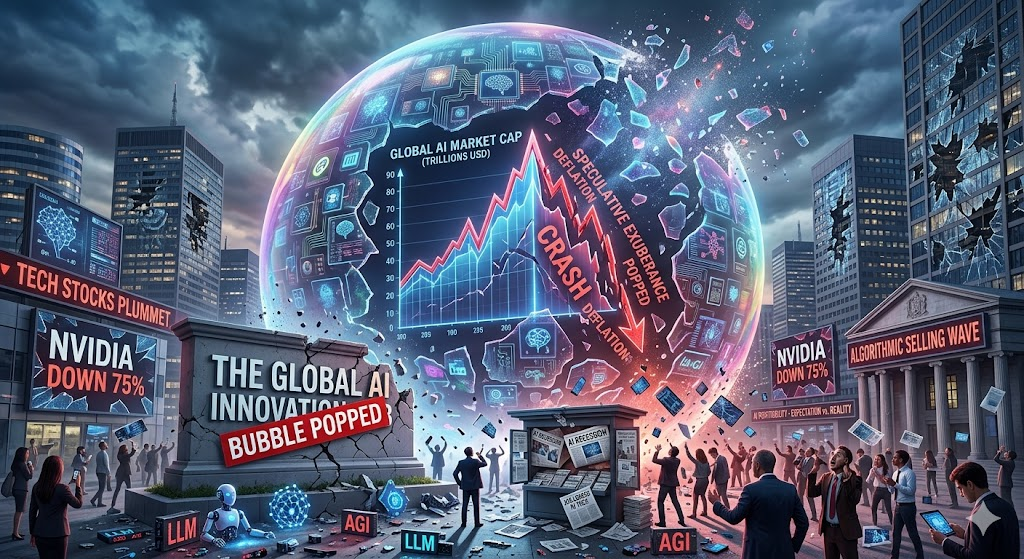
Every generation gets at least one. A technology so dazzling, so seemingly limitless in its promise, that investors pour money in faster than anyone can spend it. The railroad mania of the 1840s. The dot-com frenzy of the late 1990s. The housing bubble of the mid-2000s. And now, perhaps, artificial intelligence.
The word "bubble" gets thrown around a lot in financial circles, sometimes lazily. But a true bubble has a specific anatomy: prices detach from reality, hype substitutes for fundamentals, and debt-fueled spending races ahead of any plausible return on investment. When you look closely at the numbers behind the AI boom, it's hard not to feel a familiar chill.
That said, the picture is genuinely complicated. The technology is real. The use cases are real. And some of the world's most sophisticated financial minds — the same people paid to detect exactly this kind of excess — are split down the middle on whether this ends in tears. So let's take a careful look at both sides.
Why the Warning Signs Are Real
Start with the spending numbers, because they are staggering. Global investment in AI infrastructure — data centers, chips, power — is projected to exceed $500 billion per year in 2026 and 2027. That's not the GDP of a small country; that's larger than the entire economy of countries like Norway or Austria, spent in a single year, on one technology.
Who is doing all this spending? Largely the big tech giants: Microsoft, Google, Amazon, Meta. And OpenAI, the company behind ChatGPT, has committed to spending $1.4 trillion over the next eight years — while simultaneously projecting operating losses of $74 billion in 2028 alone. The company expected to report annual losses through the rest of the decade. Much of this infrastructure buildout is funded by debt, not profits.
Meanwhile, the people actually using these AI tools — the businesses, the developers, the enterprises paying for subscriptions and API access — aren't seeing transformative returns. Studies suggest that the vast majority of companies experimenting with AI report no measurable productivity gains. The gap between what AI costs to build and what companies are making back from it is enormous and, so far, widening.
Then there's the market concentration problem. In 2025, roughly 80% of the S&P 500's gains were driven by a tiny cluster of AI-related companies. That means the health of the entire U.S. stock market has become tightly coupled to the fate of a handful of tech firms. If sentiment on AI sours — if one big earnings miss, one shock competitor, one credibility-damaging failure lands at the wrong moment — the ripple effects could be severe and swift.
"AI is real and will ultimately pay off — just like cars and TVs paid off. But most people currently invested in it may not do well."
— Jamie Dimon, CEO, JPMorgan ChaseThe dot-com comparison keeps coming up, and it's not unfair. The Shiller price-to-earnings ratio — a key measure of whether stocks are overvalued — exceeded 40 in late 2025, a level not seen since just before the dot-com crash of 2000. Many experts note that the specific mechanism driving the bubble is slightly different this time: rather than debt-fueled startup speculation, today's AI boom is powered by the enormous balance sheets of already-profitable tech giants. But "different mechanism" doesn't mean "no risk."
Why It Might Not Be a Bubble At All
Here's the other side of the argument, and it's a real one: AI isn't the internet circa 1999. It's not a technology that promises future value at some undefined point. It's a technology that is already woven into products used by hundreds of millions of people every day. Developers use it to write code. Doctors use it to analyze medical images. Lawyers use it to review contracts. Writers, marketers, teachers, researchers — AI has already changed how actual work gets done.
Major financial institutions, including JPMorgan, have formally concluded that AI doesn't meet the classical definition of a financial bubble, because investment in the sector is linked to genuine enterprise revenue rather than pure speculation. The Federal Reserve's Jerome Powell has also drawn a sharp distinction between AI and the dot-com era, noting that today's AI companies generate real revenue and that data center buildouts contribute meaningfully to broader economic growth.
Nvidia is perhaps the most instructive example. The company's valuation surged from $1 trillion in 2023 to $4 trillion by mid-2025, and over $5 trillion by October of that year — numbers so large they exceed the GDP of every country except the United States and China. That sounds absurd. But Nvidia isn't selling promises; it's selling chips that the entire AI industry cannot function without, and demand for those chips has been relentlessly real. Revenue has matched, and often exceeded, soaring expectations.
There's also a structural argument against a dramatic crash: the companies doing the heavy AI spending — Microsoft, Google, Amazon, Meta — are extraordinarily profitable in their core businesses. Unlike the dot-com startups of the 1990s, which burned through venture capital with no revenue in sight, these companies can sustain years of AI investment even if returns are slow to materialize. That financial cushion changes the risk profile considerably.
The Scenarios: Best and Worst
The honest answer is that both a soft landing and a hard crash are plausible outcomes — and a lot depends on factors that nobody can fully predict: how fast productivity gains materialize, whether AI companies find sustainable pricing models, and how much longer investors remain patient. Here's what each scenario might look like.
The Productivity Revolution Arrives — and Pays for Itself
Over the next two to three years, businesses figure out how to integrate AI in ways that genuinely move the needle on productivity. A law firm that used to need 40 associates to review contracts can do it with 15. A software team ships twice as fast. A hospital diagnoses rare diseases in hours instead of weeks.
As these gains compound, AI stops being a cost center and becomes a profit driver. Companies start paying more for AI tools because the return on investment is obvious. Revenue models stabilize. OpenAI and its peers find sustainable pricing that actually covers the cost of running these systems.
The stock market digests the AI premium gradually — not a crash, but a slow normalization as valuations align with demonstrated earnings. Some overvalued startups fail quietly. The big players survive and grow. Infrastructure spending proves prescient: the data centers being built right now become essential backbone for a genuinely transformed global economy. The dot-com analogy actually vindicates itself — yes, Pets.com failed, but Amazon thrived, and the internet did change everything.
The Math Stops Working — and It All Unravels Fast
The productivity gains never materialize at scale. Companies keep running AI pilots and keep getting inconclusive results. The enthusiasm of early adopters doesn't translate into the kind of economy-wide transformation that would justify the trillions being spent. Businesses quietly scale back their AI subscriptions.
Meanwhile, the costs of running AI keep climbing. Pricing models that were deliberately subsidized — cheap subscriptions meant to drive adoption — shift to usage-based pricing that reflects actual compute costs. Enterprise customers sticker-shock their way out of deals. Revenue growth slows sharply.
Then comes the moment of reckoning. One major player — possibly OpenAI — can no longer service its debt obligations. The circular web of AI companies investing in each other (Nvidia chips bought by cloud providers funded by AI startups funded by Microsoft) begins to unravel. A sharp correction triggers forced selling. The S&P 500, with 80% of its recent gains concentrated in AI stocks, falls hard. Credit tightens. A broader economic recession follows. The people who built real, useful AI products survive; most others don't.
The Most Likely Path Forward
History suggests that transformative technologies rarely match the initial hype — but they also rarely disappear entirely. The railroad boom of the 1840s ended in a spectacular crash. But the railroads themselves remained, and they reshaped the world. The dot-com bubble wiped out trillions in market value and thousands of companies. But the internet itself turned out to be exactly as important as the most optimistic believers said it would be.
The most probable scenario for AI is probably somewhere in this tradition: a painful correction that wipes out the excess froth, followed by a slower, more grounded buildout of genuinely transformative applications. Some of today's most celebrated companies won't survive. The valuations that seem absurd in hindsight will indeed prove absurd. But the core technology — the ability to understand language, analyze data, generate content, and automate complex tasks — will become infrastructure as essential as electricity or the internet.
The people best positioned for whatever comes next are those who are neither true believers nor dismissive skeptics. The technology is real; the hype is real too. Navigating what comes next requires holding both truths at once — which, it turns out, is harder than picking a side.


