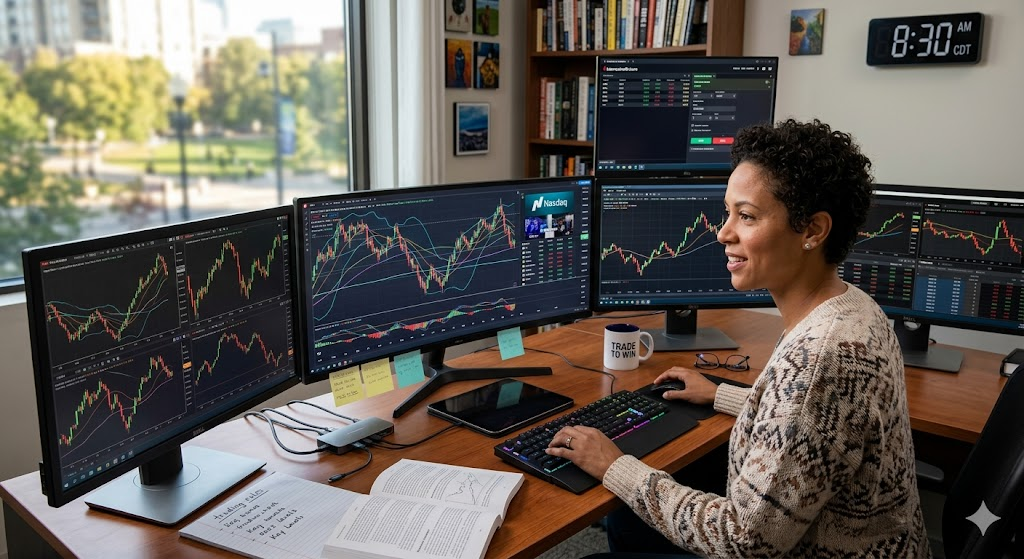
Day trading explained: a beginner's guide covering what it is, how it works, pros and cons, and who it suits.
What is day trading? A plain-English guide
You've seen the headlines — traders making fortunes (and losing them) in a single afternoon. But what actually is day trading, how does it work, and is it right for you?
The simple definition
Day trading means buying and selling a financial asset — like a stock, currency, or cryptocurrency — within the same trading day. The goal is to profit from small price movements that happen over minutes or hours, rather than holding an investment for months or years.
Think of it this way: a long-term investor buys stock in a company and waits years for it to grow. A day trader might buy that same stock at 9:45 AM and sell it at 11:20 AM — pocketing (or losing) the difference.
By definition, a day trader closes all positions before the market closes for the day. No trades are held overnight. This is what separates day trading from swing trading or long-term investing.
What do day traders actually trade?
Day traders work across several different markets. Here are the most common:
Stocks
Shares of publicly listed companies. The US stock market (NYSE/NASDAQ) is the most popular venue.
Forex
Currency pairs like EUR/USD. Forex runs 24 hours a day, five days a week, making it very accessible.
Crypto
Bitcoin, Ethereum, and altcoins. Crypto markets never close, including weekends.
Futures & options
Contracts tied to commodities or indexes. Typically used by more experienced traders.
How does a day trade actually work?
Let's walk through a simple example, step by step.
Step 1 — Find a setup
A day trader wakes up early and scans for stocks that are moving unusually — maybe a company just reported strong earnings. They look for a stock with high volume and clear momentum.
Step 2 — Enter the trade
They decide to buy 100 shares of Company X at $50.00 per share, spending $5,000 total. They believe the price will rise to around $51.50 based on the chart pattern.
Step 3 — Manage the trade
They set a stop-loss at $49.50 (to limit losses if they're wrong) and a take-profit target at $51.50. Now they wait and watch.
Step 4 — Exit the trade
The stock rises to $51.50 within two hours. They sell all 100 shares, pocketing a $150 profit — minus any broker commissions or fees.
Not every trade is a winner. Professionals aim for a high win rate and favorable risk-to-reward ratio — meaning their winning trades earn more than their losing trades cost. Consistency over time matters more than any single trade.
Key concepts every beginner should know
Technical analysis
Day traders rarely care about a company's business fundamentals. Instead they study price charts, looking for patterns that suggest where the price might go next. This is called technical analysis.
Leverage
Many brokers let traders borrow money to control a larger position than their account balance allows. For example, 4:1 leverage means a $10,000 account can control $40,000 in trades. This amplifies both gains and losses.
Liquidity
Day traders need assets they can buy and sell quickly without the price moving against them. High liquidity means lots of buyers and sellers — large-cap stocks and major currency pairs are prime examples.
Pattern day trader (PDT) rule
In the US, if you make four or more day trades within five business days in a margin account, you're labeled a pattern day trader. This requires maintaining a minimum account balance of $25,000.
The reality check: by the numbers
Day trading sounds exciting, but the statistics are sobering. Here's what research consistently finds:
Important: These numbers don't mean success is impossible — they mean it requires serious education, discipline, proper risk management, and significant practice, usually in a simulated environment first. Never trade with money you can't afford to lose.
Pros & cons of day trading
Potential upside
- Income not tied to a salary
- Work from anywhere with a laptop
- No overnight risk from news events
- Flexible schedule
- Can profit in rising and falling markets
Real risks
- Most beginners lose money
- Emotionally and mentally demanding
- Fees and commissions eat profits
- Requires significant starting capital
- No guaranteed income or benefits
Day trading vs. long-term investing
These are two completely different approaches to the market — neither is universally "better," but they suit very different people and goals.
Day trading
Short timeframes. High activity. Relies on chart patterns and momentum. Requires daily attention and fast decisions.
Long-term investing
Years-long horizon. Based on company fundamentals. Historically generates steady wealth with far less stress and time.
Most financial experts recommend long-term, diversified investing for the majority of people. Day trading is best approached as a skilled profession — not a get-rich-quick shortcut.
Is day trading right for you?
Day trading might be worth exploring if you have a strong interest in markets and are willing to study extensively, can afford to lose your initial capital without it affecting your life, are emotionally disciplined and handle stress well, have time to dedicate during market hours, and are willing to practice in a paper trading (simulated) account for months before going live.
If you're looking for a reliable way to grow savings for retirement or a major goal, traditional investing in index funds is likely a better starting point.
How beginners can learn safely
1. Educate yourself first
Read books, take courses, and study chart patterns before putting any real money on the line. There's no shortage of free and paid resources online.
2. Open a paper trading account
Most major brokers offer free simulated trading accounts. Practice until you're consistently profitable over at least 3–6 months.
3. Start very small
When you do go live, risk only a tiny fraction of your capital per trade — most professionals risk no more than 1–2% of their account on any single trade.
4. Keep a trading journal
Record every trade — your reasoning, the outcome, and what you'd do differently. Reviewing your journal is one of the most effective ways to improve.
The bottom line
Day trading is the practice of buying and selling financial assets within a single trading day to profit from short-term price moves. It's a legitimate — if challenging — profession that demands skill, discipline, and continuous learning. The barrier to entry is low technologically, but the barrier to consistent profitability is very high.
Go in with realistic expectations, invest heavily in your education before investing real money, and never risk capital you can't afford to lose. For most people, slow and steady long-term investing remains the more reliable path to financial growth.


