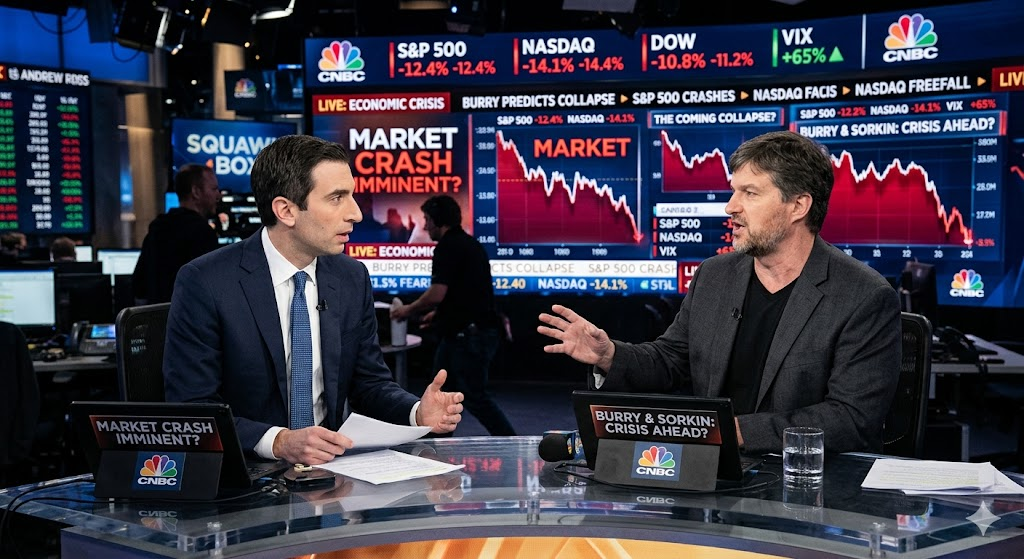
Two of the loudest names in finance — one a CNBC anchor who just wrote a 400-page book about the last great crash, the other a hedge fund manager who got Christian Bale to play him in a movie — are basically waving the same red flag. Andrew Ross Sorkin says a crash is coming. Michael Burry has already bet money on it. The market, true to form, keeps making new highs anyway.
So what exactly are these two warning about, why now, and how seriously should traders take it? Below is what they've each said, what the data shows, and what it might mean for anyone still holding a portfolio that looks suspiciously top-heavy with semiconductors.
Andrew Ross Sorkin: "We Will Have a Crash"
Sorkin, the longtime CNBC Squawk Box co-anchor and author of Too Big to Fail, spent much of 2025 buried in the archives writing "1929: Inside the Greatest Crash in Wall Street History — and How It Shattered a Nation." His 60 Minutes interview on the book, originally aired in October 2025 and rebroadcast on May 24, 2026, has been making the rounds again — and the central quote is impossible to ignore. Pressed by Lesley Stahl on whether another 1929-style collapse could be ahead, Sorkin didn't hedge: he said flatly that there will be a crash, that he can't tell anyone when or how deep, but that he wishes he wasn't saying it. You can read the full interview transcript at CBS News.
His thesis isn't built on chart patterns or one indicator flashing red. Sorkin pointed to the 1928-to-September-1929 stretch in which stocks rose roughly 90% before everything came apart, and argued the same ingredients — speculation, rising margin debt, and a quiet rollback of post-crisis regulatory guardrails — are visible right now. The book itself draws on newly uncovered documents from that era, and his argument is essentially that history doesn't repeat, but it rhymes loud enough that you can hum along. Coverage of the warning and the historical parallels comes from Prism News.
Layered on top is what Sorkin describes as a culture problem. He told Stahl that most American CEOs are currently "very scared" to speak publicly about anything for fear of political retaliation, regulatory pressure, or a merger getting blocked — which, if accurate, removes one of the natural checks on overheated markets, since the people who normally raise concerns in earnings calls are reportedly choosing not to. He also warned that confidence is the binding agent of any bull market, and when it disappears, "it happens like this." More on that part of the interview is at Fox News.
Importantly, Sorkin is not telling people to sit in cash and wait for the apocalypse. In follow-up commentary he specifically warned that investors who fled to cash after 2009 are materially poorer for it, and said the most useful exercise any investor can do is to write down — calmly, in advance — what they'd do if their portfolio fell 40%. That distinction matters: this is a structural warning about excess and fragility, not a market-timing call. As El-Balad summarized, Sorkin himself resisted the temptation to predict the next crash because "anyone who tells you they know the timing is usually selling something." If you'd like to think through how to handle position sizing under those conditions, our Trading Psychology section is a reasonable starting point.
Michael Burry: From Warning to Wager
If Sorkin is the historian sounding the alarm, Michael Burry is the guy already running the trade. The Scion Asset Management founder — the same investor who famously shorted the 2008 housing market via credit default swaps — has spent 2026 making his bearish view increasingly specific, increasingly public, and increasingly leveraged. The most recent Scion 13F filings revealed short positions in Nvidia and Palantir via put options, sized aggressively enough that market analysts compared the posture to his pre-2008 setup. The filings and Burry's history of put-based bearish bets are detailed by Wikipedia's record of his 13F disclosures.
In a May 2026 Substack post titled "The Heretic's Guide to AI's Stars Part III: Tracepalooza and the Bezzle," Burry laid out his most specific case yet. He compared Nvidia to Cisco at the peak of the dot-com bubble, called the AI infrastructure buildout "catastrophically overbuilt," and disclosed a leveraged short on SOXX — the iShares Semiconductor ETF tracking the Philadelphia Semiconductor Index — via January 2027 put options. He also flagged that hyperscalers now account for roughly 50% of Nvidia's data center revenue, which is approaching customer concentration territory most CFOs would describe as a four-alarm fire. The breakdown of the thesis and the specific position structure is reported by TheStreet.
The numbers Burry keeps citing are doing the heavy lifting. The Philadelphia Semiconductor Index rose more than 10% in a single week ending May 8, pushing its 2026 gains to roughly 65%. The current top 10 AI stocks have surged 784% in 12 months — for context, the equivalent cohort during the pre-dot-com peak rose 622%, meaning the 2026 AI trade is running approximately 162 percentage points hotter than the most extreme phase of the late-1990s bubble. The Shiller cyclically adjusted price-to-earnings ratio sat at 40.1 on May 8, a level matched only at the dot-com top. Those data points come from TheStreet's coverage of his May Substack.
Burry's blunt summary of market psychology — "Absolutely non-stop AI. No one is discussing anything else throughout the day" — is the kind of single-narrative dominance that, in his view, defines late-stage bubbles. The same week Burry posted the warning, the University of Michigan consumer sentiment index hit a record low and the market shrugged it off entirely and kept climbing, which is either a remarkable display of resilience or, depending on your priors, exactly the dynamic you'd expect right before something breaks. Additional context on his leveraged short stance and the "end is nigh" framing is at Moneywise.
The Data Stack: Why Their Concern Isn't Crazy
Setting aside the personalities, the underlying numbers describe a market that is — at minimum — historically extended. Concentration in mega-cap tech is at multi-decade highs, valuations on long-cycle measures are at levels matched only by the 2000 peak, and the Federal Reserve has kept the fed funds upper bound in restrictive territory through May 2026 even as officials including Jerome Powell and Susan Collins continue stressing residual inflation risks. The S&P 500 closed above 7,500 in May and the Nasdaq notched fresh highs, but the rally has narrowed onto a smaller and smaller group of winners — which is exactly the structure that magnifies drawdowns when sentiment turns, as also noted by Prism News.
The Warnings, Side by Side
| Concern | Sorkin | Burry |
|---|---|---|
| Core thesis | 1929 parallels: speculation, rising debt, weakening guardrails | AI bubble running hotter than dot-com; infrastructure overbuilt |
| Trigger they fear | Loss of confidence — "happens like this" | Hyperscaler capex slowdown; revenue concentration unwind |
| Specific position | None disclosed — long-term investor | Leveraged short on SOXX via Jan 2027 puts; short NVDA, PLTR |
| Timing call | Refuses to predict — "anyone who knows is selling something" | Position duration suggests 12-24 month horizon |
| Historical analog | 1928-29 bull market (+90% before crash) | 1999-2000 dot-com / Cisco peak |
What This Means for Active Traders
The honest read: neither Sorkin nor Burry is forecasting a crash next Tuesday, and both have been broadly bearish at various points before. Burry's 2023 short via S&P 500 and Nasdaq-100 ETF puts was widely mocked at the time, then quietly closed at a profit when the third quarter softened roughly 3%. He also famously started shorting subprime two to three years before the trade paid off, during which time he faced significant pressure from his own investors. Markets can stay irrational longer than your puts have until expiration — a lesson the dot-com bears learned the expensive way, as discussed in Bitget News' breakdown of his current positioning.
What active traders can actually do with this information is straightforward, if not fun. Define drawdown tolerance now, while the screens are still green — Sorkin's 40% question isn't a thought experiment, it's a position-sizing exercise. Watch concentration risk in your own book, because if your portfolio looks suspiciously like the QQQ top 10, you are not actually diversified, you are just leveraged to one narrative. And track the AI capex prints, particularly hyperscaler guidance, because that's where any unwind would show up first — Burry's bullwhip thesis hinges specifically on the idea that current Nvidia demand is being pulled forward and is therefore less durable than the current sell-side consensus implies. For ongoing coverage of those data points, the Pre-Market briefings and AI coverage are good places to track the relevant tells.
Bubble warnings from credible voices are common near tops, but they are also common well before tops. Position for the possibility, don't bet the account on the certainty. Have a written drawdown plan, manage concentration, and remember that traders who go fully to cash waiting for a crash usually underperform the people who simply trimmed risk and stayed engaged.
Both Sorkin and Burry are pointing at the same structural pattern: extreme concentration in a handful of AI-adjacent names, valuation multiples last seen at the 2000 peak, leverage building under the surface, and a single narrative dominating every conversation in markets. They disagree on what to do about it — Sorkin wants you prepared, Burry wants you short — but they agree on the diagnosis. For traders, the cleanest framing might be the one Sorkin himself offered: excess always finds a way to punish itself, usually long after the people who warned about it have lost their credibility. Whether that punishment arrives in three months or three years is the part nobody actually knows, regardless of how confidently they say otherwise. Additional historical context on Burry's positioning over time is available at the Scion Asset Management entry on Wikipedia.
Frequently Asked Questions
Is Andrew Ross Sorkin predicting an imminent stock market crash?
No — Sorkin has explicitly refused to put a date on it. In his 60 Minutes interview he said "we will have a crash" but added that he cannot tell anyone when or how deep, and he has separately warned that anyone claiming to know the timing is usually selling something. His warning is structural, not a market-timing call.
What is Michael Burry actually shorting in 2026?
Per his most recent 13F filings and his May 2026 Substack, Burry's Scion Asset Management holds put options against the iShares Semiconductor ETF (SOXX) dated January 2027, plus put positions on Nvidia (NVDA) and Palantir (PLTR). He has described the SOXX position as a "leveraged short."
How does Burry's AI-bubble warning compare to the dot-com bubble?
Burry has pointed out that the current top 10 AI stocks rose 784% in the past 12 months, versus 622% for the equivalent cohort at the pre-dot-com peak. The Shiller cyclically adjusted P/E ratio also sat at 40.1 in May 2026, matching levels only seen at the 2000 top. He has explicitly compared Nvidia to Cisco at the dot-com peak.
Has Michael Burry been wrong about a crash before?
Burry has been early — sometimes by years. His pre-2008 subprime short took 2-3 years to fully pay off, and his 2023 bearish ETF positions were widely mocked before being closed at a modest profit. Early bearish calls can face heavy drawdowns even when the broader thesis is eventually correct.
What should traders do if they think a crash is coming?
Sorkin's recommendation is to write down — calmly, in advance — what you would do if your portfolio fell 40%. The practical version: define drawdown tolerance, trim concentration risk (especially exposure to a single narrative like AI), and avoid fully exiting to cash, which historically underperforms staying invested with reduced size. Bubble warnings can persist for years before resolving.
Why does Sorkin think CEO behavior matters to crash risk?
Sorkin has argued that most US CEOs are currently reluctant to speak publicly for fear of political retaliation or regulatory pressure. That matters because corporate leaders historically act as a check on overheated markets by flagging concerns in earnings calls and public commentary. If that check is muted, problems can build longer before they're priced in.


