Cerebras IPO Day Trading: How $385 Became $280 in 36 Hours — and What Retail Got Wrong
The 36-Hour Story Arc
Cerebras priced its IPO at $185 per share on Wednesday evening, raising approximately $5.55 billion by selling 30 million shares — already pricing above the marketed range after demand reportedly exceeded supply by more than 20 times. The deal was supposed to land somewhere between $150 and $160. By the time it actually opened for trading, retail and momentum desks had collectively decided that "above range" was nowhere near above enough. (Yahoo Finance)
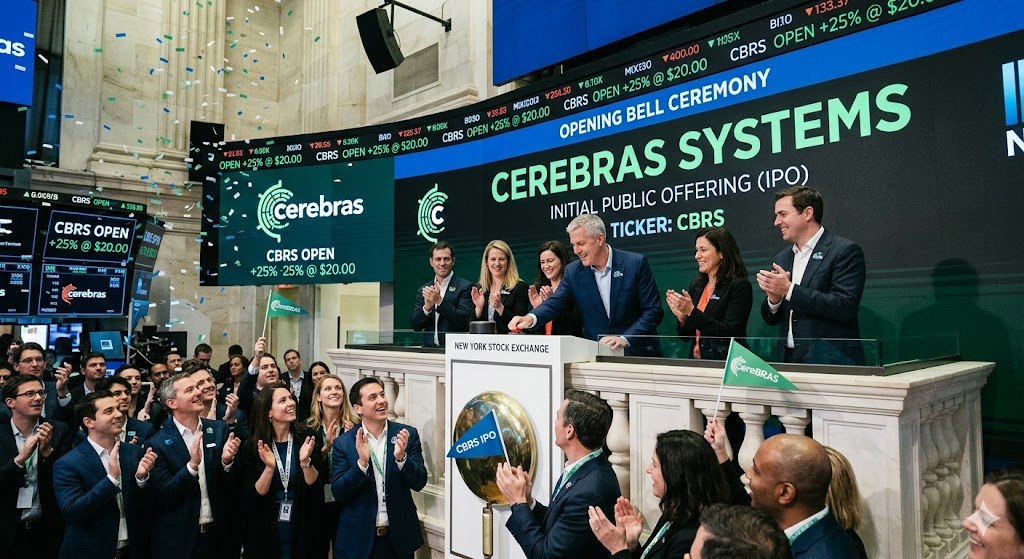
The opening print on Thursday came in at $350 — a 108% premium to the IPO price before a single retail trader had touched a buy button. Shares then ripped higher into the session, peaking at $386.34, which was enough volatility to trigger an automatic trading halt. The stock then drifted lower through the afternoon and closed at $311.07, a 68% gain over the IPO price but already 19% off the intraday high. On a fully diluted basis, that briefly put Cerebras' valuation over $100 billion. (TradingKey)
By Friday's close, CBRS was down another 10%+, settling near $280 — about 27% below where overnight champions had picked it up on the open print. (CNBC) Two trading sessions. Zero earnings reports. Nothing actually changed about the company. The only thing that changed was who was holding the bag.
The Trap That Catches Retail Every Single Time
Here's the part that gets glossed over in the breathless "Cerebras soars 68%" headlines. That 68% gain went almost entirely to institutional allocators — the funds, banks, and accredited investors who got shares at $185. By the time CBRS was tradeable on Robinhood, Fidelity, Schwab, or Webull, the opening print was $350. Retail's actual entry was at the top of a parabolic move that hadn't completed its first hour of price discovery. (CNBC)
This is not a Cerebras-specific phenomenon. It is the default behavior of every meaningfully hyped IPO since the dot-com era. The IPO price is set by the underwriters to nearly guarantee a "successful" debut — meaning it leaves intentional money on the table so the deal looks great in the press release. The market then prices in retail's enthusiasm at the open, which is where you, the day trader watching CNBC pop a champagne graphic over the trading floor, get involved. The institutional money sells into your buying. This is not a conspiracy theory; this is the explicit mechanical design of how IPOs work. (Related: Are Trading Gurus Really Rich From Trading)
What the Volatility Halt Actually Means
When CBRS hit $386, Nasdaq's Limit Up-Limit Down (LULD) circuit breakers kicked in and paused the stock. A trading halt is not a sign that something exciting is happening. It is the exchange's regulatory infrastructure announcing, in formal language, that price discovery has temporarily broken down. (Bloomberg)
For day traders, the post-halt reopen is one of the highest-variance moments in markets. The order book gets rebuilt from scratch, both sides reload, and the next print can be anywhere. Disciplined IPO traders sit out the reopen entirely. Undisciplined IPO traders — which describes most people clicking buttons during a viral debut — interpret the halt as confirmation that the stock is going higher and pile in. CBRS reopened, hit a slightly higher print, then began the slow grind down that anyone who has traded an IPO before could have called from across a room.
The Lockup Math That Nobody Is Pricing In
Day-one buyers are not just betting against gravity. They are also betting against a calendar. Cerebras' standard 180-day insider lockup expires around mid-November 2026, at which point CEO Andrew Feldman's stake (worth roughly $1.9 billion at the IPO price, considerably more at current levels) and CTO Sean Lie's roughly $1 billion position become eligible for sale. Insiders sitting on multi-bagger paper gains historically trim aggressively the moment they're legally allowed to. (Gotrade)
Translated to a chart: there is a structural supply overhang building between now and November that has nothing to do with chip demand, AI growth, or Nvidia competition. It exists purely because a wave of paper millionaires is about to be allowed to take some chips off the table. This is the kind of macro catalyst that fundamental analysts price into models and that day traders absolutely will not see coming until the chart starts doing the thing.
The Valuation Number That Should Have Stopped Everyone
At the Day 1 close of $311, CBRS traded at approximately 130x trailing sales. To put that in plainly humiliating context, Nvidia — the most valuable company in the world, fueled by a real and ongoing AI capex boom — trades around 25x sales. Cerebras' operating loss in 2025 was approximately $146 million on $510 million of revenue. The company is growing fast, yes, but it is also still losing money on its core operations and trades at five times Nvidia's multiple. (Motley Fool)
This is the part where the "but it's an AI play" crowd shows up in the comment section. Sure. So was every other AI IPO that went public at an absurd multiple and then spent the next 18 months grinding sideways or down while the underlying business "caught up" to the valuation. Sometimes the catch-up happens. Often it doesn't. Either way, paying 130x sales is not investing — it is buying a lottery ticket priced as if you've already won.
How a Disciplined Day Trader Would Have Played CBRS
The right play wasn't necessarily to short Cerebras (high-beta IPO shorts are how brokerages make their margin call coffee money), and it wasn't to long-buy and hold. The right play, for anyone whose edge isn't institutional allocation, was simpler:
| Approach | What it looked like for CBRS |
|---|---|
| Skip the open | Wait at least 30 minutes for the opening volatility to drain. Let the 108% pop happen without you in it. |
| Avoid the post-halt reopen | The post-halt 5-minute window is the highest-variance period of the entire session. Sit it out. |
| Define a setup, not a narrative | "AI is the future" is a thesis. "First red 5-minute candle after the open break of VWAP" is a setup. Trade setups, not theses. |
| Trail aggressively | If you are in a winning IPO trade, a tight trailing stop loss is mandatory. The unwind on these names is faster than you think. |
| Respect the 1:3 RR | If your stop has to be $20 wide to survive the noise, your target needs to be $60. If it's not, the trade is mathematically not worth taking. Risk-reward math here. |
None of this is exciting. None of it gets you on a YouTube thumbnail with a 🚀 emoji. All of it is what experienced IPO traders actually do.
The Broader Lesson Cerebras Will Teach Us Again in Six Months
The next wave of historic AI IPOs is reportedly already in the pipeline. Elon Musk's SpaceX (now merged with xAI) is preparing a share sale. OpenAI and Anthropic are both reportedly considering public offerings within the next 12 months. Every one of these will follow the same playbook: oversubscribed institutional allocation, gigantic opening premium, retail piling in at the top, halt, drift, post-lockup overhang. (CNBC)
The financial media will use the word "blockbuster" approximately 4,000 times. CNBC will play the bell-ringing footage in slow motion. Retail brokerages will rush to add the ticker the moment it's available. And someone — many someones — will buy the open print, watch the volatility halt, get excited, buy more, and then spend the next month telling themselves they're a "long-term holder" while the stock fades to the IPO price. Don't be that someone. The setup is the same every single time, which is what makes it so unbelievably tradeable for the people who refuse to chase it.


