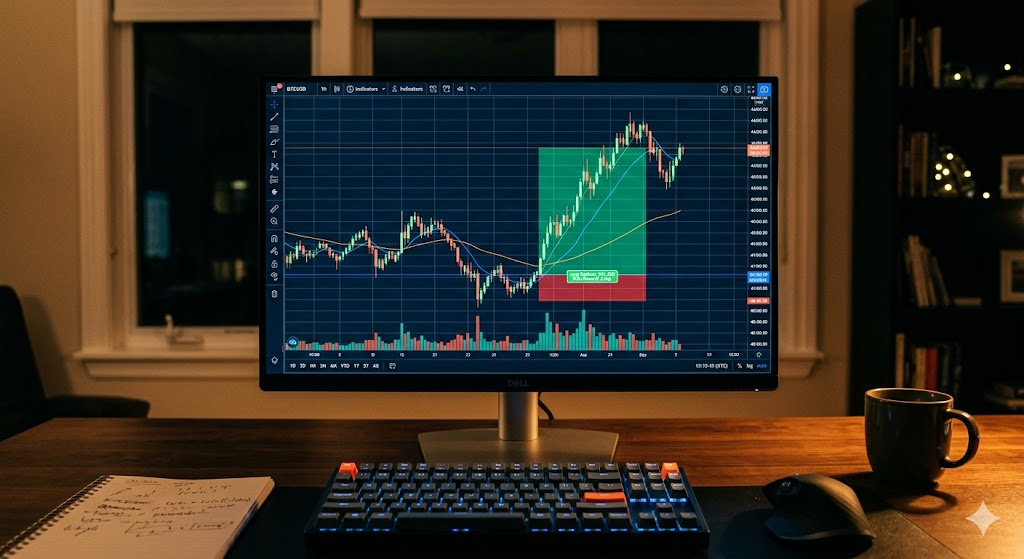
Risk vs Reward in Trading: Why a 1:3 RR Ratio Is the Difference Between Profit and a Blown Account
Every trader loves to brag about their win rate. "I'm right 70% of the time." Cool story. You're also probably broke. Because here's the dirty little secret nobody on Trading Twitter wants to admit: your win rate is borderline meaningless without a risk-to-reward ratio that actually works in your favor. The math doesn't care about your feelings, your gut instincts, or that one trade where you nailed the top tick. The math only cares about expectancy. And expectancy is built on one boring, unsexy concept: risk vs reward, a metric FBS calls the most important aspect of any trading routine.
What Is the Risk-to-Reward Ratio, Really?
The risk-to-reward ratio (RR) is the simplest concept in trading and somehow the most ignored. It measures how many dollars you stand to gain for every dollar you're willing to lose on a trade. If you risk $500 to make $1,500, that's a 1:3 RR. Risk one, make three. It is genuinely that simple, and yet most retail traders treat it like an inconvenient suggestion rather than the foundation of their entire P&L, as Alchemy Markets explains in their guide on risk-reward fundamentals.
For every $1 risked, you're targeting $3 in profit. That cushion is what lets you be wrong half the time and still win.
Do the Math: Why a 1:3 RR Is Non-Negotiable
Let's stop hand-waving and look at the actual numbers. You take 100 trades with a 50% win rate and a 1:3 RR. If I risk $500 to make $1,500, I would profit $50k over 100 trades taken. Read that again. Half your trades are losers. Half. And you still walk away with fifty grand. That's the entire point, and it's the same uncomfortable math Chart Guys uses to explain why expectancy beats accuracy every time.
| Scenario | Trades | Win Rate | Wins (×$1,500) | Losses (×$500) | Net Profit |
|---|---|---|---|---|---|
| 50% win rate @ 1:3 RR | 100 | 50% | +$75,000 | −$25,000 | +$50,000 |
| 60% win rate @ 1:3 RR | 100 | 60% | +$90,000 | −$20,000 | +$70,000 |
| 40% win rate @ 1:3 RR | 100 | 40% | +$60,000 | −$30,000 | +$30,000 |
| 70% win rate @ 1:1 RR | 100 | 70% | +$35,000 | −$15,000 | +$20,000 |
Now consider having a 60% win rate with the same RR. You're now sitting at $70k profit over 100 trades. A 10% bump in accuracy translates to a 40% increase in profit. That's the leverage you get from stacking a solid win rate on top of an already-favorable RR. And here's the kicker that should make every "high win rate" trader rethink their life: a trader hitting 40% with a 1:3 RR makes more money than the guy bragging about his 70% accuracy with 1:1 setups, a point backed by Chart Guys' expectancy breakdown of professional trader returns.
Why Most Retail Traders Get This Backwards
The retail trading world has a weird obsession with being "right." It feels good to win. It feels terrible to lose. So traders chase setups that close quickly with small profits because the dopamine hit of a green trade is more satisfying than the patience required to let a 1:3 winner develop. The problem? Chasing win rate improvement usually means trading more frequently and taking lower-quality setups just to pad the statistics, which increases costs and reduces edge, a trap Chart Guys identifies as one of the most common retail mistakes.
Then there's the opposite mistake: setting a beautiful 1:5 RR on paper but placing the stop so tight that normal market noise wipes you out before the trade even has a chance to breathe. A theoretical 1:5 setup that gets stopped out 85% of the time isn't a 1:5 setup. It's a slow bleed dressed up in nice math. Your stop location should be determined by market structure first; if that creates a poor ratio, find a better entry point or skip the trade entirely, as Chart Guys emphasizes when discussing stop placement discipline.
Expectancy: The Real Number That Matters
Professional traders don't look at win rate in isolation. They don't look at RR in isolation either. They look at expectancy, which is the combined output of both. Expectancy tells you, on average, how much you should expect to make per trade over a large sample size, a concept TradeDay calls the bridge between RR and win rate that most retail traders never cross.
The formula: Expectancy = (Win Rate × Avg Win) − (Loss Rate × Avg Loss)
Run our 50% win rate at 1:3 RR through it: (0.50 × $1,500) − (0.50 × $500) = $750 − $250 = +$500 expected profit per trade. Multiply by 100 trades and you get the $50,000 we calculated earlier. The math doesn't lie. The math also doesn't care that you "had a feeling" about that one trade, and Trade That Swing notes that most professional traders sit at or below a 60% win rate while still being highly profitable thanks to RR discipline.
The Psychology Problem (Because There's Always a Psychology Problem)
Here's where most traders blow up even when they understand the math: they can't sit through a string of losers. A 50% win rate sounds great in a spreadsheet. In real life, it means you can lose five trades in a row with statistical regularity. That's five losing tickets in your trading journal, five hits to your ego, and five moments where your brain screams at you to "adjust the strategy." Don't. The math only works if you actually take all 100 trades the way you planned. [More on this in our Trading Psychology section.]
Building a 1:3 RR Strategy That Actually Works
Slapping a 1:3 target on every trade and calling it a strategy is how accounts die. The ratio is a filter, not a magic spell. Here's how to build one that survives contact with the market:
1. Define Your Stop Based on Structure, Not Wishes
Your stop goes where the trade is invalidated, period. Below a swing low, above a swing high, beyond a key level. If structure forces a wider stop than your account can handle, that's not a sign to tighten the stop. It's a sign to reduce position size or pass on the trade, a rule Traders Mastermind reinforces in their day trading stop loss guide.
2. Target Locations That Justify the R-Multiple
Your 3R target needs to be at a logical destination, not just "3x my stop because the math says so." Look at the next significant resistance, the prior day's high, a measured move target, or a Fibonacci extension. If there's a major level sitting at 2R, you might need to take partial profit there and trail the rest.
3. Use a Trailing Stop to Capture Outliers
Sometimes the market gives you a 6R or 10R winner. A trailing stop loss lets you stay in those trades without having to babysit them, locking in profit as the move extends. This is also our whole brand around here, so it would be weird if we didn't mention it.
4. Track Everything
Your actual win rate and average RR can only be calculated from a real trading journal. Track every entry, every stop, every target, every actual exit price. Without data, you're not running a strategy. You're running a séance.
What Happens When You Ignore Risk-to-Reward
Let's flip the script. Trader A risks $500 to make $300 (a 1:0.6 RR, which is a lot of retail traders, sadly). Even at a 60% win rate, the math is bleak: (60 × $300) − (40 × $500) = $18,000 − $20,000 = −$2,000. Sixty percent accurate. Still losing money. TradeDay walks through this exact scenario to show why RR ratios viewed in isolation are equally misleading.
The Bottom Line
Understanding the math is important. It's the only thing that separates traders from gamblers. A 1:3 RR with a coin-flip win rate prints $50,000 over 100 trades. Bump that win rate to 60% and you're at $70,000. The framework is simple. The execution is the hard part. Most traders blow up not because they don't know the math, but because they can't stomach the variance long enough for the math to play out, a behavioral pattern Alchemy Markets identifies as the key separator between winning and losing traders.
So next time you're sizing up a trade and the reward is barely bigger than the risk, do yourself a favor: close the chart, walk away, and wait for the setup that actually pays you for being wrong half the time. Your future account balance will thank you.


