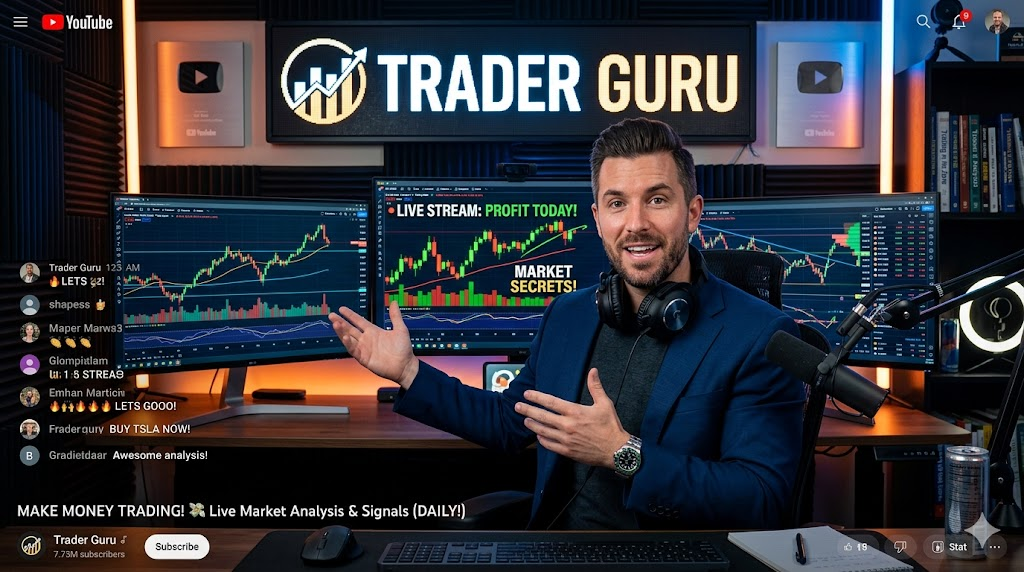
Are Trading Gurus Really Rich From Trading — Or Is the Course Money Paying for the Lambo?
We’ve all seen them. Trading gurus on YouTube, Instagram, or some other social media platform. But are they really making all this money from trading, or are their other income streams paying for their Lamborghinis?
01The Uncomfortable Truth About That Supercar in the Thumbnail
It’s a familiar tableau: a 26-year-old in a fitted t-shirt leans on a matte-black Lamborghini, swipes up to reveal a six-figure brokerage screenshot, and explains that you, too, can escape your soul-crushing job in 90 days for the modest one-time investment of $1,997. The pitch is so consistent across creators that you start to wonder whether they all studied at the same Khan Academy course called “How to Stand Next to a Rented Car.” Spoiler: a lot of them did, sort of — internet marketers and online “gurus” have a long tradition of posing in front of someone else’s Lamborghini or a private jet rented for the afternoon.
Source: Quora — The ugliest truths about trading gurus
Here’s the part the algorithm doesn’t serve you: while some social media trading personalities do have genuine market success, many of them profit far more from selling courses, memberships, and affiliate links than from their actual trading activities. The flashy lifestyle isn’t the result of the trading. The flashy lifestyle is the marketing budget for the trading course that’s selling you the result of the lifestyle. It’s an ouroboros wearing a Rolex.
Source: TrendSpider Learning Center — Social Media, Trading Gurus, and Unlicensed Financial Advisors
02The Math Is Brutal: Most Traders Lose Money
Before we talk about gurus, let’s talk about the field they claim to dominate. The academic literature on retail day trading is remarkably consistent across countries, decades, and methodologies, and it all says roughly the same thing. A landmark study by Barber and colleagues found that only about 3% of day traders make a profit, and once you account for fees, less than 1% can predictably and reliably earn meaningful returns. A separate study tracking nearly 20,000 day traders over 300 days found 97% lost money, with most quitting within 50 days. The authors concluded it is “virtually impossible for individuals to day trade for a living.” So when a 23-year-old tells you he cracked it on a Tuesday, the base rate is doing some heavy lifting on that claim.
Source: NewTrading — Is Day Trading Profitable? What Statistics Say
Even the older, more generous studies tell a similar story. A Financial Analysts Journal paper analyzing 324 U.S. day traders found about twice as many losers as winners, with only roughly one in five traders more than marginally profitable, and the average trader netting a loss of about $750 after transaction costs. To put that in perspective: if a trading guru ran his entire YouTube subscriber base through the actual statistical pipeline of day trading, the vast majority would end up worse off than if they’d done literally nothing. “Buy my course” sits awkwardly next to “the average outcome of doing this is losing money,” which is probably why you don’t see it on the thumbnails.
Source: Financial Analysts Journal — The Profitability of Day Traders
03So Where Does the Money Actually Come From?
If trading itself is a coin flip with negative expectancy for most people, how is the guru living like a minor sheikh? The answer is gloriously unsexy: he’s a content business with a trading-themed front-end. The real income streams are the same ones powering every other creator economy, just dressed in candlestick charts and a vest. Trader-influencer playbooks openly describe the menu: affiliate marketing for trading platforms and courses, premium content, paid subscriptions, signal services, and personalized coaching sessions. None of these require the guru to be a profitable trader. They require him to be a profitable marketer.
Source: BrightFunded — The Trader-Influencer Playbook
The affiliate side alone is staggering. Brokers happily pay influencers a piece of the action for every funded account they refer. Interactive Brokers’ influencer program advertises a growing monthly spend of $2 million and offers cost-per-click rates that scale with performance. Other broker affiliate programs offer up to $1,000 CPA per referred trader, with some programs paying as much as $800 CPA or per-lot rebates from major CFD brokers. So when your favorite YouTuber tells you which broker he “personally trusts,” you might consider that he also “personally trusts” the four-figure payout he gets when you sign up.
Sources: Interactive Brokers Influencer Program · Olavivo — Top 20 Trading Affiliate Programs
Crypto exchanges are even more aggressive about handing out money. Binance’s affiliate program pays up to 50% of every qualified trade and dangles potential bonuses of up to $72,000 per month based on referral trading activity. That isn’t pocket change. That is a salary. A guru who never wins a single trade, but funnels a few thousand viewers into a crypto exchange, can comfortably out-earn the actual profitable traders in his own audience. The business model isn’t “teach trading.” The business model is “produce a steady stream of traders for someone else to monetize.”
Source: Creator Hero — Best US Investing Influencer Affiliate Programs
| Income Stream | How It Works | Depends on Actually Trading Well? |
|---|---|---|
| Courses & Mentorship | One-time or installment fees, often $500–$5,000+ | No |
| Discord / Signal Subscriptions | Recurring $50–$300/month per member | No |
| Broker Affiliate (CPA) | Up to $1,000 per funded referral | No |
| Crypto Exchange Referrals | Up to 50% of trading fees from referrals; bonuses up to $72k/mo | No |
| YouTube Ad Revenue & Sponsorships | Per-thousand-view payouts plus brand deals | No |
| Books, Merch, Conferences | Front and back-of-funnel products | No |
| Actual Trading Profits | The market giveth, the market taketh away | Yes — and statistically unlikely |
There’s also a quieter incentive structure that tilts the whole industry. As one trader put it bluntly, the business model rewards training, subscriptions, signal services, and higher-ticket coaching — not necessarily ensuring you become a consistently profitable trader, with revenue often dependent on churn and continual selling rather than student outcomes. Translation: a guru is financially better off if you stay confused for a long time than if you actually master trading and unsubscribe. The incentives are doing exactly what incentives do.
Source: Quora — The ugliest truths about trading gurus
04Receipts: When the Regulators Showed Up
This isn’t just internet skepticism. Regulators have repeatedly walked into the guru economy with subpoenas. In one of the more spectacular cases, the SEC charged eight individuals in a $100 million stock manipulation scheme run through Twitter and Discord, in which seven of the defendants promoted themselves as successful traders, cultivated hundreds of thousands of followers, and then quietly dumped their shares onto the very followers they were pumping the stocks to. The eighth defendant ran a podcast that promoted the others as expert traders. The actual product wasn’t trading skill. It was an audience to sell into.
Then there’s the case of RagingBull.com’s Kyle Dennis, pitched as a stock trading “guru.” The Federal Trade Commission alleged he made numerous false claims in online videos and seminars, deceiving consumers out of more than $40 million, and ultimately faced a permanent injunction blocking him from making further false earnings claims. RagingBull.com and its owners separately agreed to pay $2.425 million to settle. The pattern, when regulators bother to dig, is depressingly repeatable: bold income claims, polished marketing, lousy actual outcomes for the customer.
Source: FTC Press Release — RagingBull.com Stock Trading “Guru” Kyle Dennis Faces Permanent Injunction
The newer wrinkle is the AI-flavored version. In December 2025, the SEC charged three purported crypto trading platforms and four investment “clubs” in a scheme that allegedly defrauded U.S. retail investors of more than $14 million by using social media ads, sometimes featuring deepfake videos of well-known financial professionals, to lure people into WhatsApp groups led by fake “professors” pushing supposedly AI-generated trade signals. No actual trading took place. The platforms were fake. The professors weren’t professors. The signals were vibes. The Lamborghinis, presumably, were real.
Source: SEC Press Release — SEC Charges Crypto Platforms and Investment Clubs in $14M Scheme
The SEC’s Office of Investor Education and Advocacy has bluntly warned: “Fraudsters often use social media to scam investors… never make investment decisions based solely on information from social media platforms or apps.”
05Red Flags: How to Spot a Guru Whose Real Skill Is Marketing
Once you understand the business model, the marketing tics become hilariously visible. Many trading personalities on social media follow a near-identical playbook that researchers have catalogued in some detail. Common warning signs include guarantees of “risk-free” or extreme returns, missing proof of trading success, vague answers to specific strategy questions, and heavy course promotion — with the FTC noting that only scammers promise over-the-top profits. If you find yourself watching a video where the guru can’t answer a basic question about position sizing but absolutely can answer how to get to the checkout page, the asymmetry is your answer.
Source: For Traders — Should You Trust YouTube Trading Gurus?
- Guaranteed returns. Anyone using the word “guaranteed” in the same sentence as “market returns” is either lying or working for someone who is.
- No audited track record. Screenshots are not a track record. A track record is a continuous, third-party-custodian statement covering all trades, including the bad ones.
- Cherry-picked wins. A 90% win rate is meaningless without knowing the risk-to-reward ratio. You can have a 90% win rate and a negative expectancy.
- The lifestyle is the proof. A rented Lambo, a stock-photo private jet, and a Miami penthouse are evidence of someone’s budget, not their skill.
- Aggressive course funnels. “Free webinar” → $97 starter course → $1,997 mastermind → $9,997 inner circle. It’s a ladder, and you’re the rung.
- Unverifiable credentials. Most are not licensed financial advisors and are not bound by the fiduciary or ethical standards that bind real registered advisors.
- Vague “proprietary” strategies. The “secret indicator” is usually a re-skinned standard tool you can find on TradingView for free.
Even when the trading is real, replicating it is usually impossible. As one trader noted, some gurus are genuinely good scalpers whose decisions happen so fast they themselves can’t always explain why they exited a trade when they did — instinct that cannot be taught no matter how many thousands of people pay to try to replicate it. So even the legitimate ones are often selling something that can’t actually be transferred. Which raises the question of what, exactly, you’re paying for. (Hint: a video of someone else’s instincts.)
Source: Quora — The ugliest truths about trading gurus
06How to Protect Yourself Without Becoming a Cynic
None of this means you can’t learn anything from trading content online. Some of it is excellent. The discipline is just to treat trading content the way you’d treat a stranger handing you stock tips in a parking lot — politely, with skepticism, and definitely before you wire anyone money. The regulators recommend a simple set of moves: verify credentials through FINRA’s BrokerCheck and SEC databases, test any strategy in a paper trading simulator before risking real money, and check claims against independent sources like the SEC’s EDGAR database rather than the guru’s own marketing.
Source: For Traders — Should You Trust YouTube Trading Gurus?
The SEC’s Office of Investor Education is even more direct: be wary of any group chat where you receive investment advice from someone you don’t know, and never rely solely on information from group chats or social media to make investment decisions. If the next bit of life-changing investment advice has to come through a WhatsApp group invited by a stranger, the “life change” is going to be the bad kind. The regulators have seen this movie. They know how it ends.
Source: Investor.gov — Group Chats as a Gateway to Investment Scams
Are trading gurus really making all their money from trading? For the vast majority of them, the honest answer is no. The Lamborghini is being paid for by you — your course fee, your subscription, your broker signup, your clicks, your attention. The market isn’t making them rich. You are. Once you see the business model clearly, the thumbnails get a lot less impressive.
Real trading is hard, statistically miserable, and almost entirely unglamorous. It doesn’t fit in a 60-second Reel. It doesn’t look good next to a supercar. And it definitely doesn’t scale into a high-margin online business taught in twelve modules with a money-back guarantee. The next time a guru leans on a Lambo and offers to teach you the “one weird trick” the banks don’t want you to know, just remember: the banks are fine. He needs you to click.


