The $100,000 Fast Lane: Trump Media’s Truth API and the Two-Tier Market for Presidential Posts
Market StructureHere’s a sentence that would have sounded insane a decade ago and is merely Thursday now: the fastest access to a sitting president’s social media posts is being sold to hedge funds for up to $100,000 a month. Trump Media & Technology Group launched a licensed data feed called Truth API, and according to reporting from the Financial Times and Reuters, it has pitched trading firms a six-figure monthly subscription — with a discount to around $60,000 a month for anyone signing a three-year deal. If you trade index futures and you’ve ever been run over by a headline you didn’t see coming, this story is about you. CNBC
What was actually announced
TMTG unveiled Truth API as a paid, licensed data feed giving banks and trading firms the fastest access to posts from the ten most influential accounts on Truth Social. It runs around the clock, includes an archive of posts going back to 2022, and represents the company’s first move into data licensing — a new revenue line for a business that has struggled to scale its media operation against far larger competitors. TMTG says it has already signed customers. The company did not publish pricing, which is where the reporting comes in: the FT first reported the $100,000 figure, and Reuters subsequently confirmed both it and the discounted three-year rate through people familiar with the discussions. Hedgeweek
For context on why anyone would pay that: Donald Trump has roughly 12.9 million followers on the platform and has repeatedly used it to break news that moves markets before any official channel does. On April 9, 2025, US indexes ripped higher after he posted that he would pause many of his new tariffs for 90 days — the S&P 500 closed up around 9.5%, one of the largest single-day gains in its history, and he had posted that it was a good time to buy shortly beforehand. More recently, a post describing productive conversations with Iran, after hostilities had broken out, sent oil prices sharply lower. That is not “social media sentiment.” That is monetary and geopolitical policy, published to a consumer app, at a time of the author’s choosing. Hedgeweek
Why traders care about milliseconds
If you’ve never worked on a low-latency desk, the pricing looks absurd. Inside that world it’s ordinary arithmetic. Sources cited by Reuters framed it plainly: for high-frequency firms, a speed advantage of a few milliseconds can translate into hundreds of thousands of dollars on large trades. At $100,000 a month, the feed pays for itself if it improves the fill on one significant tariff headline a quarter. Firms already buy colocation, microwave links between Chicago and New Jersey, and licensed feeds from other platforms — X sells algorithmic-trading data feeds through terminals and market-data vendors today. Truth API isn’t inventing a category. It’s adding an unusually consequential publisher to an existing one. CNBC
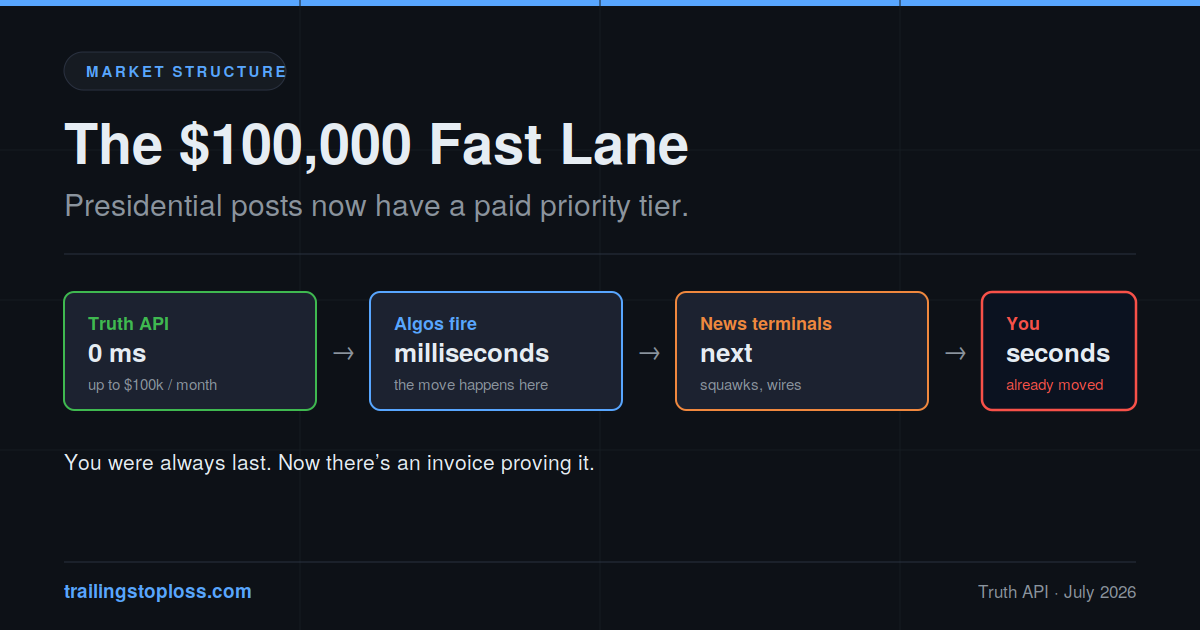
You were always last. Now there’s an invoice proving it.
Retail traders have never been first to a headline, and pretending otherwise has been an expensive fantasy for a long time. What changes here is that the gap is now an explicitly priced product tier rather than an accident of infrastructure. When the next tariff post drops, the sequence is fixed: subscribers get it at the source, algorithms react inside milliseconds, standard terminals and squawks carry it next, and your phone buzzes after the candle has already printed. Trying to trade the release itself is not a strategy — it’s donating liquidity to someone with a $100,000 monthly line item and a colocated server. The practical response isn’t to get faster. It’s to stop competing on speed entirely: size down into known event windows, avoid holding through unscheduled political risk, and let the first impulse resolve before you engage. Our true cost work makes the same point about fees — the edge you can’t win, you avoid paying for.
The criticism, and the counterarguments
The announcement drew immediate objections from Democratic lawmakers. Senator Ron Wyden of Oregon, the ranking Democrat on the Senate Finance Committee, said the arrangement would financially benefit the Trump family and enrich Wall Street traders. Senator Elizabeth Warren, the top Democrat on the Senate Banking Committee, called it “an egregious scheme to profit off the presidency.” Donald Sherman, president of the nonpartisan watchdog group Citizens for Responsibility and Ethics in Washington, described the arrangement as wildly unethical. The core objection across all three is structural rather than partisan: the same person generates the market-moving information and, through his ownership stake, benefits when access to it is sold. ARY News
Follow the incentive, not the personality
Set aside what you think of the man and look only at the machine, because the structure is worth stating plainly. A subscription to Truth API is worth precisely as much as the posts are market-moving. A feed carrying nothing but commentary is worth nothing to a trading desk; a feed carrying unscheduled tariff decisions, rate-policy commentary, and geopolitical announcements is worth six figures a month. The content that determines the product’s value is not entertainment — it’s official policy news, generated by the sitting president, published at a time and in a manner he alone controls. And the revenue flows to a company in which he holds a substantial stake, through a trust of which he is the beneficiary, even with day-to-day oversight in his children’s hands. Investing.com
Put those pieces next to each other and you get an arrangement with no real precedent in American markets: the more consequential and unexpected the policy announcement, the more valuable the subscription that delivers it first. That is a description of an incentive structure, not an accusation of one — no law is alleged to have been broken, and TMTG is entitled to license its data like any other publisher. But traders are professional readers of incentives, and it’s worth noticing that this one points in a direction that has nothing to do with orderly markets or equal access to material information. Draw your own conclusions; we’d rather hand you the mechanism than the verdict. ARY News
The counterarguments
The other side of the ledger deserves equal space. Selling low-latency data feeds is a completely normal business — X does it, exchanges do it, and news wires have monetized speed tiers for decades; nobody calls Bloomberg unethical for charging for a terminal. TMTG is a public company with a legitimate need for revenue, and its shares are down roughly 27% this year, closing around $9.66 with a market capitalization near $2.7 billion. The posts themselves remain free and public to anyone with the app; what’s being sold is delivery speed and a licensed, machine-readable format, not exclusive content. The White House has said the president’s business empire is overseen by his children, though he remains the beneficiary of income flowing into his trust. The White House referred questions to TMTG, which did not immediately respond to requests for comment. Investing.com
| The concern | The counterargument |
|---|---|
| The information source benefits financially from selling access to it | Posts stay free and public; only speed and format are licensed |
| Creates a paywalled tier on market-moving policy news | Speed tiers already exist across exchanges, wires, and X |
| Widens the gap between institutional and retail traders | That gap predates this product by decades |
| Ethics watchdogs call the structure improper | TMTG is a public company pursuing a normal revenue line |
The bottom line
Strip out the politics and a plain market-structure fact remains: a recurring source of unscheduled, high-impact policy news now has an official fast lane, and the toll is up to $100,000 a month. Whatever you think of the ethics — and reasonable people are loudly disagreeing about them right now — the trading implication doesn’t change. Presidential posts belong in the same mental bucket as an unscheduled FOMC leak: an event you position around, never one you try to react to. You are not going to outrun a colocated algorithm reading a licensed feed, and any strategy premised on doing so is a fee you pay to firms that can. Manage exposure into political risk, keep size honest, and let someone else pay six figures a month to be three milliseconds early.
Frequently asked questions
What is Truth API?
Truth API is a paid, licensed data feed launched by Trump Media & Technology Group that gives banks and trading firms the fastest access to posts from the ten most influential Truth Social accounts. It operates 24/7 and includes an archive of posts dating back to 2022. It is TMTG’s first move into data licensing.
How much does Truth API cost?
TMTG has not published official pricing. The Financial Times reported, and Reuters corroborated through sources familiar with the discussions, that the company pitched trading firms as much as $100,000 per month, with a discounted rate of around $60,000 per month for firms signing a three-year agreement.
Why would a trading firm pay that much for social media posts?
Because presidential posts have repeatedly moved markets before official channels. Sources cited in the reporting noted that a speed advantage of a few milliseconds can be worth hundreds of thousands of dollars on large trades, so a faster feed can pay for itself on a single major headline.
Does this disadvantage retail traders?
It formalizes a disadvantage that already existed. Retail traders have never been first to market-moving headlines, but Truth API makes the priority tier an explicitly priced product. The practical takeaway is to position around political risk rather than attempting to trade the instant reaction.
Is selling a fast data feed unusual?
No. Exchanges, news wires, and social platforms including X already license low-latency data feeds to algorithmic traders. The controversy here is specific to the source being a sitting president whose family benefits from the revenue, not to data licensing as a practice.
Sources: CNBC, Reuters, and Financial Times reporting on the Truth API launch and pitched pricing; Hedgeweek and Investing.com on market impact and TMTG financials; ARY News on watchdog reaction. Pricing figures are attributed to anonymous sources; TMTG has not confirmed them publicly.


