▸ Trading Psychology · Prop Firms
The Psychology of the Trailing Drawdown
Every funded trader knows the number. Not the balance — the other number, the one underneath, the distance to the floor. It sits in your peripheral vision on every trade, it’s the first thing you check in the morning, and it quietly decides things you think you’re deciding yourself: when you take profit, how long you hold, whether you press a good position. The trailing drawdown isn’t just a risk rule. It’s a psychological operating system, and if you don’t understand what it’s doing to your behavior, it will make you a worse trader while you’re busy following it.
The asymmetry that defines everything
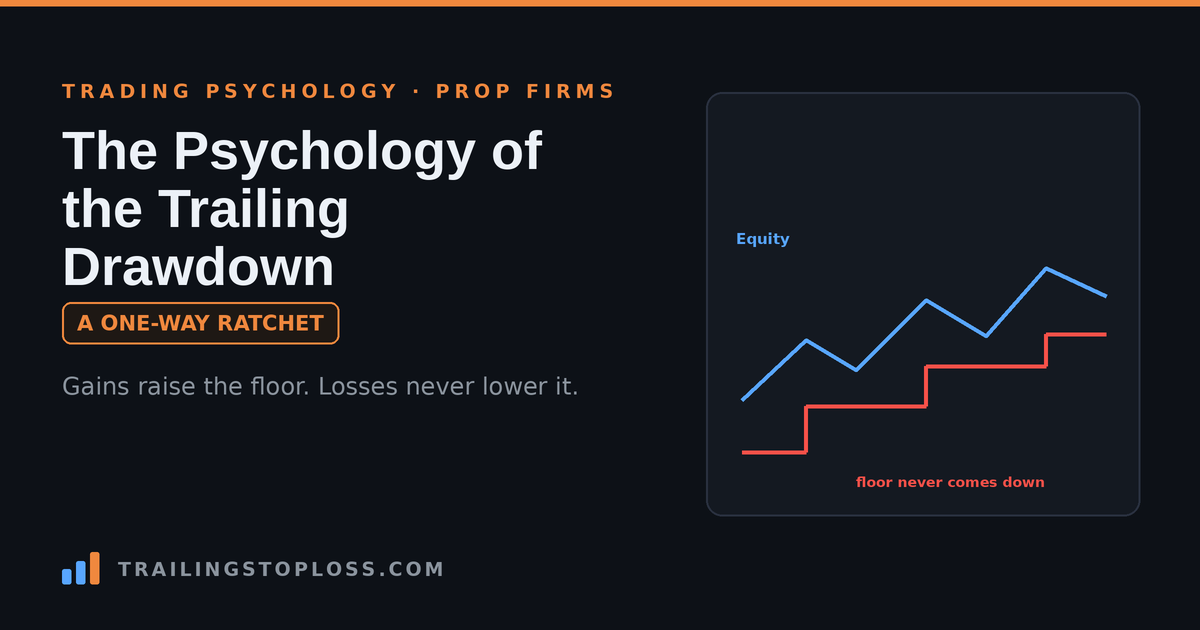
Mechanically, it’s simple: your floor follows your high-water mark. On a $50,000 account with a $2,000 trailing drawdown, the stop-out starts at $48,000. Climb to $51,000 and the floor trails up to $49,000 — and you can now never fall back to $48,000 without breaching. Profit gets locked into the threshold whether you want it there or not. (DayTradingz: profit gets locked into the threshold)
Now the part that matters psychologically. Gains raise the floor permanently. Losses never lower it. That asymmetry means you can finish a day profitable and still have less headroom than you started with. Your buffer is not a renewable resource — it’s a one-way ratchet, and every new peak you print spends a little of it forever. Most of the traders this rule catches never fully understood that before they violated it. (TradeZella: headroom is non-renewable)
Intraday trailing: when your best trade becomes your enemy
The harshest version tracks your peak in real time, counting unrealized profit on open positions. A trade that runs to +$1,500 before you close it at +$400 still lifts the floor by the full $1,500 — because the threshold moved the instant the high printed. You banked $400 in realized profit and spent $1,500 of drawdown room to do it. (DayTradingz: the open-trade high ratchets the floor)
Play that forward and you get the scenario every funded trader dreads. You’re up $5,000 in a trade. It pulls back $2,000. You close the day up $3,000 — a great day by any normal standard. With a $2,000 intraday trailing drawdown, your account is gone. Same trade, same plan, and under an end-of-day rule you’d finish +$3,000 and still be chasing your target. One rule lets you win; the other takes you out. (Topstep: same trade, different outcome)
⚠ The EOD misunderstanding that kills accountsTraders on end-of-day accounts routinely assume they can dip below the current floor intraday and recover before the close. Wrong. The floor moves only at end of day — but it is enforced in real time, always. Touch it for one second at 10:14am and the account closes immediately, regardless of where you’d have finished. EOD governs when the line rises, never when it bites.
What the rule does to your head
Here’s the thesis of this whole piece, and it’s the part almost nobody says out loud: the trailing drawdown manufactures the exact psychological pathologies that destroy traders. It doesn’t merely test your discipline — it actively trains bad habits, and it pays you for them in the short run.
Start with the big one. Under intraday trailing, every dollar of unrealized profit shrinks your remaining buffer the moment it prints. So the rational response — the one the rule rewards — is to grab profit near the peak and get flat. Which means the rule encourages premature profit-taking, converting an open winner into a closed one before it can ratchet your floor any higher. Read that again: the firm’s risk rule is teaching you to cut your winners short. (Tradeify: it encourages premature profit-taking)
Cutting winners short is the disposition effect — the single most reliable way to invert your risk-reward and destroy your expectancy. You spend months trying to unlearn it, and then a funded account pays you to do it on purpose. That’s the cruel joke at the center of prop trading: the rule designed to protect the firm’s capital quietly corrodes the exact behavior that made you profitable enough to get funded.
It doesn’t stop there. The other documented effects: hypervigilance (you’re managing a live threshold, not a chart — and if you’re not watching it, you’re literally guessing where your account can be failed); loss-triggered revenge trading, because watching your buffer shrink after a loss produces the visceral urge to win it back right now; and a systematic bias against exactly the strategies that need room — trend-following, letting winners run, wider stops — because all of them are punished by a floor that counts every peak. (Tradeify: revenge trading and the shrinking buffer)
Know which version you’re actually trading
The single most consequential thing you can know before funding an account — more important than the price, the account size, or the split. (PropTradingVibes: know your type before your first trade)
| Type | How the floor moves | The trap | Difficulty |
|---|---|---|---|
| Intraday trailing | Real time, off every equity peak — including unrealized profit on open trades. | A winner that round-trips spends buffer you never banked. You can fail while green. | Hardest |
| End-of-day trailing | Once per day, off the highest closing balance. Intraday spikes are ignored. | Still enforced in real time — touching the current floor mid-session ends the account. | Moderate |
| Static | Never. Fixed below your starting balance for the life of the account. | Usually a tighter dollar amount, since the firm carries more fixed risk. | Most forgiving |
And know the milestone that changes your life: the floor lock. At most firms, the trailing stops once the floor reaches your starting balance — from that point it’s effectively static, and every further dollar of profit is a genuine cushion rather than a tightening noose. That moment is the most important checkpoint in a funded account, and it should reshape how you trade the instant it happens. (PropTradingVibes: the drawdown floor lock)
How to trade around it without letting it rewire you
You can’t argue with the rule. You can build a process that satisfies it without adopting the habits it’s trying to teach you. (The5ers: treat firm limits as a line you never approach)
- Pick the rule before you pick the firm. If you let winners run on NQ or ES, an intraday trailing account is structurally hostile to your edge — no discount makes up for it. Choose EOD or static, and compare drawdown type before price on our true-cost hub.
- Know your live floor before every session. Current balance, current floor, exact dollars of headroom, and whether the floor moves on ticks or on closes. Platform dashboards are frequently wrong — calculate it yourself and keep it written down.
- Set your personal floor well above theirs. Treat the firm’s number as a cliff you never approach, not a budget you’re entitled to spend. A personal stop at roughly half the firm’s limit means routine volatility can never force the breach.
- Match your exit style to the rule — deliberately, not fearfully. On intraday trailing, scale out into strength as a planned tactic (take partial at target, trail the rest) rather than as a panic response. On EOD or static, let the winner run as your plan intended. Same trade, different rule, different correct answer.
- Guard the lock. Before the floor locks, protect headroom like the finite resource it is — smaller size, cleaner setups. After it locks, you can breathe. Most traders trade identically on both sides of that line, which is backwards.
- Never let the number make the decision. If you’re exiting a valid trade purely because the buffer feels tight, the rule is trading your account, not you. That’s the moment to cut size so the buffer stops dictating your exits — not to keep taking good setups and mismanaging them.
🧠 The reframeThe drawdown isn’t your opponent and it isn’t your risk manager — it’s the terrain. Your job is to pick terrain that suits your game (EOD or static if you let winners run), then size small enough that the terrain never gets a vote on your exits. The trader who loses to a trailing drawdown usually didn’t misread the market. They let a number they’d agreed to make decisions they hadn’t.
The bottom line
The trailing drawdown ends more funded accounts than bad trades do — not because it’s unfair, but because it’s misunderstood, and because it teaches you things you spent years trying to unlearn. Gains raise the floor forever, losses never lower it, and under intraday trailing your best unrealized moment is charged to you in full whether you bank it or not. Understand the version you’re on, size so the floor never gets a vote, protect your headroom until it locks, and take profit because your plan said so — not because a number underneath your equity got too close to the line.
Compare drawdown types firm-by-firm on the True Cost hub and the comparison tool — the rule matters more than the price. Part of our trading psychology guide; see also why most traders fail the evaluation, where drawdown breaches cause ~70% of failures.
FAQ
What is a trailing drawdown in prop trading?
It’s a maximum loss limit that follows your account’s high-water mark upward. On a $50,000 account with a $2,000 trailing drawdown, the floor starts at $48,000; if you reach $51,000, the floor trails to $49,000. The critical asymmetry is that gains raise the floor permanently while losses never lower it — so your headroom is a non-renewable resource.
What’s the difference between intraday and end-of-day trailing drawdown?
Intraday trailing updates in real time off every equity peak, including unrealized profit on open trades — a position that runs to +$1,500 before you close it at +$400 still lifts the floor by $1,500. End-of-day trailing updates once daily off your highest closing balance, so intraday spikes don’t count. EOD is substantially more forgiving; static (a fixed floor) is the most forgiving of all.
Can I dip below my drawdown level intraday on an EOD account and recover?
No — and this misunderstanding kills accounts. On an EOD account the floor only moves at the close, but it is enforced in real time. If your equity touches the current floor at any point during the session, the account closes immediately regardless of where you would have finished the day.
Why does the trailing drawdown make me cut my winners short?
Because under intraday trailing, every dollar of unrealized profit immediately shrinks your remaining buffer — so the rule literally rewards you for banking profit near the peak before it can ratchet your floor higher. That’s the disposition effect, the habit that inverts risk-reward and destroys expectancy, being trained into you by the firm’s risk rule. It’s why matching your drawdown type to your trading style matters more than the price of the challenge.
What is the drawdown floor lock?
At most firms, the trailing drawdown stops trailing once the floor reaches your starting account balance — after that it behaves like a static drawdown, and further profit becomes a genuine cushion instead of a tightening threshold. It’s the most important milestone in a funded account: before the lock, protect headroom aggressively; after it, you finally have room to breathe.
TrailingStopLoss publishes independent, funded-trader analysis of prop firms, strategy, and trading psychology. Drawdown rules vary by firm and change frequently — always verify the current rules with your specific firm before trading. Educational content only, not financial advice. Trading futures involves substantial risk of loss.


