Thursday, June 4, 2026 — Pre-Market Briefing
Welcome to Thursday, where the AI trade decided to take a personal day. Broadcom dropped a revenue miss on a market that has been priced for perfection since roughly the dawn of time, chip stocks are getting sold like they owe somebody money, and the Nasdaq is wearing it. Meanwhile, oil is flirting with $100 again because the Middle East "ceasefire" continues to feature a suspicious amount of fire. Strap in.
Futures: NQ Takes the Punch, Dow Ducks
Index futures are split this morning, and not in a subtle way. S&P 500 futures are down about 0.4%, Nasdaq 100 futures are off roughly 1.1%, and Dow futures are up around 226 points as traders rotate away from anything with the word "semiconductor" in its 10-K. The culprit: Broadcom shares cratered 13% pre-market after a fiscal Q2 revenue miss, CrowdStrike slid 10% on soft guidance, and the VanEck Semiconductor ETF lost more than 3% before the bell with Arm, Micron, and Marvell each down about 6%. CNBC
For NQ scalpers, this is the kind of morning where the open can be fast, sloppy, and emotionally educational. Heavy gap-down opens driven by single-stock earnings tend to produce violent two-way rotations in the first 30 minutes — exactly the environment where chasing the first move gets expensive. If you have a habit of revenge trading after a stopped-out first attempt, today is a good day to re-read our trading psychology archive before the bell instead of after the damage.
Equities: The Record Streak Hits a Wall
Wednesday's cash session ended the party. The Dow dropped 532 points (1.04%) to close at 50,776, the S&P 500 lost 0.74%, and the Nasdaq Composite fell 0.89%, with six of eleven S&P sectors closing red — led, naturally, by the technology and financials names that had been dragging the indexes to records all spring. The pullback came as fresh exchanges of strikes between the U.S. and Iran undermined peace-deal hopes and rekindled inflation and rate worries. Trading Economics
Asia followed Wall Street lower overnight, with South Korea's Kospi sinking 1.84% as elevated oil prices stoked energy-cost and inflation fears across the region. On the calendar today: Ciena reports before the open, Samsara after the close, and both Netflix and Walmart hold annual meetings — none of which will matter even slightly if a missile headline crosses the tape at 10 AM. CNBC
The War: A Ceasefire in Name Only
The U.S.–Iran conflict remains the market's background radiation, and this week it got louder. Iranian drones struck Kuwait's airport and killed one person on Wednesday as the on-again, off-again ceasefire was tested yet again, and the Republican-led House approved a war powers resolution seeking to limit President Trump's ability to continue military operations against Iran — a rare rebuke from within his own party. Britannica
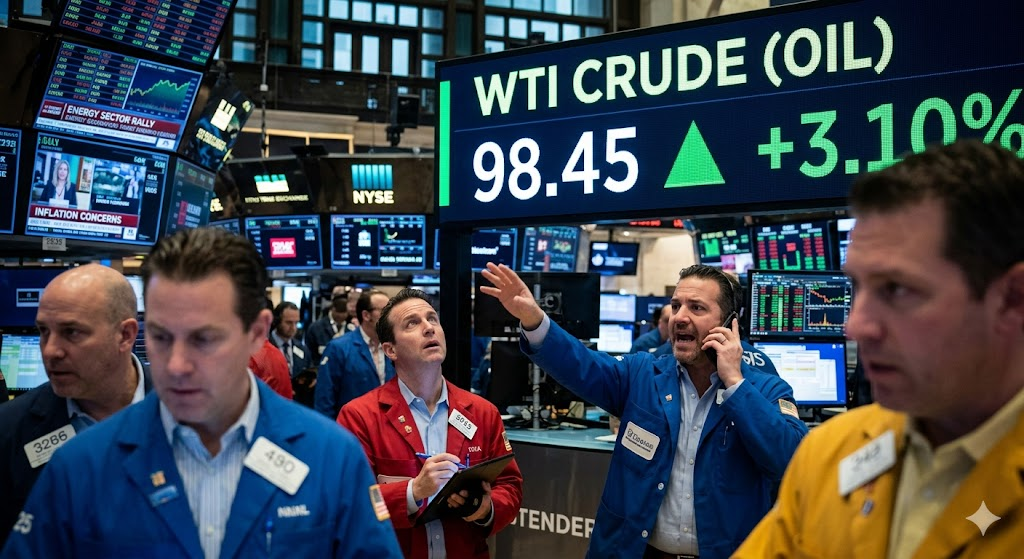
The oil market is where the war math gets done. Brent is hovering near $97 after Trump claimed Iran agreed not to pursue a nuclear weapon and floated a possible meeting with Supreme Leader Khamenei — comments that landed roughly 24 hours after U.S. forces struck Qeshm Island and Iran launched missiles toward neighboring countries. Strait of Hormuz traffic remains well below pre-conflict levels, though some vessels are now moving in coordination with the U.S. military. Add a 7.97-million-barrel crude inventory draw — the sixth consecutive weekly decline, with stockpiles approaching minimum operating levels — and you have a market that simply cannot price out supply risk. Trading Economics
Crypto: Bitcoin's June Diet Continues
Crypto is having the kind of month that makes laser-eye profile pictures quietly disappear. Bitcoin opened Wednesday at $66,667, down 6.5% from Tuesday, after sliding below $66,000 earlier in the week — leaving BTC down roughly 11% in June and more than 50% below its October 2025 all-time high near $126,200. Ethereum opened below $2,000 and traded into the $1,850–$1,880 zone, revisiting its February lows. Yahoo Finance
The drivers are the same ones strangling every risk asset: sticky inflation, a Fed that has priced out 2026 rate cuts, renewed dollar strength, and ETF outflows. Citi added a cheerful note that the bigger problem isn't Strategy's bitcoin sale rattling markets — it's the absence of demand from new buyers entirely. Ether's slide has pushed Bitmine's Ethereum treasury bet toward a $9 billion loss. Ouch. CoinDesk
Metals: Gold Slips, Silver Holds the Line
Gold fell 1.11% Wednesday to around $4,440 per ounce, dipping below $4,500 and edging toward last week's March-low retest as markets brace for central banks staying higher for longer. The metal is still up roughly 32% year-over-year, but it's well off the January peak — nearby futures printed a record $5,586 earlier this year before the air came out. Silver sits near $74 with futures around $73.65, supported by industrial demand even as the hawkish-Fed narrative caps the upside. Platinum trades near $1,884 and palladium around $1,338. Trading Economics
The setup for metals is genuinely conflicted: a shooting war near one-fifth of global oil supply argues for safe-haven bids, while hot labor data and rate-hike chatter argue for a stronger dollar and weaker gold. Until one of those forces blinks, expect chop. CBS News
Pre-Market Scoreboard
| Asset | Level (approx.) | Direction | Driver |
|---|---|---|---|
| S&P 500 futures (ES) | — | ▼ 0.4% | Chip selloff, Iran risk |
| Nasdaq 100 futures (NQ) | — | ▼ 1.1% | Broadcom −13%, CrowdStrike −10% |
| Dow futures (YM) | +226 pts | ▲ 0.4% | Rotation out of tech |
| WTI crude (CL) | ~$95 | ▲ | 6th straight inventory draw, war premium |
| Brent crude | ~$97 | ▲ | Hormuz disruption, ceasefire doubts |
| Gold (GC) | ~$4,440 | ▼ 1.1% | Hawkish Fed repricing |
| Silver (SI) | ~$74 | ◆ Flat | Industrial demand floor |
| Bitcoin | ~$66–67K | ▼ | ETF outflows, no new buyers |
| Ethereum | ~$1,880 | ▼ | February lows revisited |
| 10-yr Treasury yield | ~4.45% | ◆ Elevated | Cuts priced out for 2026 |
This Week's High-Impact Releases
The main event is tomorrow. The Bureau of Labor Statistics releases the May Employment Situation report Friday, June 5 at 8:30 AM ET — and with recent ADP and JOLTS data pointing to accelerating job growth, a hot print would pour gasoline on the "Fed hikes before it cuts" trade. BLS
| Day | Time (ET) | Release | Why It Matters |
|---|---|---|---|
| Thursday, June 4 | 8:30 AM | Initial Jobless Claims | Weekly labor pulse ahead of NFP; low claims = hawkish fuel |
| Thursday, June 4 | Pre-open / after close | Ciena / Samsara earnings | Tech sentiment check after Broadcom's faceplant |
| Friday, June 5 | 8:30 AM | May Jobs Report (NFP) | The week's main event — sets the tone for Fed expectations under Warsh |
Markets spent the week watching Fed speakers and labor data for clues about what a Warsh-led Fed does next, and so far the answer has been "nothing dovish." If NFP comes in hot Friday morning, expect the bond market — and by extension NQ — to throw a tantrum at 8:30 sharp. Kiplinger
The Bottom Line
Today's open is a gap-down, headline-saturated, pre-NFP Thursday — three separate reasons to size down, and you only need one. The AI trade is wobbling, the war refuses to resolve on schedule, oil is doing inflation's dirty work, and tomorrow morning the jobs report gets the final vote. Trade the chart in front of you, respect the chop, and remember: flat is a position, and it's the only one that can't get stopped out. Catch the recap in tonight's post-market briefing.