Good morning. Wall Street walks into Wednesday fresh off another record close, which apparently is just what we do now, while futures take a small step back, Bitcoin face-plants under $67K, gold cools off, and Iran and the U.S. swap missiles over the Persian Gulf before most of us have finished our coffee. Here's everything moving the tape before the open on June 3, 2026.
Futures: catching its breath at the top
Index futures are leaning slightly lower in the pre-market after all three major averages closed at record highs on Tuesday, with S&P 500 contracts off about 0.10% and the Dow's June future sliding 172 points to roughly 51,228. Nothing dramatic — this is the kind of "down" that's really just the market deciding whether nine straight weeks of green is a personality trait or a warning sign. A Polymarket contract for the session put the odds of a higher open at about 47%, which is the prediction-market equivalent of a shrug. If you trade index futures, today is a good day to respect the chop rather than fight it, a theme we hammer on constantly over in day trading. Benzinga reported
On the single-stock front, Macy's is the early pre-market standout, climbing about 2.3% after the retailer posted better-than-expected first-quarter results and raised full-year guidance on its strongest first-quarter comparable sales in four years — proof that even a department store can have a glow-up if you give it three years and close enough underperforming malls. Beyond that, the morning is light on earnings, so the tape will take its cues from this week's labor data and whatever the Middle East does next. For the mechanics of trading these gaps without donating your account, see our guide on the futures desk. TheStreet noted
Equities: the AI rally is still the only show in town
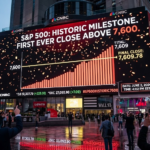
The S&P 500 ticked up 0.13% to a record 7,609.78 on Tuesday, closing above 7,600 for the first time ever, with the move powered — surprising no one — by semiconductors. Marvell Technology was the star, surging more than 25% after Nvidia CEO Jensen Huang publicly called it the "next trillion-dollar company," which is the 2026 version of getting a gold star from the teacher, except the star is worth tens of billions in market cap. Hewlett Packard Enterprise added to the chip-and-AI strength. The rally remains narrow and AI-led, which is great until it isn't. Benzinga reported
The obvious question hanging over the open: can a benchmark that just logged nine consecutive weekly gains keep climbing while missiles fly over the Strait of Hormuz? Markets have spent months treating the Iran conflict as background noise, and so far that bet has paid. The risk is complacency — a narrow, record-priced market is exactly the kind that doesn't enjoy a surprise. If your edge depends on staying calm when everyone else isn't, our trading psychology library exists for mornings like this. Benzinga noted
Crypto: the risk-off canary stops singing
Crypto is where the real bleeding is happening. Bitcoin opened Wednesday at $66,667 — down 6.5% from Tuesday's open — before nudging back to around $67,100, a brutal slide from roughly $73,568 just on Monday. Ethereum opened at $1,857, down 7.3% and firmly under the psychologically important $2,000 line, with XRP around $1.23 and Solana near $74.77. While stocks and metals have been relatively steady, crypto has been moving in exactly the wrong direction as investors rotate toward risk-off positioning and chase the AI trade instead. Yahoo Finance reported
The pressure isn't just price. Spot Bitcoin ETFs logged about $1.42 billion in outflows as sentiment turned defensive, and the geopolitical angle got more direct after the U.S. sanctioned Nobitex, Iran's largest digital-asset exchange, along with three other entities — a reminder that "decentralized" and "untouchable" are not the same word. If you're trading the majors through this volatility, the broader context lives in our crypto coverage. Britannica reported
Metals: gold takes a breather, not a vacation
Precious metals are softer this morning, with gold futures down 0.78% to $4,484.60 an ounce and silver off 1.32% to $74.56, both pressured by rising U.S. Treasury yields and firmer crude oil that's stoking inflation worries. It's worth keeping perspective: a sub-1% dip in gold sitting near $4,500 is a stretch, not a trend reversal — the metal has been the quiet, boring overachiever of 2026 while crypto does cartwheels off the roof. With an active Middle East war and a brand-new Fed chair, the safe-haven bid isn't going anywhere fast. TheStreet reported
The war: a "ceasefire" that keeps firing
Escalation overnight. Iranian drones and missiles struck Kuwait International Airport early Wednesday, killing one person and briefly shutting the airport, while Bahrain intercepted three missiles and several drones. The U.S. responded with strikes on an Iranian ground-control station on Qeshm Island in the Strait of Hormuz.
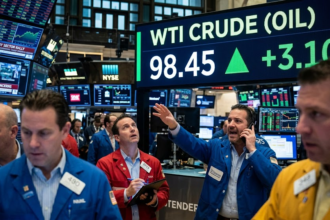
The so-called ceasefire from the 2026 Iran war — which kicked off with U.S.–Israeli strikes on February 28 — is looking less like a truce and more like a suggestion. Overnight, Iran hit Kuwait and Bahrain, the U.S. struck back near the Strait of Hormuz, and semi-official Iranian outlets said Tehran has stopped talking to mediators about extending the ceasefire, even as Trump insists negotiations continue. For traders, the only number that matters here is the one on the crude screen: anything that threatens shipping through Hormuz puts a bid under oil, and higher oil feeds straight into the inflation story that's already nudging yields up. NPR reported
The macro tail risk is real. The OECD warned that a prolonged disruption to Middle East energy flows stretching into 2027 could drag global growth down to 2.1% in 2026 and 1.8% in 2027 — rates it bluntly described as the kind normally seen only in major recessions like the financial crisis or the pandemic. If the conflict resolves quickly, the OECD still sees growth merely slowing to 2.8% this year. Translation: the market's calm is priced for the optimistic path, and the optimistic path is currently being tested by drones. CNN reported
High-impact data this week: it's a jobs week
This is a heavy labor-market week, and the new central-bank era adds spice — Kevin Warsh's first FOMC meeting as Fed chair begins Saturday, June 6, so every data point gets read through the "what will the new guy do" lens. Today's focus is the ADP private payrolls print (consensus around 110,000) plus the ISM Services PMI and the Fed's Beige Book, all appetizers before Friday's main course: the May nonfarm payrolls report at 8:30 a.m. ET. A soft jobs number revives rate-cut bets and pressures the dollar; a hot one complicates everything. Plan your size around these, not into them — the same discipline we preach across the pre-market desk. Kiplinger reported
| Day | Release (ET) | Why it matters |
|---|---|---|
| Mon Jun 1 | ISM Manufacturing PMI | Factory health + prices-paid inflation read |
| Tue Jun 2 | JOLTS Job Openings (~6.87M) | Labor demand gauge |
| Wed Jun 3 | ADP Payrolls (~110K) · ISM Services · Beige Book | Today's movers; ADP previews Friday |
| Thu Jun 4 | Initial Jobless Claims · Challenger Cuts | Weekly labor pulse |
| Fri Jun 5 | May Nonfarm Payrolls + Unemployment (8:30am) | The week's main event |
The bottom line
Records up top, carnage in crypto, a slow bleed in metals, and a war that won't stay in its lane. Futures are flat-to-soft, which is honestly the most reasonable reaction available. Watch oil for the Hormuz premium, watch ADP and Friday's jobs print for the Fed path, and don't confuse a calm tape with a safe one. The market is priced for the good ending; the news flow keeps auditioning for the bad one.
FAQ
Why are stock futures lower if the market just hit record highs?
Why is Bitcoin crashing while stocks are at records?
What's the most important economic release this week?
How is the Iran–U.S. war affecting markets?
Why are gold and silver down today?
This briefing is for informational and educational purposes only and is not financial advice. Prices are pre-market snapshots and move fast — verify levels before trading. Trade your plan, manage your risk.