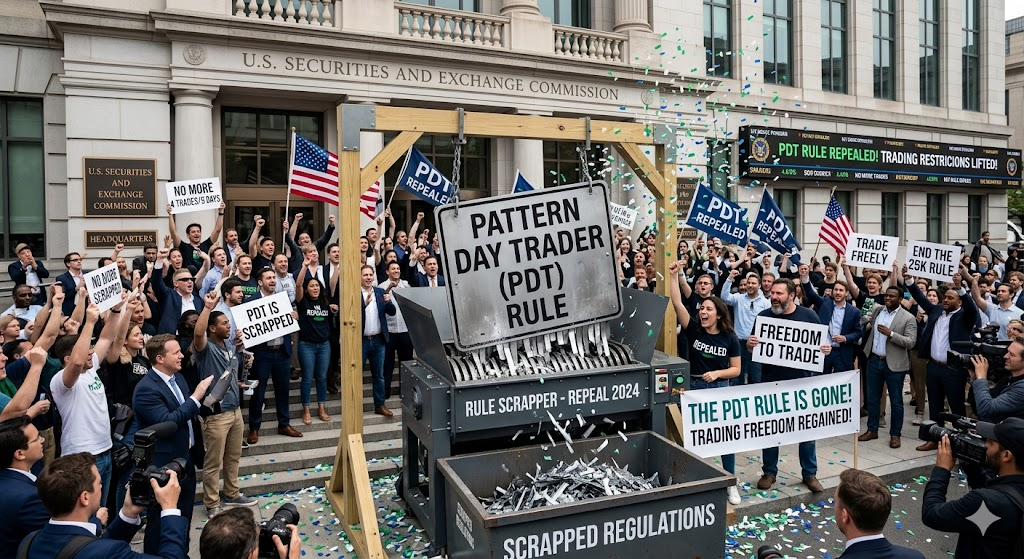
The PDT Rule Is Dead: What Scrapping the $25,000 Pattern Day Trader Minimum Means for Retail Traders in 2026
After 25 years, the most despised number in retail trading — $25,000 — finally lost its job. Here's what replaces it, who actually benefits, and who's about to learn a very expensive lesson about leverage.
On April 14, 2026, the Securities and Exchange Commission did something retail traders had been begging for since roughly the invention of the smartphone: it approved FINRA's proposal to scrap the Pattern Day Trader (PDT) rule outright. The $25,000 minimum equity requirement, the four-trades-in-five-days counter, the 90-day account freeze, and the "PDT" designation itself are all being retired — replaced on June 4, 2026, by a new intraday margin framework under an amended FINRA Rule 4210. Brokerages have until October 20, 2027, to fully implement the new system, so the transition will be staggered rather than instant.
Source: FINRA Regulatory Notice 26-10 · Charles SchwabThe TL;DR
- What was killed: The PDT designation, the $25,000 minimum, the day-trade counter, and the 90-day freeze tied to PDT status.
- Effective date: June 4, 2026 (brokers have until October 20, 2027, to phase in).
- What replaces it: A real-time, risk-based intraday margin framework that monitors actual position exposure, not trade count.
- Minimum account balance to use margin: $2,000, set by individual brokerages from there.
A Quick History Lesson Nobody Asked For
The PDT rule was born in 2001, in the smoldering aftermath of the dot-com crash. FINRA's predecessor, the NASD, decided that the cure for retail traders blowing themselves up on Pets.com was a flat $25,000 capital floor on any margin account that day-traded four or more times in five business days. The idea was that $25,000 was enough of a cushion to absorb leveraged losses without the broker holding the bag. In 2001, $25,000 was also enough money to make a real cushion. Twenty-five years later, that same $25,000 has the purchasing power of roughly $16,500 in 2001 dollars — and yet the threshold never moved.
Source: Angel Investors Network · tastytradeCritics — and there were a lot of them, loudly, for decades — argued the rule was paternalistic and structurally inequitable. A trader with $24,999 was forbidden from a fourth day trade. A trader with $25,001 had unlimited 4x intraday buying power. Apparently $2 was the difference between "responsible market participant" and "menace to society." The rule also applied only to U.S. margin accounts at FINRA member broker-dealers, meaning futures traders, forex traders, foreign accounts, and anyone with offshore structures were entirely exempt. The wall existed for one group: undercapitalized American retail traders. Everyone else walked through the door.
Source: tastytrade · QuantInstiOld Rule vs. New Framework: The Visual
The Positives: What's Actually Good About This
1. The Capital Barrier for Retail Traders Is Gone
This is the headline. For 25 years, anyone who wanted to day-trade U.S. stocks or options actively but didn't have $25,000 sitting in a margin account was effectively locked out. They could make three round trips per five business days and then sit on their hands. The workarounds — opening accounts at multiple brokers, splitting capital into cash accounts to dodge margin requirements, using offshore brokers — were all friction and fees in service of getting around an arbitrary number. As of June 4, 2026, a trader with $5,000 can execute as many round trips as their risk-adjusted intraday margin allows, full stop.
Source: My Investing Club · moomoo2. The Replacement Framework Actually Makes Sense
The old rule was a blunt instrument: count trades, apply a dollar threshold, freeze accounts that misbehaved. It did not care whether you were trading one share of a slow-moving blue chip or fifty contracts of 0DTE options. The new framework requires your equity to be proportional to your actual intraday market exposure. Brokerages can choose to monitor in real time (and block trades that would breach margin) or perform a single end-of-day calculation. Either way, the system reflects how modern trading platforms actually work — repricing positions second by second — instead of pretending it's still 2001 and risk gets calculated overnight on a mainframe.
Source: Alpaca · FINRA's New Intraday Margin Rule · Day Trading Toolkit3. 0DTE Options Are Finally Covered
Zero-days-to-expiration options didn't meaningfully exist when the PDT rule was written, which is the regulatory equivalent of writing traffic laws before anyone invented the car. These instruments now drive enormous intraday volume and can lose 100% of their value in hours — yet the old rule had no framework for capturing their risk. The new intraday margin standards fill that gap explicitly, requiring exposure-based margin treatment for these high-velocity instruments. Better late than never.
Source: Prosper Trading Academy · Yahoo Finance4. Forced Overnight Risk Goes Away
One of the great ironies of the PDT rule was that it pushed undercapitalized traders into more risk, not less. Because the rule only counted "day trades" (open and close in the same session), traders were incentivized to hold positions overnight to avoid tripping the counter — exposing themselves to gap-down risk on earnings, news, or overnight macro events. Letting traders close intraday whenever they want eliminates this perverse incentive.
Source: Alpaca · FINRA's New Intraday Margin RuleThe Negatives: What Could Go Sideways
1. Leverage Is Now Available to Accounts That Probably Shouldn't Have It
Under the new framework, accounts as small as $2,000 can access intraday margin buying power, with the actual multiplier set by each brokerage based on position risk. Andrew Sather, co-host of The Investing for Beginners Podcast, summarized retail's concerns bluntly: "It's like, let's let kids under 18 buy cigarettes. You know, why not?" His co-host Stephen Morris walked through the math: a trader with $30,000 using 4x margin to buy $120,000 of stock loses $12,000 if that stock drops 10% — a 40% account hit from a 10% market move. Scale that down to a $1,000 account at 4x buying power and a 25% adverse move wipes out the account and leaves the trader owing the broker interest on the debit balance. The $25,000 floor was annoying, but it also functioned as a capital cushion. Remove the cushion and the math runs the other way.
Source: 24/7 Wall St.2. The New Rules Are Harder to Understand
The old rule was, for all its flaws, easy to explain: don't day-trade more than three times a week unless you have $25,000. The new framework requires traders to understand maintenance margin, intraday margin excess, real-time vs. end-of-day monitoring (which varies by broker), the 90-day freeze for repeat intraday deficits, and the small-deficit carve-out (the lesser of 5% of account equity or $1,000). Available buying power now changes dynamically throughout the day as prices move. Traders who used to glance at their account balance and multiply by four will need a more sophisticated mental model — or a very forgiving brokerage app that does the math for them.
Source: Day Trading Toolkit · Intraday Margin Explained · QuantInsti3. Implementation Will Be Messy and Uneven
Brokerages have an 18-month phase-in window — from the June 4, 2026 effective date through October 20, 2027 — to fully roll out the new framework. Some firms (Schwab, Webull, tastytrade) have publicly committed to day-one or near-day-one implementation. Others will take their time. Each broker also gets to choose between real-time monitoring (which can block trades preemptively) and end-of-day calculation (which doesn't). That means buying power, risk treatment, and trade-blocking behavior will vary significantly depending on where you keep your account. The same $10,000 trader at two different brokers may have wildly different margin profiles.
Source: Charles Schwab · Day Trading Toolkit · Complete Guide4. Brokerages Have Strong Incentives to Encourage Risk-Taking
This isn't a conspiracy theory — it's basic accounting. Brokerages make money on margin loan interest, payment-for-order-flow on retail trading volume, and options contract fees. Two of the most obvious winners of the rule change, Robinhood and Interactive Brokers, saw their stock prices jump immediately after the announcement, and their margin loan books have already been climbing. More small-account traders with margin access means more interest income and more order flow. The platforms that profit most from retail leverage are the same platforms now responsible for educating users about it. That alignment is, let's say, imperfect.
Source: 24/7 Wall St.5. Margin Discipline Did Not Disappear
One thing worth being clear about: the rule change does not eliminate margin requirements. Maintenance margin still applies to every position. Accounts that repeatedly run intraday deficits — failing to meet the requirement by close of business on the fifth business day after it occurs — still face a 90-day freeze on creating or increasing short positions or debit balances. The blunt $25,000 equity floor has been swapped for a continuous, exposure-based check, but the regulator still cares whether you're solvent. The freedom is real; the guardrails are just shaped differently.
Source: FINRA · Understanding the New Intraday Margin Requirements · tastytradeQuick Comparison: Who Benefits, Who Should Be Careful
| Trader Profile | Impact | Risk Level |
|---|---|---|
| Experienced trader with $10k–$24k account, documented P&L discipline | Strongly positive — removes paperwork friction, no behavior change needed | Low |
| Trader who previously used multiple accounts to dodge PDT | Positive — can consolidate capital and stop paying duplicate platform costs | Low |
| Cash-account trader who avoided margin entirely | Neutral — nothing changes if you don't opt into margin | Low |
| New trader with sub-$10k account, limited experience | Mixed — gains access but loses the capital cushion that absorbed mistakes | High |
| Trader who sizes positions "by what the platform allows" | Dangerous — 4x leverage on a small account is a fast path to a debit balance | Very High |
Practical Steps to Take Before June 4, 2026
- Check whether your account is set to cash or margin. If you don't intend to borrow, a cash account makes it mathematically impossible to go negative.
- If you keep margin enabled, set a personal cap on buying-power usage (most disciplined retail traders cap at 1.5x to 2x — well short of the 4x platforms may offer).
- Read your broker's updated margin agreement. Pay attention to the maintenance call threshold, the interest rate on borrowed funds, and whether the broker uses real-time or end-of-day intraday monitoring.
- Confirm your broker's implementation timeline. Not every firm flips the switch on June 4 — some take the full 18 months.
The Bottom Line
Scrapping the Pattern Day Trader rule was, on balance, overdue and correct. The $25,000 threshold was an artifact of a different era — one with $20 commissions, end-of-day risk calculations, and no real-time position monitoring. Replacing it with a dynamic, exposure-based framework reflects how markets actually work in 2026. For experienced, disciplined retail traders with sub-$25k accounts, this is unambiguously good news. For everyone else, the rule change shifts the burden of risk management from the regulator to the trader. The wall is gone. So is the cushion that sat behind it. Whether that's a gift or a trap depends entirely on the person walking through the door.
Source: FINRA Regulatory Notice 26-10 · FINRA Investor Insights


