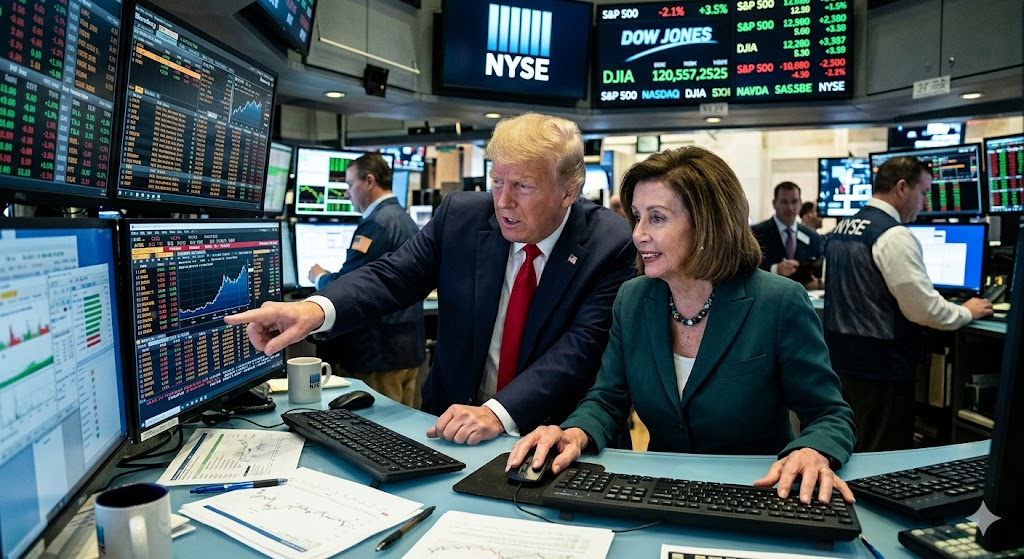
Post-Market Briefing: Wall Street's Tech Hangover, $109 Brent, and a Weekend of Hormuz Anxiety
The Headline Numbers
After Thursday's record-setting close — the Dow reclaiming 50,000, the S&P 500 finishing above 7,500 for the first time ever — Friday was the inevitable hangover. The S&P 500 shed 92.74 points (-1.24%) to close at 7,408.50, while the Nasdaq Composite dropped 410.08 points (-1.54%) to 26,225.14, and the Dow gave back 537.29 points (-1.07%) to finish at 49,526.17. The Russell 2000 was the real victim of the session, hemorrhaging 2.4% in its worst single-day performance in more than six months and snapping a seven-week winning streak.
| Index | Close | Day Change | Driver |
|---|---|---|---|
| Dow Jones | 49,526.17 | -1.07% | Boeing, Caterpillar, Nvidia drag |
| S&P 500 | 7,408.50 | -1.24% | Tech profit-taking, yields |
| Nasdaq | 26,225.14 | -1.54% | AI hyperscaler unwind |
| Russell 2000 | 2,793.30 | -2.43% | Rate-sensitive small-caps |
| VIX | ~18.0 | +4% | Geopolitical premium creeping back |
The Tech Wreck Nobody Wanted to See Coming
The AI complex finally choked on its own valuation. After Cerebras Systems (CBRS) ripped 68% on its Nasdaq debut Thursday, the new shiny chipmaker gave back about 10% Friday — because of course it did. Intel plunged nearly 7%, Micron lost 6.6%, AMD fell 5.7%, and Nvidia dropped 4.4% as traders decided that a sector trading 32% above its 50-day moving average might possibly, conceivably, be a little frothy. Schwab noted the PHLX Semiconductor Index is up 143% over the last year versus just 15% for the S&P 500 equal-weight, which is the kind of divergence that historically resolves itself in ways that nobody enjoys.
The lone bright spot in mega-cap tech was Microsoft, which actually rose after Bill Ackman revealed Pershing Square had been quietly accumulating shares since February at roughly 21x forward earnings, calling it a "core holding". Boeing extended Thursday's drubbing, falling another 3% on top of a 5% prior-day plunge, after the much-hyped China order for 200 jets turned out to be only marginally above what analysts already expected. Surprise!
The Iran Situation: Now in Month Whatever-It-Is
Here is the news that actually moved everything else today. President Trump returned from his summit with Xi Jinping in Beijing with handshakes, photo ops, vague promises about $30 billion in "nonsensitive goods," and exactly zero concrete progress on the Iran conflict that has now effectively closed the Strait of Hormuz. Trump told Fox News he is "losing patience" with Iran, adding "they should make a deal," which is the kind of statement that tends to make oil traders very, very awake.
According to the International Energy Agency, the Hormuz blockade has now removed roughly 10 million barrels per day of Persian Gulf exports — about 10% of total global consumption — making it the largest oil supply disruption in recorded history. The only reason crude isn't trading at $150 is that U.S. and other non-Middle East producers have ramped exports by about 3.5 million bpd, partially plugging the gap. The White House said Trump and Xi agreed Hormuz "must open," which is nice, except nobody actually knows when, how, or whether Iran agrees.
Futures: Energy Up, Everything Else Down
The energy complex was the only place to make money Friday. Brent crude for July gained more than 3% to settle at $109.26 per barrel, while WTI for June advanced more than 4% to $105.42. Gasoline futures continued to grind higher — retail pump prices hit a fresh crisis high of $4.46 per gallon earlier this month, the most expensive in nearly four years, and there is precisely zero relief on the horizon until Hormuz reopens or somebody invents teleportation.
| Contract | Friday Close | Move |
|---|---|---|
| WTI Crude (June) | $105.42 | +4.0% |
| Brent Crude (July) | $109.26 | +3.0% |
| 10Y Treasury Yield | 4.55% | +9 bps |
| 30Y Treasury Yield | 5.12% | 2007 highs |
| Copper | — | -4.2% |
The bond market is where the real story lives. The 30-year hitting its highest yield since June 2007 is not a "noise" event. According to the CME FedWatch Tool, the probability of a Fed rate hike sometime in 2026 climbed to 45% on Friday — up from just 1% a month ago. That is not a typo. The market has gone from "imminent cuts" to "possibly hiking by December" in approximately four weeks, which is the kind of repricing that breaks portfolios built for the old regime.
Precious Metals: A Bloodbath in Slow Motion
If you thought gold and silver were going to be the safe-haven heroes of a geopolitical crisis, Friday had some news for you. Gold spot collapsed to around $4,564 per ounce, down about 1.83% on the day and roughly 4% for the week, while silver got annihilated, falling more than 10% to $77.52 — its worst single-session decline in months. The gold/silver ratio blew out from 53.6:1 to 58.9:1 in a single session, which is the kind of move that gets your risk manager calling on a Friday night.
The driver is straightforward but counterintuitive: in a forced-deleveraging event, traders sell what they can, not what they want to. Gold is the most liquid hard-asset reserve on earth, which makes it the first thing institutions dump when margin calls hit. Add in UBS slashing its full-year silver investment demand forecast from 400 million ounces to 300 million and a Treasury yield complex screaming at multi-year highs, and you get exactly what we got — a synchronized commodity rout.
| Metal | Friday Spot | Day | Week |
|---|---|---|---|
| Gold | ~$4,547 | -2.22% | ~-4% |
| Silver | ~$77.52 | -10.61% | ~-13% |
| Platinum | ~$1,975 | -4.4% | ~-6% |
| Copper | — | -4.2% | — |
Crypto: Bitcoin Can't Escape the Macro
The "Bitcoin is digital gold and a hedge against currency debasement" thesis got another reality check Friday. BTC dropped as low as $78,600 — down roughly 4% from Thursday's $82,000 high — before stabilizing just above $79,000 into the close, still off 2.8% on the 24-hour. Ether fell 3.8% to around $2,214, with the broader altcoin complex getting hit harder: XRP, ADA, LINK and AVAX all down around 5%, and SUI down roughly 8%.
Crypto equities took an even bigger beating. Coinbase (COIN), Circle (CRCL), Strategy (MSTR), and the mining names were down 5-10% across the board. In a particularly piquant footnote, Strategy's Michael Saylor confirmed the firm will probably sell some Bitcoin to fund a dividend and "inoculate the market", which is a sentence that the 2021 Saylor would have found physically painful to hear.
The interesting wrinkle: the Senate Banking Committee advanced the CLARITY Act — the long-awaited crypto market structure bill — on the same day. So crypto is now in a fascinating spot where regulatory clarity is finally arriving while the macro environment is the most hostile it has been in two years. Stay tuned for whichever force wins. For deeper crypto context, see our Crypto category.
The Wildcard: Kevin Warsh Takes the Fed
Quietly, on the same day as all of this, Jerome Powell's term ended and Kevin Warsh prepared to take over as Federal Reserve Chair. Warsh disclosed more than $100 million in personal cryptocurrency holdings during his confirmation, including stakes in Solana, dYdX, and a Bitcoin Lightning company — a first for a sitting Fed Chair. He won't actually conduct policy until his first FOMC meeting in June, but his public commentary between now and then is going to move markets. J.P. Morgan expects him to be more dovish than Powell. The bond market, as of Friday, is voting precisely the opposite way. Somebody is wrong.
What's Interesting (Sarcastic Edition)
A few things worth chewing on over the weekend:
- The AI bubble is now measurably bigger than the dot-com peak. CNBC reports the AI chip concentration now rivals French stocks in the 1700s and exceeds the Nasdaq during dot-com on at least one measure. The 1700s. That is the comp. Sleep well.
- Consumer sentiment is at all-time lows while the stock market is at all-time highs. Those two things have historically had a strong correlation, which is just a fun thing to remember.
- Cerebras went from $0 to nearly $100B market cap on $500M of 2025 revenue. That is a P/S ratio of roughly 200. Cisco at the dot-com peak was about 30. Just data.
- Amazon laid off more people from its Selling Partner Services division, on top of roughly 30,000 layoffs in the last six months. The AI productivity miracle is going great for shareholders.
The Weekend Setup: All Eyes on Nvidia Wednesday
Next week is the big one. Nvidia reports fiscal Q1 earnings after the close on Wednesday, May 20, with Street consensus around $78.5B in total revenue and roughly $72.8B from data center. Options markets are pricing a ~3.24% near-term move on the print. Given that NVDA is roughly 7% of the S&P 500 and a meaningful chunk of the Nasdaq, this is not just an Nvidia event — it is a market event.
Also on deck: Walmart, Target, Home Depot, Lowe's, and a parade of other retailers reporting into a tape where consumer sentiment is in the toilet. That divergence between AI-fueled equity highs and Main Street malaise gets stress-tested in real-time starting Tuesday morning.
Other things to watch:
- Any weekend headlines from Iran or the Strait of Hormuz. Sunday night oil opens are going to be twitchy.
- Warsh commentary or Fed-related leaks. The 45% hike-odds repricing has more room to run if any FOMC member backs it.
- CLARITY Act amendments. There are over 100 amendments pending, with Senator Warren leading 40+. The crypto rally could either accelerate or unwind depending on how this looks heading to the floor.
- Treasury auctions next week — if the 10Y or 30Y bid is weak, the yield narrative gets uglier.


