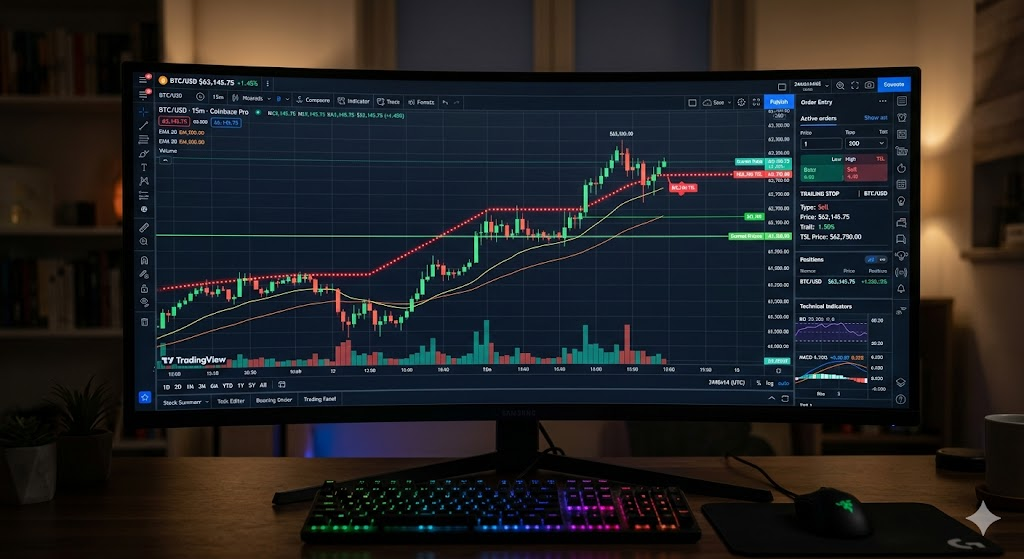
What Is a Trailing Stop Loss, Anyway?
A short, slightly opinionated explainer for everyone who has typed TrailingStopLoss.com into a browser and immediately wondered what they just signed up to learn about.
Since launching TrailingStopLoss.com, I have had a few people ask what it actually means. So I thought, what better way to explain it than in an article that nobody asked me to write but I am writing anyway.
The Quick Definition
A trailing stop loss is an order you place with your broker that automatically sells your investment if the price drops by a set amount or percentage from its highest point. The "trailing" part is the important bit: as the price climbs, the stop level climbs with it. As the price falls, the stop level just sits there, arms crossed, refusing to move. It is a one-way ratchet for your gains.
Source: SoFi — What a Trailing Stop-loss Is and How To Use OnePut another way, a regular stop loss is the friend who tells you to leave the casino once you have lost $100. A trailing stop loss is the friend who lets you keep playing as long as you are winning, but the moment you give back $100 of your winnings, drags you out by the collar. Same protective instinct, very different vibe. TL;DR
Source: CMC Markets — Trailing Stop Loss ExplainedHow It Actually Works
When you place a trailing stop, you choose a trailing amount — either a fixed dollar value or a percentage. That number is the leash. The current market price walks the dog. As long as the price keeps walking forward (up, for a long position), the stop level follows along behind at the same distance. The instant the price turns around and walks backward by more than the leash length, the order triggers and your position is sold as a market order.
Source: Charles Schwab — Trailing Stop Orders: Mastering Order TypesHow to read this: The green line is the stock's price climbing from $100 to $130, then falling. The yellow dashed line is your trailing stop — it ratchets up as the price climbs but never moves down. When the price falls back to the stop level, your shares are sold. You exit at $120 with a $20-per-share gain locked in instead of riding it back down.
A Worked Example
The U.S. Securities and Exchange Commission walks through a textbook example: you buy XYZ stock at $20 per share, it rises to $22, and you set a sell trailing stop $1 below the market price. As the stock climbs, your stop climbs with it, always staying $1 below the high. When XYZ peaks at $24, your stop is sitting at $23. The price then starts to fall, and your stop holds firm at $23. As soon as the price touches $23, your shares are sold — though the actual execution price might be a few cents off, because by the time the order triggers, it becomes a market order.
Source: SEC Investor.gov — Stop, Stop-Limit, and Trailing Stop OrdersTrailing Stop vs. Regular Stop Loss
Both order types are trying to do roughly the same thing — get you out before things get ugly — but they go about it very differently. The regular stop loss is static. You set it once, and it sits there at that exact price until either it triggers or you manually move it. The trailing stop is dynamic. It updates itself in your favor automatically. If you have ever forgotten to manually raise a stop loss after a big rally and then watched the stock give back all its gains, this is the order type you wish you had been using.
Source: Questrade — Trailing Stop OrdersRegular Stop Loss
Fixed price level. Doesn't move unless you move it. Good for capping losses, terrible at protecting profits unless you're paying close attention. Requires babysitting.
Trailing Stop Loss
Dynamic distance from price. Climbs with gains, freezes during pullbacks, triggers on reversals. Locks in profit and limits loss with one setup. Set it and stop checking your phone every 11 minutes.
Why People Like Them
- Lets winners run. Unlike a take-profit order that caps your upside, a trailing stop keeps you in the trade as long as the trend is intact.
- Removes the emotion. A predefined exit rule is much easier to follow than the rule "I'll sell when it feels right," which, statistically, is never.
- Hands-off protection. You don't have to stare at a screen all day to lock in gains or limit losses.
- Works in trending markets. When a stock is in a sustained uptrend, a properly sized trailing stop captures most of the move.
Why They Are Not Magic
Now for the part the brokerage marketing materials tend to whisper rather than shout. A trailing stop is not a force field. If you set it too tight, normal day-to-day volatility — the kind of routine 2% wobble that markets do before breakfast — will trigger your exit and toss you out of a position that was about to keep climbing without you. Set it too wide, and you give back more profit than you needed to. There is no universally correct trailing distance, which is annoying but true.
Source: Questrade — Trailing Stop OrdersOnce a trailing stop triggers, it becomes a market order. Your actual execution price can be different from the stop level — sometimes meaningfully so, especially in fast-moving or low-volume stocks. If a stock gaps down overnight, your order may execute well below your stop. Most brokers also only trigger trailing stops during regular market hours (9:30 a.m. to 4:00 p.m. ET in the U.S.), so weekend news is its own special kind of unpleasant surprise.
How to Pick a Trailing Distance
The honest answer is "it depends," but a slightly more useful answer is: look at how much the asset normally moves. If a stock routinely pulls back 3% during healthy uptrends before resuming, a 1% trailing stop is too tight — it will keep stopping you out of perfectly fine trades. A trailing distance somewhere a bit wider than the asset's typical noise, but tight enough that you don't give back everything in a real reversal, is the sweet spot. Some traders use a percentage (good for stocks that swing in big absolute dollar amounts), others use a fixed dollar or point value (good for lower-priced names where percentages get squirrelly).
Source: Questrade — Trailing Stop OrdersThe Bottom Line
A trailing stop loss is one of the more genuinely useful tools an everyday investor has access to. It is not a strategy on its own — it is a discipline mechanism. It removes the "I'll just check it tomorrow" excuse, it lets profitable trades keep being profitable, and it gives you a written-in-stone exit before you are emotionally invested in not having one. Used well, it is one of the rare cases where a piece of automation actually saves you from yourself, which, let's be honest, is most of the battle.
Source: heygotrade — Understanding Trailing Stop Order


