What Are the Odds of Becoming a Profitable Trader?
It depends entirely on what you mean by “profitable” — and the three honest answers are roughly 20%, under 1%, and 1 in 2,456. The gap between them is the most important thing a new trader can understand, because courses quote the first number and sell the third.
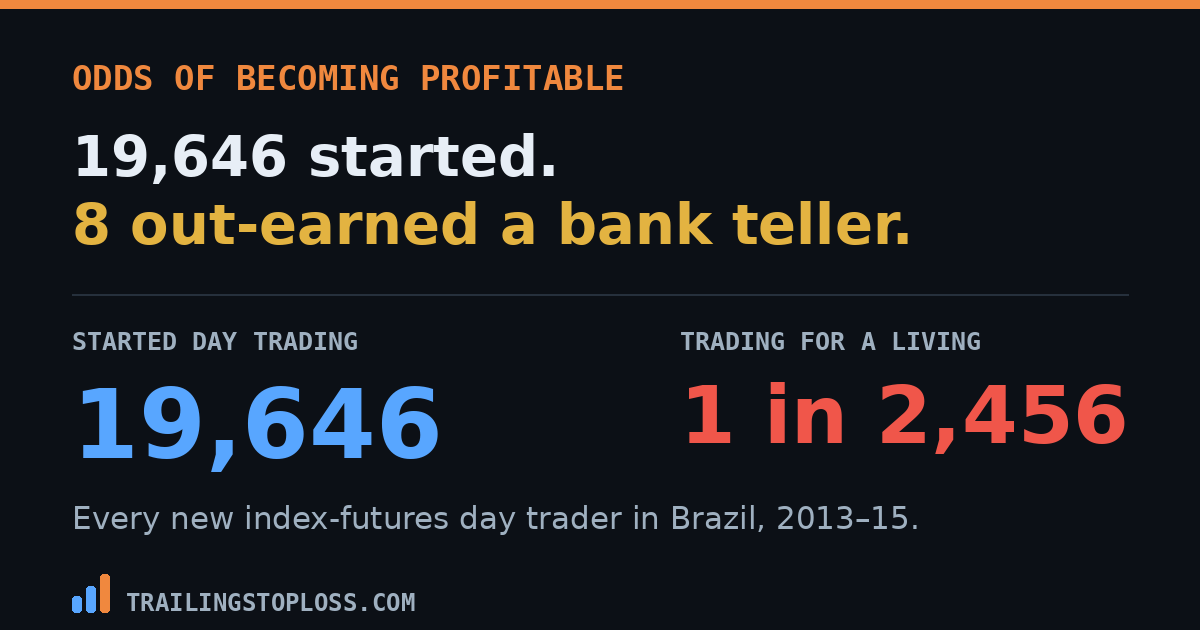
One study followed every person who started day trading index futures in a single country for three years. Of 19,646 who began, eight earned more than a bank teller’s starting salary.
Three definitions, three answers
| What “profitable” means | Rough odds | Source |
|---|---|---|
| Made money over a given period | ~20% | Taiwan, all day traders 1992–2006 |
| Profitable reliably, year after year | <1% | Same Taiwan dataset |
| Earned a living from it | 1 in 2,456 | Brazil, every new trader 2013–15 |
Barber, Lee, Liu and Odean analyzed every day trader on the Taiwan Stock Exchange over fifteen years and found about 20% profited net of fees in a given period. The same research found fewer than 1% were predictably profitable — able to repeat it reliably rather than catching a good run. (summarised in Chague et al.)
Those are different questions, and conflating them is how the trading-education industry works. “One in five traders are profitable” is technically defensible and practically meaningless, because most of that fifth won’t repeat it.
The funnel
The most useful study for anyone considering this seriously comes from Brazil. Chague, De-Losso and Giovannetti obtained records from the Brazilian securities regulator for every individual who began day trading mini-Ibovespa futures between 2013 and 2015 — 19,646 people — and followed them through 2017. (SSRN)
Two things make it unusually relevant. It tracks new traders from their first trade, so it isn’t contaminated by seasoned professionals. And the instrument is an equity index future — the same kind of market as NQ and ES, and at the time the most-traded equity index futures contract in the world.
Here’s what happened to those 19,646 people, using only the paper’s own figures:
| Stage | People | Of all who started | Odds |
|---|---|---|---|
| Started day trading | 19,646 | 100% | — |
| Still trading after 300+ days | 1,551 | 7.9% | 1 in 13 |
| Profitable net of fees | ~47 | 0.24% | 1 in 418 |
| Earned more than minimum wage (~$16/day) | 17 | 0.09% | 1 in 1,156 |
| Earned more than a bank teller’s starting pay | 8 | 0.04% | 1 in 2,456 |
Minimum wage in that study was about $16 a day. The single best performer among the persistent group earned around $310 a day — with a daily standard deviation near $2,560, meaning swings eight times the average result. The best trader in the country’s most-traded index futures market was running a business with a coefficient of variation most people would find unbearable.
The authors looked for evidence that traders improved the longer they persisted — the “just keep at it” argument. They found none. Staying in the game for more than 300 days did not measurably improve results. Persistence selected for people who kept going, not for people who got better.
Why the odds are this bad
Costs, paid hundreds of times. A round trip carries commission, exchange fees and slippage. A strategy with a modest real edge has to clear that toll on every trade, and at day-trading frequency the toll compounds into a hurdle most edges never clear. The Taiwan research found heavy day traders often earned gross profits that costs then consumed.
Variance hides skill for a long time. A genuine edge still produces losing months routinely. With a 55% win rate at 1:1, twenty trades show a loss about a quarter of the time. Most people quit — or change strategies — long before they’ve collected enough trades to know whether they had anything, which we worked through in what poker players understand about sample size.
Sizing ends accounts that had an edge. A profitable strategy risking half a percent per trade still loses a trailing-drawdown account most of the time within 200 trades. The arithmetic of ruin removes people who might eventually have been in the profitable column.
And the other side of the trade. Every contract you buy, someone sells. A meaningful share of that flow is market makers and algorithmic firms with better data, lower costs and no emotional stake. The profitable fraction exists; it’s just very thin, and the top of it is disproportionately professional.
What actually moves your odds
None of this says the number is zero, and the Taiwan data is clear that the small group who win tend to keep winning — which luck alone doesn’t produce. Something is learnable. It’s just rare, and the levers are different from the ones courses sell.
- Cut cost per trade before anything else. It’s the only input you control completely, and at high frequency it’s often the difference between a gross edge and a net loss.
- Trade less until you’ve proven the sign of your edge. Frequency multiplies whatever edge you have, positive or negative. Scaling up a losing process just gets you to the bottom faster.
- Size so a normal losing streak can’t end you. Twenty to twenty-five losing trades of room inside your drawdown, not ten.
- Decide your sample size before you start. Somewhere between roughly 90 and 400 trades depending on your win rate and payoff. Don’t judge the method, or yourself, before you get there.
- Treat trading-for-a-living as the least likely outcome, not the goal. The realistic success case for most people is a supplementary income with a day job behind it, which is also the arrangement least likely to push you into oversizing.
Do prop firms change the odds?
They change what failure costs, not how often it happens. Losing an evaluation costs the fee rather than your own capital, which is a genuine improvement in the downside. But the base rate of traders with a durable edge is the same whether the account belongs to you or a firm, and industry-reported evaluation pass rates of roughly 5–14% sit comfortably inside the funnel above. A prop account is a cheaper way to find out which side of the funnel you’re on. It doesn’t move you across it.
The honest limits
Brazil in 2013–15 isn’t your market today. Fees were higher and the instrument is different. Lower costs now would mechanically shift a few more people into the profitable column. The direction of the finding almost certainly holds; the exact 1-in-2,456 does not transfer precisely.
“A living” was defined in Brazilian wages. Minimum wage around $16 a day and a teller’s starting pay around $54 are low bars by US standards, which makes the result more severe, not less.
The ~47 profitable figure is derived. The paper reports that 97% of the 1,551 lost money; 3% of 1,551 is about 47. The minimum-wage and teller counts of 17 and 8 are the paper’s own.
Survival bias runs through all of it. The people who quit early may include some who would have learned. We can’t observe the counterfactual, and neither can the researchers.
The short version
The odds of becoming a profitable trader depend on the definition. About 20% of day traders profit over a given period; fewer than 1% do it predictably; and in the one study that followed every new trader from day one, the odds of earning a living were about 1 in 2,456. That study tracked all 19,646 people who began day trading Brazilian index futures from 2013 to 2015: 1,551 lasted more than 300 days, roughly 47 were profitable, 17 beat minimum wage and 8 beat a bank teller’s starting pay — and the authors found no evidence that persisting made anyone better. Costs, variance, sizing and professional counterparties explain most of it. What improves your odds is cutting cost per trade, sizing to survive a normal losing streak, proving your edge before trading more, and treating trading for a living as the least likely outcome rather than the plan. (Chague, De-Losso & Giovannetti)
Frequently asked questions
What percentage of traders become profitable?
Around 20% of day traders profit net of fees in a given period, according to fifteen years of complete Taiwan Stock Exchange data. But fewer than 1% are predictably profitable year after year. In Brazil, of everyone who began day trading index futures from 2013 to 2015 and persisted more than 300 days, 97% lost money. The answer changes enormously depending on whether you mean one good period, consistent profit, or a living.
Can you day trade for a living?
It’s possible but extremely rare. In the most complete study of new traders, 19,646 people started day trading Brazilian index futures between 2013 and 2015. Only 17 earned more than the minimum wage of about $16 a day, and 8 earned more than a bank teller’s starting salary — roughly 1 in 2,456 of those who started. The best performer earned about $310 a day with daily swings of around $2,560.
Do traders get better with experience?
The Brazilian study found no evidence that traders improved the longer they persisted beyond 300 days. The Taiwan research did find that the small group of winning traders tended to keep winning, suggesting skill exists — but it appears concentrated in a small group rather than developing broadly through time spent trading. Persistence alone doesn’t appear to move people from the losing majority into the winning minority.
Why do most day traders lose money?
Mostly because costs are paid on every trade, and at day-trading frequency they compound into a hurdle most edges can’t clear. Variance also hides real skill for a long time, so people quit or change methods before they have enough trades to know. Position sizing ends accounts that had a genuine edge, and a meaningful share of the other side of each trade is professional firms with better data and lower costs.
Do prop firms improve your chances of success?
They reduce what failure costs — you lose an evaluation fee rather than your own capital — but they don’t change how many traders have a durable edge. Industry-reported evaluation pass rates of roughly 5–14% are consistent with the academic base rates. A prop account is a cheaper way to find out whether you’re in the profitable minority, not a way to join it.
Related on this site: what share of traders make money · why most traders blow their accounts · which trading method actually wins · what poker teaches about sample size
Funnel figures come from Chague, De-Losso and Giovannetti, “Day Trading for a Living?” (2020), using records from Brazil’s securities regulator; the profitable count of ~47 is derived from the paper’s reported 97% loss rate. Taiwan figures are from Barber, Lee, Liu and Odean (2014). Nothing here is financial advice. Futures trading carries substantial risk of loss.