▸ Trading Psychology
Cutting Winners, Riding Losers
Here’s a puzzle that ruins accounts: you can be right on more than half your trades and still lose money. You take profit the second you’re green, you feel like a genius, and yet the balance keeps sliding. The culprit isn’t your entries — it’s your exits, and specifically a bias so common it has a name in the academic literature. You snatch your winners early and let your losers run, which is the exact reverse of the one rule everybody already knows.
The rule everyone knows and nobody follows
“Let winners run, cut losers short” is day-one advice — not an advanced secret, not a paywalled edge. And yet study after study shows traders doing the precise opposite, with remarkable consistency. Knowing the rule changes nothing, because the problem was never knowledge. It’s psychology, and it operates below the level where good intentions live. (Trinity Trading: everyone knows the rule, few follow it)
Behavioral economists Hersh Shefrin and Meir Statman gave this its name in 1985: the disposition effect — the systematic tendency to sell winners too early and ride losers too long. Their paper’s title says it all, and four decades of data have only reinforced it. It runs directly against rational strategy, which says a decision should rest on a position’s future prospects, not on whether it’s currently above or below the price you happened to pay. (Australian Shareholders: Shefrin & Statman, 1985)
The scale of it is startling. Terrance Odean’s landmark 1998 study analyzed trading records from 10,000 brokerage accounts and found investors were roughly 1.5 times more likely to sell a winning position than a losing one — a pattern that held regardless of experience, account size, or market conditions. A follow-up found the most active traders underperformed a simple buy-and-hold by about 6.5 percentage points a year, with the disposition effect among the largest identifiable causes. This isn’t a rounding error; it’s a behavioral tax that compounds. (Odean 1998: 10,000 accounts) (Quant Decoded: a 3–4pp annual drag)
The math that dooms you
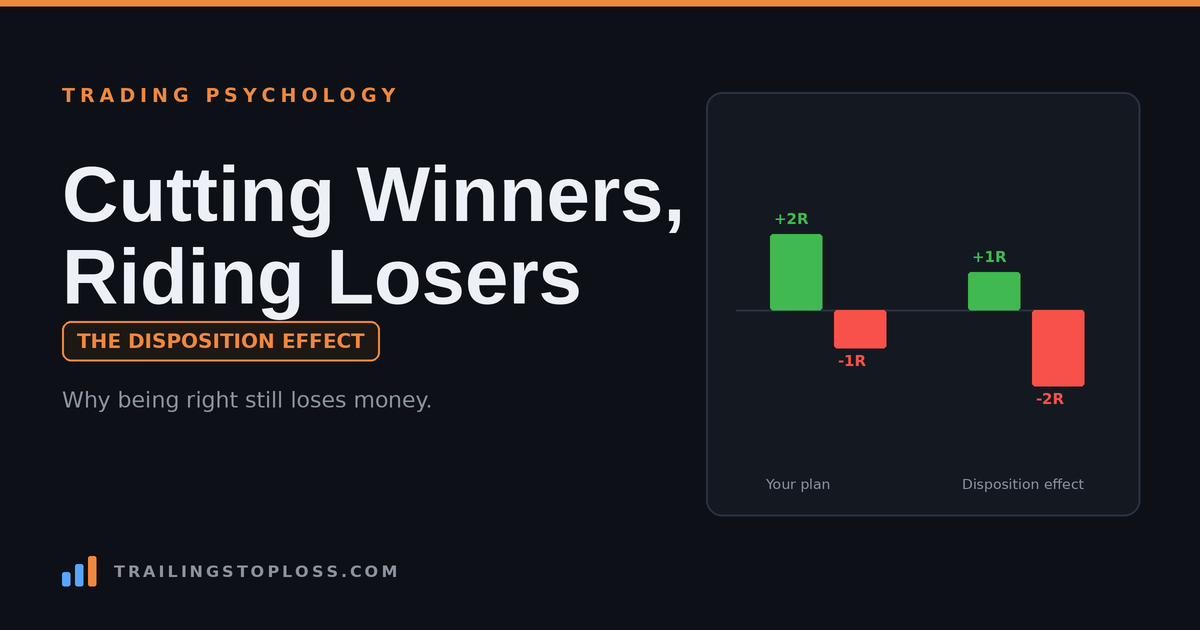
Here’s why this bias is lethal rather than merely annoying. Your strategy’s profitability depends on the relationship between how big your average win is and how big your average loss is. Cut your winners short at +1R while letting losers run to −2R or −3R, and you invert that ratio — now you need a win rate north of 65–75% just to break even. Almost no strategy wins that often. The disposition effect quietly makes even good systems unprofitable by sabotaging the one number they need to work. (TradesViz: the R-multiple trap)
Sit with that for a second, because it’s the whole game. Two traders can take the identical entries with identical win rates and end the year in completely different places, purely because one honored their exits and the other let feelings do the closing. The edge you spent months building lives or dies at the exit, and the disposition effect attacks it there. (Stock Trading Pro: the exit is where edge is won or lost)
Why your brain flips the script
The engine underneath it all is prospect theory, from Nobel laureates Daniel Kahneman and Amos Tversky: the pain of a loss is felt roughly twice as intensely as the pleasure of an equivalent gain. That 2:1 asymmetry does something strange to your risk appetite. When you’re in profit, that painful-loss machinery makes you risk-averse — you grab the certain gain before it can vanish. When you’re in a loss, it makes you risk-seeking — you’d rather gamble on a recovery than accept the certain sting of realizing the loss. Risk-averse in green, risk-seeking in red: exactly backwards. (Trinity Trading: prospect theory & the 2:1 rule)
Layered on top is something more human than any equation: the refusal to be wrong. Closing a loser converts a “paper” loss into a real, admitted mistake, so the ego stalls, whispers “it’ll come back,” and keeps the position open to avoid the regret of confirming a bad call. Meanwhile the winner gets sold fast to lock in the good feeling of a confirmed success. The behavior isn’t really about the money — it’s about protecting your self-image from the word “wrong.” (Arab Psychology: avoiding the regret of a confirmed loss)
And there’s a subtle logical error powering the whole thing: your entry price. The market has no idea what you paid, and your P&L relative to that number tells you nothing about what price will do next. But the disposition effect anchors every decision to that reference point, so a trade’s future gets judged by its past relative to you, rather than by the setup in front of you. The moment you catch yourself thinking “I just want to get back to break-even,” that anchor has you. (The Decision Lab: judging by reference point, not prospects)
The two halves of the same mistake
Selling winners too early
You’re up, the momentum is real, and a voice says “take it before it disappears.” So you close at +1R and feel the little hit of a booked win — then watch the trade run to the target you originally planned, without you. Premature profit-taking feels responsible (“you never go broke taking profits,” goes the lie), but it systematically caps your upside while your downside stays full-sized. A strategy can’t survive if its winners are amputated and its losers are left whole. (TradesViz: premature profit-taking caps the upside)
Riding losers too long
The trade goes against you, hits the level where your plan said “out,” and instead of clicking you start negotiating — widening the stop, hiding the platform, telling yourself it just needs room. The most honest description of it came from a trader who admitted his ego kept saying “it’ll come back” while his emotions said “hold a little longer,” and by the time reality landed, the damage was done. Moving a stop to avoid a small, planned loss is how a −1R turns into the −5R that actually blows the account. (Trinity Trading: the ego says “it’ll come back”)
How to break it
You don’t out-discipline the disposition effect in the moment — by then prospect theory is already driving. You beat it by removing the decision from the heat, with rules set before you’re emotionally invested. Here’s the protocol. (Stock Trading Pro: predetermined rules over in-the-moment willpower)
- Set both exits before you enter. Define your stop and your target as part of the entry decision, when you’re calm and objective. A trade without a pre-set exit is a trade you’ll close on emotion.
- Put the stop in the market and never widen it. Moving a stop further away is the single most expensive habit in trading. The stop can trail in your favor; it never, ever retreats. This is the whole point of holding the stop.
- Let winners run with a trailing stop or a scale-out. Instead of slamming the exit the moment you’re green, trail your stop behind structure or peel off part of the position while letting the rest chase the target. This keeps your average win from being amputated.
- Judge every trade in R-multiples, not dollars or feelings. Scoring in R relative to your initial risk lets you compare a disciplined exit and an emotional one honestly, and makes “I need a 2R average win at a 45% win rate” a concrete target rather than a vibe.
- Review your history for the pattern. Periodically pull your closed trades and ask two questions: am I selling winners before target, and am I holding losers past stop? The bias hides in the moment but is obvious in the data.
- Divorce your ego from the entry price. The market doesn’t know what you paid and doesn’t care whether you’re “right.” Judge the trade by the setup that’s live now, not by your distance from break-even. A closed loss isn’t a verdict on you; it’s the cost of doing business.
🧠 The reframe that fixes the exitsA loss you take at your planned stop is a success — you followed your process. A win you cut short of target is a failure — you broke it, even though the P&L was green. Grade yourself on whether you honored your exits, not on the color of the number, and the disposition effect loses its grip.
The bottom line
The disposition effect is the reason so many traders have a respectable win rate and a shrinking account. It’s loss aversion wearing a disguise, turning you cautious exactly when you should press and reckless exactly when you should fold. You can’t delete the instinct — it’s wired in — but you can make it irrelevant by deciding your exits in advance, holding your stop like it’s law, and letting your winners breathe. Fix the exit, and the same entries you already take quietly start making money. (Quant Decoded: predefined exits are the counter-strategy)
Build the exit discipline on purpose: pre-commit your stop and target with the Hard-Stop Plan Builder, visualize risk-reward with the Stop-Loss & R:R Visualizer, and review whether you’re honoring your exits on the P&L Calendar. If cutting winners and riding losers is your recurring leak, it’s a fixable one.
FAQ
What is the disposition effect?
The disposition effect is the well-documented tendency to sell winning trades too early while holding losing trades too long. Named by Shefrin and Statman in 1985 and confirmed by Odean’s 1998 study of 10,000 accounts, it’s the exact reverse of the “let winners run, cut losers short” rule, and it’s driven by loss aversion rather than lack of knowledge.
Why do I sell my winners too early?
Because prospect theory makes you risk-averse when you’re in profit: the fear of the gain vanishing outweighs the potential of it growing, so you grab the certain, feel-good win. It feels responsible, but systematically capping your winners while leaving losses full-sized inverts the risk-reward your strategy needs.
Why do I hold onto losing trades?
Closing a loser turns a “paper” loss into a real, admitted mistake, and the pain of that regret makes you risk-seeking — you’d rather gamble on a recovery than accept the certain loss. That’s why traders widen stops and tell themselves “it’ll come back,” turning a small planned loss into a large one.
Can a high win rate still lose money?
Yes, and the disposition effect is the main reason. If you cut winners at +1R but let losers run to −2R or −3R, you invert your risk-reward and need a win rate around 65–75% just to break even. Most strategies don’t win that often, so a “high” win rate of 55–60% can still bleed money when the exits are backwards.
How do I stop cutting winners short and holding losers?
Set your stop and target before you enter, put the stop in the market and never widen it, and let winners run with a trailing stop or scale-out. Score trades in R-multiples rather than dollars, review your closed trades for the pattern, and grade yourself on whether you honored your exits — not on whether the trade was green.
TrailingStopLoss publishes independent, funded-trader analysis of prop firms, strategy, and trading psychology. Educational content only — not financial advice. Trading futures involves substantial risk of loss.