▸ Futures 101 · Contract Comparison
NQ vs ES vs YM: Which Index Future Should You Actually Trade?
Three tickers, three indexes, three completely different personalities — and plenty of new traders pick between NQ, ES, and YM based on which chart looks coolest at 9:30 a.m. That’s a fantastic way to donate money to the market. The E-mini S&P 500 (ES), E-mini Nasdaq-100 (NQ), and E-mini Dow (YM) all let you trade the broad U.S. market through one futures contract, but the dollar risk, speed, and liquidity behind each are wildly different. Here’s the honest breakdown — and which one a beginner should actually start with (spoiler: probably not the one you’ve been eyeing).
Meet the big three
ES tracks the S&P 500 — the 500 largest U.S. companies and the de facto benchmark for the entire market. It’s the most actively traded equity futures contract on the planet, averaging well over 1.5 million contracts a day with more than $400 billion in daily notional turnover. When people say “the market,” this is usually the number they mean. (TradeAlgo: index futures guide)
NQ tracks the Nasdaq-100 — the 100 largest non-financial names, heavily weighted toward technology (Apple, Microsoft, Nvidia, Amazon, Meta, Alphabet). That concentration gives NQ the highest beta of the three and makes it the most reactive to tech earnings, AI headlines, and Fed rate decisions. When big tech moves, NQ moves harder than everything else. (PropScorer: CME contracts explained) (CME: NQ contract specs)
YM tracks the Dow — just 30 blue-chip stocks, and it’s price-weighted, meaning a few high-priced names (UnitedHealth, Goldman Sachs, Microsoft) swing it far more than lower-priced components regardless of company size. Fewer stocks means less diversification, but also calmer, more idiosyncratic dollar moves. (TradeAlgo: Dow price-weighting)
The specs that decide your risk
Before personality, tick math. Every stop, target, and position-size decision starts from the point value and tick value of the contract — and mixing them up is the single fastest way to nuke a prop-firm evaluation. Here’s the reference table for 2026. (Young Money Investments: ES/NQ specs)
| Contract | Tracks | Point value | Tick size | Tick value | Micro (tick) | ~Daily volume | Typical daily $ range (1 contract) | Prop intraday margin |
|---|---|---|---|---|---|---|---|---|
| ES | S&P 500 (500 stocks) | $50 / pt | 0.25 | $12.50 | MES ($1.25) | ~1.5M+ | ~$2,000–4,000 | ~$500 |
| NQ | Nasdaq-100 (tech-heavy) | $20 / pt | 0.25 | $5.00 | MNQ ($0.50) | High (2nd to ES) | ~$4,000–8,000 | ~$500 |
| YM | Dow 30 (blue chips) | $5 / pt | 1.0 (whole pt) | $5.00 | MYM ($0.50) | ~200k–300k | ~$1,000–2,000 | ~$500 |
Read that table as risk, not trivia. A 10-point stop is $500 on ES, $200 on NQ, and $50 on YM — identical distance on the chart, wildly different damage to your account. One quirk in YM’s favor: it trades in whole-point ticks worth $5 each, while ES and NQ move in 0.25 increments, so a 30-point Dow move is simply 30 ticks and $150 — mental math you can do mid-trade without a spreadsheet. (PropTradingVibes: tick math blows evals) (QuantVPS: E-mini tick cheatsheet)
Volatility: the part that actually matters
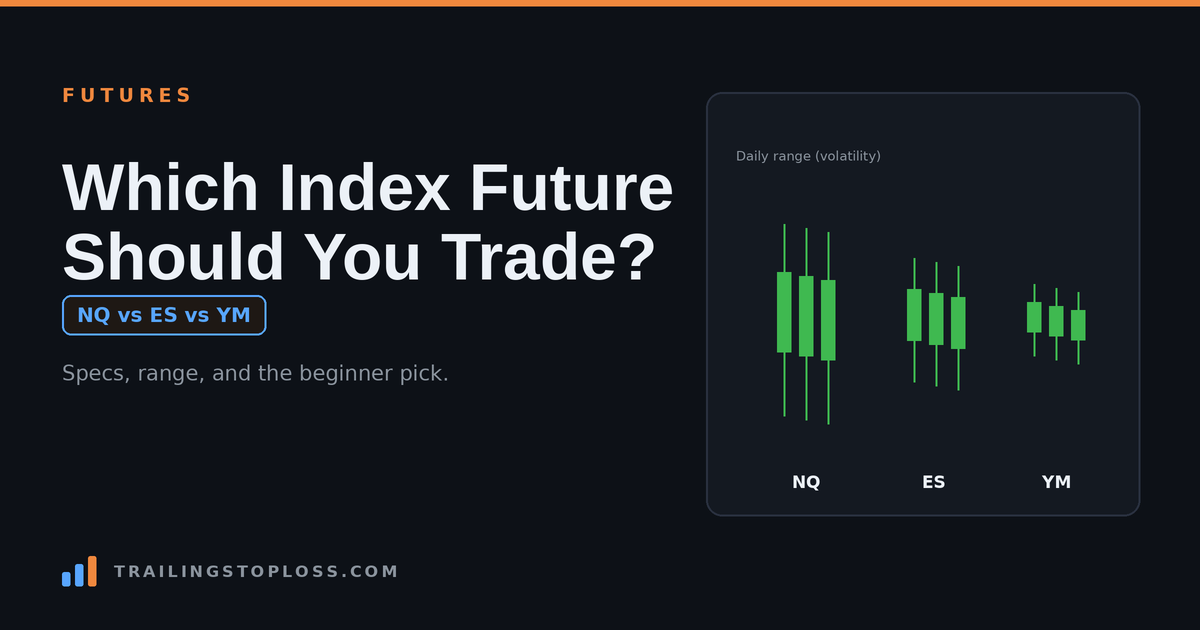
This is where the three contracts stop being cousins and start being different animals. NQ is the most volatile major equity index future, full stop. A typical day sees it travel 200–400 Nasdaq points, and at $20 a point that’s roughly $4,000–8,000 of range per single contract. ES covers about 40–80 S&P points (~$2,000–4,000), and YM’s 200–400 Dow points translate to a gentler ~$1,000–2,000 because each Dow point is worth only $5. Same market, three very differently sized rollercoasters. (PropScorer: NQ 200–400 pt days) (Damn Prop Firms: YM dollar range)
That volatility is exactly why experienced scalpers love NQ, and why it’s the single most popular contract in prop-firm evaluations. It’s also why beginners detonate accounts on it: a $2,500 trailing drawdown that feels roomy on YM can evaporate in two bad NQ swings before you’ve finished your coffee. Bigger range cuts both ways, and when you’re still learning, it mostly cuts you. (PropScorer: NQ is the prop-eval favorite)
Liquidity and fills
ES is the most liquid equity futures contract in the world, so spreads stay tight and fills stay clean even when you’re trading size. NQ is deep too, second only to ES. YM runs a fraction of that — roughly 200,000–300,000 contracts a day, five to seven times thinner than ES — so its bid-ask can widen and fills can slip, especially in off-hours. For a scalper counting single ticks, that slippage is real money leaking out of every trade. (Damn Prop Firms: YM liquidity vs ES) (Emini-Watch: YM volumes down, NQ up)
The personality of each contract
NQ — the adrenaline junkie
NQ offers the greatest absolute dollar opportunity per contract and the highest risk to match. It’s tech-driven, high-beta, and whippy through earnings season, and its margin runs roughly 40% higher than ES. Glorious when you’re right, brutal when you’re still figuring out where your stop goes. (TradeAlgo: NQ risk & margin)
ES — the benchmark
ES is the all-rounder: the deepest liquidity, the tightest spreads, moderate volatility, and the reference every other index is measured against. It’s boring in the best possible way — the kind of boring that keeps you in the game long enough to actually get good. (Damn Prop Firms: ES is the default)
YM — the gentle giant
YM carries the smallest multiplier and the lowest notional value of the four majors, whole-point ticks that make math easy in fast markets, and the smallest daily dollar swings of the three. The price for that calm is thinner liquidity and the occasional wide spread — a fair trade for a nervous beginner, less so for a high-frequency scalper. (TradeAlgo: YM small notional, clean ticks)
The micros change everything
Here’s the detail that reframes the whole question for a new trader: CME’s Micro E-minis are exactly one-tenth the size of the minis. MES is $5 a point ($1.25 a tick), MNQ is $2 a point ($0.50 a tick), and MYM is $0.50 a point ($0.50 a tick). Same charts, same setups, same strategies — one-tenth the dollar risk. A 100-point move on MNQ is $200 instead of $2,000 on NQ. (PropScorer: micros are 1/10th size)
That’s why micros dominate prop-evaluation accounts, where not tripping the drawdown is the entire game, and why they’re the honest starting point for anyone new. Intraday margins run around $50 a micro versus roughly $500 a mini, so you can practice real position sizing, real stops, and real emotions without betting the rent on your first fifty trades. (PropTradingVibes: micro margins ~$50, evals love them)
So which should a new trader actually trade?
Here’s the part you came for. For a brand-new trader, the ranking isn’t close — and it deliberately leads with micros, because sizing down is the highest-return decision a beginner can make.
-
MES (Micro S&P) — the best all-around starting point.
You get the deepest, most liquid market on earth for clean fills, moderate volatility that won’t turn one bad tick into a catastrophe, and micro sizing that keeps dollar risk tiny while you build a repeatable process. If you only ever learn on one contract, make it this one.
-
MYM (Micro Dow) — the most forgiving.
If MES still feels too fast, MYM has the smallest daily dollar range of the three, whole-point ticks, and dead-simple math. The tradeoff is thinner liquidity, so expect slightly worse fills — a reasonable price for the gentlest on-ramp in the group.
-
MNQ / NQ — last, and it’s not the contract’s fault.
NQ’s volatility is precisely what makes it a favorite for experienced scalpers and precisely what shreds beginners against a drawdown limit. If you’re set on trading the Nasdaq, do it on MNQ, keep size microscopic, and earn your way up to the full contract.
Full disclosure, since this is TrailingStopLoss and not a brochure: I trade NQ for a living. I also didn’t start there — and if I had, I’d probably have blown three evaluations learning the lesson the expensive way. The contract that makes you money at year five is often the one that empties your account in month one. Start slow, prove consistency on micros, and graduate up when your process — not your ego — says you’re ready. (PropScorer: NQ favored for scalping)
💰 Bonus that applies to all threeEquity index futures get Section 1256 tax treatment — 60% long-term / 40% short-term regardless of how long you held — which often beats the short-term rate on stocks. That’s a reason to trade futures at all, not a reason to pick NQ over ES over YM. (TradeAlgo: 60/40 treatment)
The bottom line
NQ, ES, and YM all trade the U.S. market, but they hand you very different amounts of speed, dollar risk, and liquidity. NQ is the fast, tech-driven heavyweight the pros scalp; ES is the deep, balanced benchmark; YM is the calm, clean-math contract with a thinner book. For a new trader the answer is boring and correct: start on a micro — MES first, MYM if you want it gentler — keep size tiny, and leave full-size NQ for after you’ve earned it. The market will still be there when you’re ready. (TradeAlgo: not all index futures move alike)
Run the numbers before you trade: check every contract on the Futures Tick Value Reference, size trades with the Position Size Calculator, log results on the P&L Calendar, and if you’re picking a prop firm to trade these on, start with the Prop Firm Comparison Tool.
FAQ
What’s the difference between NQ, ES, and YM?
They track different indexes at different dollar multipliers. ES follows the S&P 500 at $50/point ($12.50/tick), NQ follows the tech-heavy Nasdaq-100 at $20/point ($5/tick), and YM follows the 30-stock Dow at $5/point ($5/tick, in whole-point increments). NQ is the most volatile and highest-risk, ES the most liquid and balanced, and YM the calmest with the smallest dollar swings.
Which index future is best for beginners?
MES (Micro S&P 500) is the best all-around starting point: deepest liquidity, moderate volatility, and one-tenth the dollar risk of ES. MYM (Micro Dow) is the most forgiving if you want smaller swings and simpler math. Full-size NQ is the worst choice for a new trader — its volatility is what wrecks accounts against a drawdown limit.
Is NQ or ES more volatile?
NQ, by a wide margin. A typical day moves NQ 200–400 points (~$4,000–8,000 per contract) versus roughly 40–80 points on ES (~$2,000–4,000). NQ’s tech concentration gives it a higher beta, so it reacts harder to earnings, AI news, and Fed decisions.
Should I start with micros or full E-minis?
Micros. MES, MNQ, and MYM are exactly one-tenth the size of their E-mini counterparts, so you trade identical charts and setups with a fraction of the dollar risk. They’re the standard choice for prop evaluations and the smart way to learn before scaling to full contracts.
How much money do I need to day trade ES, NQ, or YM?
At most futures prop firms, intraday margin is around $500 per E-mini contract (ES, NQ, YM) and about $50 per micro. Retail overnight margins are far higher — roughly $12,000–16,000 for ES, $17,000–21,000 for NQ, and about $8,500 for YM — which is a big reason most retail day traders use micros or a prop account.
TrailingStopLoss publishes independent, funded-trader analysis of prop firms, strategy, and trading psychology. Educational content only — not financial advice. Trading futures involves substantial risk of loss.