Prop Firm Server Reliability: What Happens to Your Funded Account When the Server Goes Down
This week a data center in Amsterdam quietly made the trade press by offering retail brokers somewhere to park their MetaTrader 5 backup servers. On the surface that is the kind of B2B plumbing story you scroll straight past — one more dot on an infrastructure map that already had dots near it. But strip away the rack-and-stack language and there is a question every funded trader should be asking: what actually happens to your account when the firm holding it loses a server? Finance Magnates
The honest answer is that you, not the firm, tend to absorb the damage. A dead trade server can mean positions you cannot close during a news spike, a drawdown breach triggered by a fill that never executed, or a withdrawal stuck behind a “technical maintenance” banner. Server reliability is usually filed under IT. For a funded trader it is closer to consumer protection — and almost nobody shopping for a prop firm reads the fine print on it. Liquidity Connect
The short version: “Amsterdam backup hosting” is the news peg. The real subject is whether the firm guarding your evaluation fee and your payouts has a plan for the day its primary server falls over — and whether that plan protects you or just protects them.
What a failover server actually is
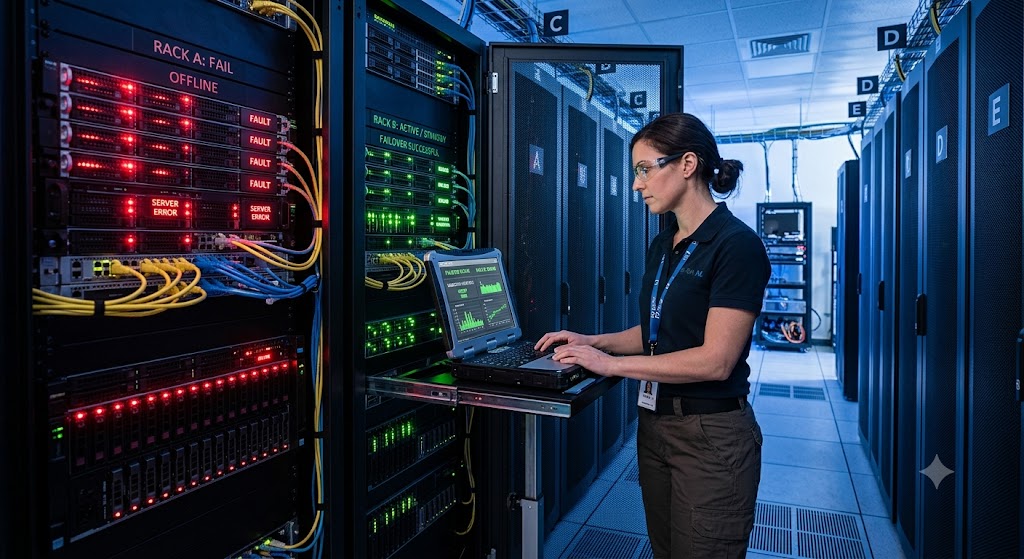
A broker or prop firm runs your account on a primary trade server, typically housed in a major financial data center like Equinix LD4 in London or NY4 in New York. A failover — or backup — server is a second copy of that environment kept in a different data center, continuously synced and sitting on standby. If the primary dies from a power cut, a botched update, or a denial-of-service attack, traffic reroutes to the backup so the lights stay on. Finxsol
The reason placement matters is redundancy through separation. Industry best practice is to put the live trade and demo servers in one data center and the backup in a different one entirely, so a single physical failure cannot take down both at once. Adding an Amsterdam location simply gives European-facing brokers another geographically separate spot to keep that second copy — useful, incremental, and completely invisible to you until the day it is the only thing standing between you and a frozen account. Liquidity Connect
The trader’s-eye view of an outage
From the firm’s side, downtime is a support ticket and an apology email. From your side it can be a blown account. Picture an outage that lands mid-CPI or during an FOMC release: you cannot exit a runner, your stop never fires, and by the time the platform reconnects the market has moved through three levels you would have been out of. If the firm’s risk engine then reads that as a max-drawdown breach, the failure was theirs and the consequence is yours. Finxsol
This is not hypothetical or limited to fly-by-night operators. Even the largest, most established names in the space have had their MetaTrader servers go dark unexpectedly before coming back online — outages are a question of when, not if. The differentiator between firms is not whether they ever go down; it is whether they have a tested failover plan and whether their rulebook treats you fairly when they do. Finance Magnates
The fine print that protects them, not you
Here is where the honest-broker lens earns its keep. Most prop firm and broker terms contain a server-error or force-majeure clause, and they are almost never written in your favor. They reserve the right to void trades opened during a “technical malfunction,” disclaim liability for losses caused by connectivity issues, and define “downtime” however suits them. Read carefully and you will often find the firm is liable for nothing and you are liable for everything. Liquidity Connect
| Outage scenario | What the firm usually says | What it can cost you |
|---|---|---|
| Server down during a news spike | “Not liable for losses from connectivity issues” | Open positions you cannot exit; runaway loss |
| Stop-loss never triggered | “Orders are not guaranteed during malfunctions” | Drawdown beyond your planned risk |
| Drawdown breach during downtime | Risk engine logs the breach automatically | Account closed for a failure that was theirs |
| Profitable trades during the outage window | “Trades during malfunctions may be voided” | Your gains reversed; their gains rarely are |
| Withdrawal stuck behind maintenance | “Processing delayed due to technical work” | Payout you earned, parked indefinitely |
The asymmetry to watch for: when an outage hurts you, it’s “market conditions.” When it would have hurt the firm, it’s a “voidable malfunction.” A clause that only ever cuts one way tells you how the firm thinks about operational responsibility.
How to vet reliability before you fund
You cannot audit a firm’s data center, but you can read the signals that separate operators who take uptime seriously from ones running a single box and a prayer. Reliability is checkable before you ever hand over an evaluation fee — it just takes knowing where to look. Trading FX VPS
The pre-funding reliability checklist
- Is there a public status page? Firms that publish real-time uptime and incident history are inviting scrutiny. Firms that hide downtime in a Discord channel are not.
- Do they name their infrastructure? Mentions of Equinix data centers, named hosting partners, or an explicit failover setup are good signs. Vague “enterprise-grade servers” copy is not.
- Platform risk: a firm on its own regulated MT5 license controls its server fate differently than one renting access — and proprietary platforms carry their own outage profile. Know which you are trading.
- Outage track record: search the firm’s name with “down” or “outage.” Everyone has incidents; you are looking at frequency and how they communicated.
- The rulebook test: read the server-error and withdrawal clauses before funding. If downtime breaches are non-reversible but downtime profits are voidable, you have your answer.
Reliability is a cost — it just never shows on the pricing page
Our entire Prop Firm True Cost framework exists because the headline price of a challenge is rarely the real price. Operational risk belongs in that same bucket. A cheap evaluation at a firm with no failover plan is not cheap if a single outage voids your funded account during the one week it mattered. Whether you trade futures or forex, reliability is a line item — an invisible one, until it is the only one that counts.
Where this standard comes from: our editorial position is built on watching the prop space the hard way, including firms that wound down and left traders stranded. It’s also why our own One Trade a Day challenge runs on a futures account we vet for stability rather than the cheapest sticker price.
Disclosure: TrailingStopLoss.com earns affiliate commissions from some prop firms. Our rankings are not for sale — flagged or unreliable firms are demoted regardless of whether they pay. One firm we currently run a live account with is Alpha Futures.
The bottom line
An Amsterdam backup server is a footnote. The principle behind it is not. Failover is the difference between an inconvenient afternoon and a dead account, and the firms quietly spending money on redundancy are telling you how seriously they take the job of holding your capital. Before you fund anything, read the outage clauses, find the status page, and treat reliability as part of the true cost — because the day the server goes down, it is the only part that matters. Finance Magnates
Frequently asked questions
What is a failover server in prop trading?
It is a continuously synced backup copy of a firm’s trade server, kept in a separate data center on standby. If the primary server fails, traffic reroutes to the backup so your account stays online instead of freezing.
Can a prop firm close my account because of their own server outage?
It happens. If an outage causes a fill to miss or a stop not to trigger, some firms’ risk engines log the resulting drawdown as a breach automatically. Always read the server-error clause before funding to see how the firm handles downtime-caused breaches.
How do I check if a prop firm is reliable before paying?
Look for a public status page, named infrastructure such as Equinix data centers or a stated failover setup, and search the firm’s name with terms like “down” or “outage.” Then read the technical-malfunction and withdrawal clauses in the rulebook.
Does it matter which data center a prop firm uses?
Yes, for redundancy. Best practice is to keep the live server and the backup in two physically separate data centers so a single power failure or attack cannot take both down at once. A new location like Amsterdam simply gives firms another separate spot for that backup.
Are server outages common with MetaTrader 5 prop firms?
Outages happen to firms of every size, including the largest and most established names. The meaningful difference is not whether a firm ever goes down, but whether it has a tested failover plan and rules that treat traders fairly when downtime occurs.