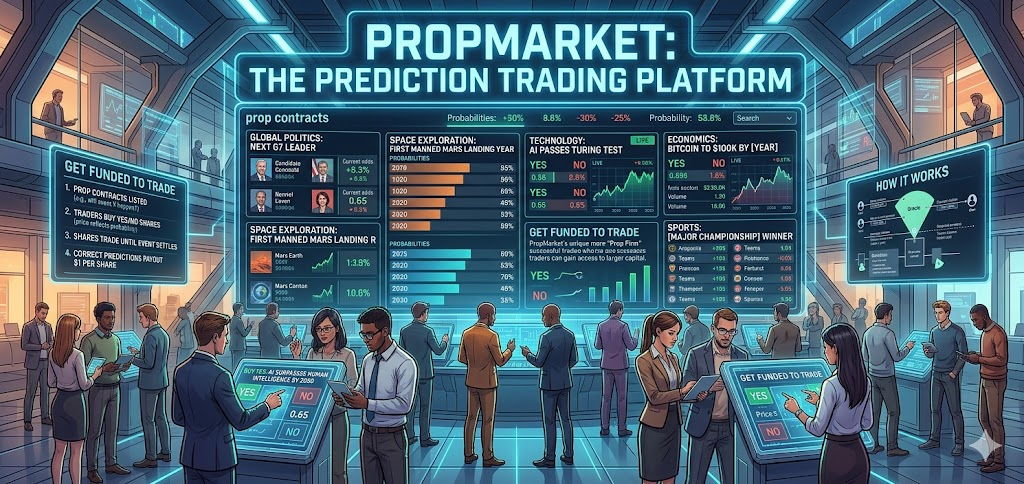
The prop firm industry has spent five years running out of asset classes to gamify. Forex, futures, crypto, even sports betting all got the evaluation-fee treatment. So it was only a matter of time before someone pointed the funded-account model at prediction markets — and on May 15, 2026, a firm called PropMarket did exactly that, offering simulated accounts that, once passed, fund you with up to $250,000 to trade event contracts on Polymarket. PropMarket
What PropMarket actually is
Strip away the novelty and the mechanics are the same model every funded trader already knows: you pay a one-time evaluation fee, trade a simulated account, hit a profit target without breaching a drawdown limit, and graduate to a "funded" account where you keep a cut of the gains. PropMarket sets the target at 20%, the max drawdown at 10%, and the profit split as high as 90/10. Account sizes run from $5,000 to $100,000 today, with a $250,000 tier still in development despite the press release leading with that headline number. PropMarket
The wrinkle is the underlying instrument. Prediction-market contracts don't have a price chart in the conventional sense — every contract settles at either $1 or $0 depending on whether an event happens. That binary structure meant the firm couldn't lift its risk rules off the shelf from a futures playbook; position sizing, drawdown, and consistency rules all had to be rebuilt around outcomes that resolve to one or zero. To actually run the platform and supply liquidity, PropMarket partnered with the development team behind BreakoutProp, an existing prop firm. GlobeNewswire
Is it really the "first" prediction market prop firm?
No, and it isn't especially close. PropMarket's marketing leans hard on being "the world's first prediction market prop firm," but Maven Trading planted that exact flag back in April 2026, announcing live prediction markets and crowing about being first to ship. Maven Trading
And even Maven wasn't truly first. For Traders rolled out a prediction-market prop offering in beta back in March 2026, which trade press covered at the time as the opening move in the category. When three different firms in three months all claim to be "first," the honest read is that "first" has become a marketing word rather than a chronological one — so if you see PropMarket repeat it, mentally file it under branding. TradeInformer
The category is also being actively commoditized behind the scenes. Trade Tech Solutions, an infrastructure provider that powers dozens of prop firms, now sells a turnkey package that lets an operator stand up a branded prediction-market prop firm in roughly 15 days. Translation: the "first" land-grab is irrelevant, because a flood of near-identical firms is already on the assembly line. Finance Magnates
Who's behind PropMarket
This is where a funded trader should slow down. PropMarket's co-founders, Mitchell Morgan and Colton Brooks, come from crypto and entertainment marketing — Morgan was a founding marketer at a startup later valued around $115 million, and Brooks built a social-media management firm to over two million followers and did social-growth work with names like Coinbase. Both are clearly capable operators. Neither résumé is built on trading desks, risk management, or running a balance sheet that has to pay traders out. GlobeNewswire
That isn't disqualifying on its own — plenty of prop firms are marketing engines with a risk team bolted on — but it's exactly the profile worth noting before you wire an evaluation fee to a company that's days old. The promised payout layer is what you're really buying, and a payout promise is only as good as the operator standing behind it. If you've followed our prop firm coverage, you know that's not a hypothetical concern.
We've watched this movie. FundingTicks retroactively changed its rules in December 2025 and shut down in January 2026 with only partial refunds, stranding traders who held legitimate profits. A brand-new firm with a marketing-led founding team and an unproven payout history is precisely the counterparty profile that burned people then. Whatever the asset class, the payout track record is the product — and PropMarket doesn't have one yet.
The regulatory catch nobody's putting in the headline
Here's the part that should give US traders pause. PropMarket funds accounts to trade on Polymarket, and the global Polymarket exchange has been geoblocked for US users since its 2022 settlement with the CFTC, in which the company paid a $1.4 million penalty and agreed to bar US persons from the international platform. A separate, CFTC-regulated Polymarket US exchange came online later and dropped its waitlist in May 2026, but it's a distinct product with full KYC, and it isn't obvious which Polymarket a globally-marketed prop firm is routing funded traders onto. TradeInformer
That ambiguity isn't an accident — trade analysts have openly described prediction-market prop firms as a form of regulatory arbitrage, a way to give traders in regions where the underlying product is restricted a side door into it via a funded account. That framing is great for the firm's addressable market and genuinely murky for the individual trader, who needs to know whether they can legally trade the thing they just paid to be evaluated on. TradeInformer
Confirm, in writing from the firm, exactly which venue your funded account trades on and whether traders in your jurisdiction can use it. If you're in the US, this matters more than the profit split: an evaluation you can pass but can't legally trade afterward is the most expensive kind of practice account there is. None of this is legal advice — verify your own state and federal position before funding anything.
Should you fund a prediction market account?
For most traders, the answer right now is "watch, don't wire." PropMarket clears exactly zero of the bars we use to list a firm: it has no 12-month operating history, no meaningful base of independent reviews, and no payout track record to vet. That doesn't make it a scam — it makes it unproven, which is a different word with the same practical implication for your evaluation fee. The same logic we apply to the true cost of getting funded in every other asset class applies here: the sticker price of the eval is the smallest number in the equation.
There's also a genuine question of whether prediction markets even suit the funded model. A 10% trailing drawdown on instruments that gap straight to zero when an event resolves is a fundamentally different risk surface than a futures contract you can scale out of. The prop wrapper assumes you can manage risk continuously; a binary contract doesn't always let you. If the category interests you, the more proven adjacency is the regulated crypto space, where firms like the ones in our crypto prop firm coverage at least have history behind them.
The honest summary: PropMarket is a real, live product riding a real, fast-growing trend, built by capable marketers on top of someone else's infrastructure, routed through a venue with a US-access asterisk, with no track record yet. That's not a recommendation and it's not a warning to stay away — it's a reason to let other people's evaluation fees generate the payout data before you risk yours.
Frequently asked questions
What is PropMarket?
PropMarket is a proprietary trading firm that launched on May 15, 2026, offering funded accounts to trade prediction-market contracts on Polymarket. Traders pay an evaluation fee, trade a simulated account to a 20% profit target while staying under a 10% drawdown, and then receive real capital — account sizes currently range from $5,000 to $100,000, with a $250,000 tier in development and profit splits up to 90/10.
Is PropMarket really the first prediction market prop firm?
No. Maven Trading announced live prediction markets in April 2026, and For Traders launched a prediction-market prop offering in beta back in March 2026. PropMarket's "world's first" claim is marketing language; the category already had at least two earlier entrants and a turnkey infrastructure provider building more.
Can US traders use PropMarket?
It's unclear and worth confirming directly with the firm. The international Polymarket exchange has been geoblocked for US users since a 2022 CFTC settlement, while a separate CFTC-regulated Polymarket US product launched later with full KYC. Before paying an evaluation fee, US traders should verify exactly which venue funded accounts trade on and whether their jurisdiction permits access.
How are prediction-market risk rules different from futures or forex?
Prediction-market contracts settle at either $1 or $0 based on whether an event happens, so there's no continuous price action to scale in and out of. PropMarket says it rebuilt position sizing, drawdown, and consistency rules from scratch for this binary structure, because a standard trailing-drawdown model designed for futures doesn't map cleanly onto contracts that can gap straight to zero on resolution.
Should I trust a brand-new prop firm with my money?
Caution is warranted. PropMarket has no 12-month operating history, no large base of independent reviews, and no payout track record yet, and its founders come from marketing rather than trading or risk backgrounds. The collapse of FundingTicks in early 2026 showed how an unproven counterparty can strand traders holding real profits, so the prudent move is to watch the firm establish a payout history before funding an account.


