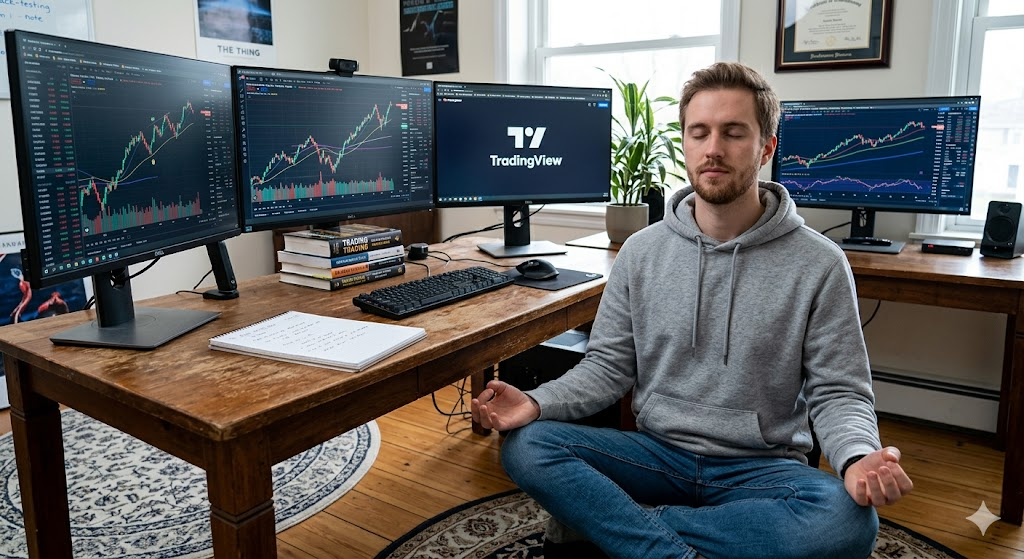
Tools to Get Your Mind Right Before the Trading Session
Your strategy can be flawless and your charts can be pristine, and you will still hand your account back to the market if you sit down to trade with a brain that's running on three hours of sleep, two energy drinks, and a low-grade sense of dread. The hard truth most new traders learn the expensive way: the trade is won or lost before the bell, in the boring fifteen minutes nobody posts about. Below are the pre-session tools that actually have evidence behind them — not vibes, not crystals — plus how to stack them into a routine you'll actually do.
The mental game decides the session, not the setup
There's a tidy little curve from performance psychology that explains why you can't just "lock in" by sheer willpower. Too little arousal and you're flat, bored, and slow on the trigger. Too much and you're tilted, jumpy, and revenge-clicking. Peak execution lives in a narrow band in the middle — calm but alert. The entire point of a pre-session routine is to walk yourself into that band on purpose instead of letting the first red candle decide your nervous system for you. If you trade fast, like the scalping and continuation style a lot of futures traders run, that band is even narrower, because you don't have time to "calm down later."
1. Build a real pre-session routine (and actually run it)
Elite athletes don't walk up to a free throw cold; they run the same little sequence of actions and cues every single time, because it pulls their focus onto the task and away from the noise. A meta-analysis pooling 112 effect sizes found that pre-performance routines produced moderate-to-large improvements in execution under pressure — and the effect held whether the pressure was low or genuinely high. The market is a closed, self-paced environment, which is exactly the kind of setting where these routines work best. Yours doesn't need to be elaborate; it needs to be the same every day so your brain learns "this sequence means it's go time," according to the International Review of Sport and Exercise Psychology.
2. Breathe on purpose for two minutes
This sounds like the kind of advice you scroll past, right up until you understand the wiring. Slow, deliberate breathing — roughly five to six breaths per minute, with the exhale longer than the inhale — shifts your autonomic nervous system toward parasympathetic ("rest and digest") dominance by way of the vagus nerve, which is the same system that throttles your fight-or-flight response. A systematic review of the physiology found that slow breathing reliably tips that balance away from the sympathetic spike that makes you stab at entries, per Frontiers in Human Neuroscience.
Even a single short session moves the needle. In a controlled study, five minutes of deep, slow breathing increased markers of parasympathetic activity and lowered self-reported anxiety — five minutes, not a weekend retreat in Sedona. Box breathing (inhale 4, hold 4, exhale 4, hold 4) is the version most traders default to because it's stupid-simple to count when your heart rate is already climbing, and the research on slow paced breathing in Scientific Reports backs the underlying mechanism.
Do this: Right before the open, four rounds of box breathing. Inhale 4, hold 4, exhale 6, hold 2 if you want extra calm — the long exhale is the part that does the heavy lifting.
3. Protect your sleep like it's part of your edge
Here's the one nobody wants to hear, because the fix isn't a hack — it's going to bed. Sleep loss hammers the exact brain regions you trade with. The classic University of Iowa work using the Iowa Gambling Task showed that sleep-deprived people make markedly more disadvantageous choices, get overconfident, and — this is the killer — fail to learn from negative feedback. In other words, a tired trader takes the bad setup, doubles down after it loses, and doesn't update. Neuroimaging tied this to reduced activity in the prefrontal cortex (your executive brakes) and increased activity in reward-seeking regions, as summarized in research from the University of Iowa psychological laboratory.
A 2024 review confirmed the relationship is real and consistent: sleep deprivation reliably degrades risk-related decision-making, with the ability to process negative feedback impaired after as little as a single short night, according to the National Library of Medicine. If you're trading a funded or evaluation account where one undisciplined day blows the whole thing, treating sleep as optional is just an expensive way to fail a challenge. (If you're not sure how unforgiving those rules really are, the math is laid out in our prop firm true cost breakdown.)
4. Move your body before you sit in the chair
A short bout of exercise before you trade isn't about getting jacked; it's a free, legal nootropic. Reviews of acute exercise find that a single 20-to-30-minute session of moderate activity measurably improves executive function and attention — specifically the inhibition and conflict-control abilities you lean on when you're deciding not to take a trade. Tasks built to measure exactly that (Flanker, Stroop, Go/No-Go) improve after a brisk walk or a quick lift, according to the National Library of Medicine. The effect tends to peak in the window shortly after you finish, which is conveniently when the open happens if you time it right.
5. A few minutes of mindfulness (yes, it's been studied on actual traders)
This one even has trader-specific evidence, which is rarer than it should be. A study of 226 stock traders in Thailand found that those who practiced mindfulness meditation more intensively reported better trading performance, and the link ran through impulse control — more mindfulness, fewer impulse-control problems, less panic selling and overreaction, per ResearchGate. If you've ever closed a winner early out of pure twitchiness, that's the exact mechanism being described.
It also shows up in the bloodwork. A 2025 study of finance professionals found that a brief mindfulness intervention raised testosterone and lowered cortisol — your primary stress hormone — during live trading, which is precisely the hormonal profile you'd want before a session, according to ScienceDirect. You don't need to become a monk; you need a few quiet minutes of watching your breath without checking the pre-market for the ninth time.
6. Decide your max loss before the bell, not after
Every method above lowers your stress. This one removes a decision you'd otherwise make at the worst possible moment. Set your hard daily loss limit, your max position size, and your "I'm done for the day" line while you're still calm — because the version of you that's down two reds is in no condition to be negotiating with the version of you that wrote the rules. Sleep-deprived or stressed brains are exactly the ones that ignore negative feedback and chase, which is why the limit has to exist on paper (or in an alert) before you can talk yourself out of it. For the mechanics of building those guardrails, see our trading psychology coverage.
Pre-commit, don't improvise: Write your max daily loss and max trades on a sticky note, or set a hard kill line. A rule you set when calm beats a judgment call you make when tilted — every single time.
Put it together: a simple pre-open stack
None of these tools is impressive on its own. The point is the stack — a short, repeatable sequence that walks you from "civilian" to "calm and alert" in well under half an hour. Here's a no-nonsense version you can run before the New York open and adjust to taste.
| When | What | Why it works |
|---|---|---|
| Night before | 7–8 hrs sleep, screens off early | Protects prefrontal control & feedback learning |
| T–45 min | 20-min brisk walk or quick workout | Sharpens attention & inhibition for the open |
| T–15 min | 3–5 min mindfulness / quiet | Lowers cortisol, improves impulse control |
| T–5 min | Review plan: levels, max loss, max trades | Locks in rules while you're still calm |
| T–1 min | 4 rounds box breathing | Flips you toward parasympathetic / "the zone" |
Run the same stack daily and it stops being a chore and becomes the cue your brain reads as "we're trading now." That consistency is the whole point — the routine itself is what reliably nudges you into the calm-alert band, which is the entire reason pre-performance routines beat winging it. If you want the bigger picture on how mindset fits alongside risk and strategy, our trading education section ties it together.
Reality check: No routine turns a bad strategy into a good one. It just stops a good strategy from being sabotaged by the person running it. That person, unfortunately, is you.
Frequently asked questions
How long before the open should I start my pre-session routine?
Most of the stack fits in about 45 minutes: a short workout earlier, a few quiet minutes mid-window, a plan review near the open, and breathing right before the bell. The exact timing matters less than running the same sequence every day so it becomes an automatic cue.
Does box breathing actually calm you down, or is it a placebo?
It has a real physiological basis. Slow breathing at roughly five to six breaths per minute, especially with a longer exhale, shifts your nervous system toward parasympathetic dominance via the vagus nerve, lowering the stress response. Even a single five-minute session has been shown to raise parasympathetic markers and reduce anxiety.
Can one bad night of sleep really hurt my trading?
Yes. Research shows sleep loss impairs the prefrontal cortex while ramping up reward-seeking brain regions, which makes traders more impulsive, more overconfident, and worse at learning from losing trades. Studies have found risk-decision impairment after even a single short night, so it's not just an all-nighter problem.
What's the single most important pre-session habit if I only pick one?
Sleep, with risk pre-commitment a close second. No breathing exercise can out-run a brain that won't process negative feedback. Set your max daily loss and max trades while you're calm, and the rest of the routine has something solid to protect.


