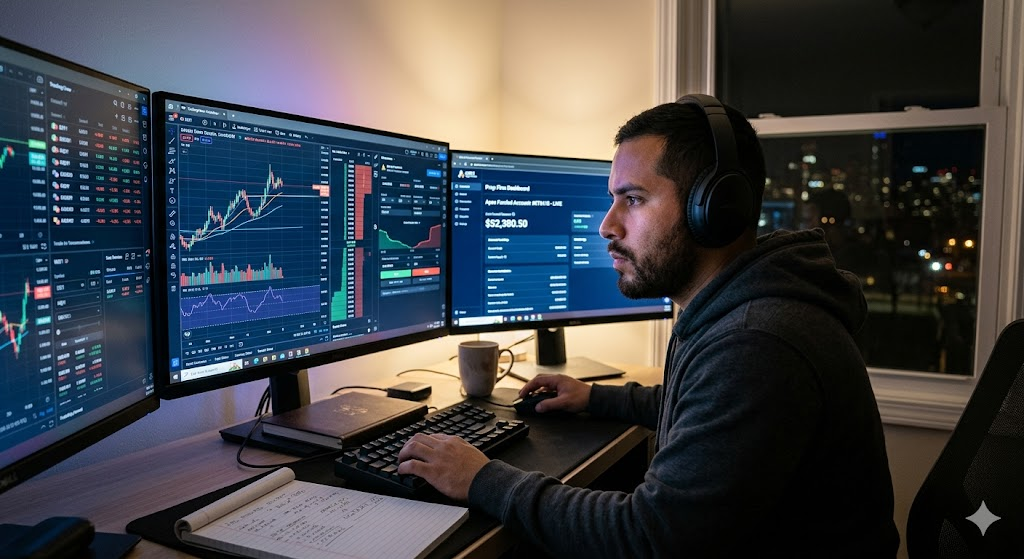
Somewhere right now, a retail trader with three monitors and a YouTube subscription is paying $500 for the privilege of trading a fake account that he will probably blow up by Friday. Multiply that scene by a few million people and you have the modern proprietary trading industry, a roughly $20 billion ecosystem built almost entirely on the gap between what traders think they can do and what the data shows they actually do. The business is not exactly a scam, but it is not exactly what the slick funnels imply, either. Below is the math, the mechanics, and the recent industry chaos, all in one place.
The Industry by the Numbers
Prop firms are no longer a niche corner of the trading world. WorldMetrics' 2025 industry report values the global proprietary trading sector at roughly $20 billion, with more than 2,000 firms operating worldwide and roughly 60 to 65 percent of them headquartered in the United States. Search interest in "prop firm" has climbed about 607 percent between 2020 and 2024, which is the kind of growth curve usually reserved for memecoins and Stanley cups. For broader context on where this fits in the retail trading boom, see our coverage of the day trading ecosystem. Source: Atmos Funded industry report.
The growth has not been confined to one region. In the United States, search volumes for prop firms jumped from 7,475 in 2020 to 46,820 in 2024, a 526 percent climb in four years. The UK saw a 315 percent increase over the same window, and Canada posted a 377 percent rise from a smaller base. Indonesia has emerged as the fastest-growing market in the world, with monthly search volume now running roughly five times higher than a year ago. Source: BestPropFirms 2026 prop trading statistics.
How Prop Firms Actually Make Money
The marketing pitch is that prop firms make money when traders make money. That is technically true the way it is technically true that casinos make money when players win. The dominant revenue source for the retail-facing prop industry is, by a wide margin, evaluation fees from the people who fail. The industry generates an estimated $2 to $4 billion annually in evaluation fee revenue globally, and that figure does not include reset fees, activation fees, monthly platform subscriptions, or any of the smaller charges sprinkled throughout the funnel. Source: ThePropFirmGuide 2026 statistics report.
1. Evaluation Fees: The Engine
Every retail prop firm sells a paid "challenge" or "evaluation" before granting a funded account. Fees typically range from about $50 for a small futures evaluation to $1,000 or more for a $200K forex challenge. The $100K account is the industry's flagship product, representing roughly 45 percent of all evaluations purchased, with the $50K account holding the number-two spot. The genius of the model is that the firm collects the fee upfront whether the trader passes, fails, or quits in week two to take up pickleball. Source: ThePropFirmGuide.
2. Reset Fees: The Quiet Cash Cow
When a trader fails a challenge, most firms offer a discounted "reset" so they can try again on the same account. The reset is priced to feel like a deal. Statistically, it is not. A trader who resets three times has paid three evaluation fees without altering the underlying probability of passing. For firms that lean on this revenue stream, repeat failures are not a bug, they are the recurring subscription. Source: Apex Trader Funding revenue model breakdown.
3. Monthly Subscriptions and Add-Ons
Several prop firms, particularly in the futures space, charge monthly platform or data fees. Apex Trader Funding, for example, charges traders roughly $85 per month for ongoing platform and data access. Multiply that by tens of thousands of active accounts and it becomes a recurring revenue stream that arrives whether anyone trades a single contract or not. If you're focused on this segment, our prop firm category page tracks the major futures and forex programs. Source: LuxAlgo retail prop firm revenue analysis.
4. Profit Splits on Funded Accounts
The profit split is the part the marketing actually emphasizes, and it is real, just smaller than you'd think relative to the rest. Retail firms typically hand traders 80 to 90 percent of their profits and keep 10 to 30 percent for the house. The catch is that most "funded" accounts at retail firms are still simulated. The firm is not always risking its own capital on every trade. They are running a payout model based on the trader's tracked performance, often hedged or mirrored selectively in live markets when a trader proves genuinely profitable. Source: Prop Trading Vibes evaluation guide.
5. The Hybrid: Treating Profitable Traders as Signal
A meaningfully profitable trader is not a liability to a well-run firm, they are an asset. Their trades can be mirrored into live positions where the firm captures both the profit split and the gains from the replicated trade. The 90 percent who fail effectively bankroll the infrastructure that lets the firm identify and ride the 1 to 2 percent who are genuinely good. It is a feeder system, not a charity. Source: Apex Trader Funding.
The Pass Rate Reality
This is where it gets uncomfortable. FPFX Tech analyzed more than 300,000 prop accounts from 100,000 traders across 10 firms and found that only 14 percent pass a challenge, only 7 percent of all traders ever reach a payout, and the average payout amount is roughly 4 percent of the funded account size. Translated, that means if you buy a $100K evaluation, you have about a 1-in-7 shot of passing, a 1-in-14 shot of ever seeing a payout, and the typical payout when it does happen is around $4,000. For more context on why retail traders struggle so badly, see our trading psychology coverage. Source: Atmos Funded analysis of FPFX Tech data.
| Metric | Industry Average | What It Means |
|---|---|---|
| Challenge pass rate | ~14% | About 1 in 7 traders clears the evaluation |
| Traders who ever receive a payout | ~7% | Passing is not the same as getting paid |
| Average payout vs. account size | ~4% | Roughly $4K on a $100K funded account |
| Most popular account size | $100K (45% of buys) | The marketing sweet spot |
| Consistently profitable over a full year | <15% | Even most funded traders fade out |
| Annual evaluation fee revenue (industry) | $2-4 billion | Before resets and subscriptions |
The gap between "passed an evaluation" and "actually got paid" is the most-ignored statistic in the entire industry. Roughly half of traders who pass a challenge never withdraw a dollar. They either blow the funded account before reaching a payout milestone, fail a consistency rule, or violate a max-loss limit that quietly resets the whole journey. Source: PropAccount pricing model breakdown.
The 2024 Industry Reckoning
For most of its history the retail prop industry rode one platform: MetaTrader, built by Cyprus-based MetaQuotes. An estimated 70 to 80 percent of all prop firms used MT4 or MT5 as their evaluation environment. On February 2, 2024, MetaQuotes terminated True Forex Funds' MT4/MT5 licenses with no warning, and within weeks systematically revoked access from dozens of other prop firms, citing grey-label abuse, regulatory exposure to U.S. authorities, and demo-server arrangements that generated zero licensing revenue for the platform owner. Source: VeritasChain analysis of the 2024 collapse.
The fallout was brutal. Between February 2024 and late 2025, approximately 80 to 100 prop firms ceased operations. Brokers like Eightcap, Purple Trading, and Blackbull Markets were forced to choose between their prop firm B2B clients and their own MetaTrader licenses, and unsurprisingly they picked the licenses. FTMO, the largest player in the space, halted U.S. client acquisition entirely and eventually migrated to DXtrade for that market. Source: Finance Magnates coverage of the FTMO halt.
The survivors share a few traits: platform independence (Apex Trader Funding, which uses proprietary infrastructure, was immune), proper licensing (FTMO held European regulation and kept MetaTrader for non-U.S. markets), and the financial reserves to absorb a forced platform migration. FTMO ultimately secured a $250 million credit line from a UniCredit-led bank syndicate and acquired OANDA on December 1, 2025, bringing regulated entities across New York, London, Singapore, and Tokyo under its umbrella. Source: VeritasChain.
Retail Props vs. The Real Thing
The word "prop firm" is doing a lot of heavy lifting these days. The retail evaluation-based model that dominates Google search results is structurally different from the institutional prop firms that drive actual market liquidity. Jane Street, for example, posted $10.1 billion in net trading revenue and $6.9 billion in net profit in Q2 2025 alone, averaged $2 trillion per month in equity trading volume in 2024, and dominated 41 percent of bond ETF trading volume. Jane Street traders receive 10 to 30 percent of their book's profit and loss but take on zero personal capital risk and pay no evaluation fees. Source: QuantVPS 2026 prop firm statistics.
For some perspective on the broader industry, proprietary trading firms are responsible for over 60 percent of daily trading volume on major stock exchanges, contribute roughly 15 percent of total liquidity in the global FX market, and account for nearly 40 percent of total revenue at major investment banks globally. The retail evaluation model is the loud, brightly-colored consumer wrapper around an industry that mostly happens at the institutional level. Source: WifiTalents prop trading industry statistics.
What Traders Should Actually Take Away
Prop firms are not categorically bad. For a skilled, disciplined trader with a tested strategy and proper risk management, the math can absolutely work. Self-reported data suggests that traders with a defined strategy and disciplined position sizing report pass rates closer to 20 to 40 percent, well above the 14 percent industry average. The difference between the average outcome and the prepared-trader outcome is preparation, not luck. For a structured approach to risk before you ever click "buy challenge," see our trading education resources. Source: Prop Trading Vibes 2026 evaluation guide.
The questions worth asking before you swipe a card: How does this firm actually generate revenue? Are funded accounts simulated or live? What is the payout track record, ideally on-chain or third-party verified? Are there hidden consistency rules that quietly disqualify profitable trades? How exposed is the firm to one trading platform or one regulatory jurisdiction? The 80 firms that closed in 2024 had answers to none of these. The ones that survived had answers to all of them.
FAQs
How do prop firms make most of their money?
Evaluation fees from traders who fail their challenges are the largest single revenue source, generating an estimated $2 to $4 billion globally per year. Reset fees, monthly platform subscriptions, and profit splits on funded accounts make up the rest, with profit splits typically being a smaller share than the marketing implies.
What percentage of prop firm traders actually get paid?
Based on FPFX Tech's analysis of more than 300,000 accounts, only about 7 percent of traders who buy an evaluation ever receive a payout. Roughly 14 percent pass the initial challenge, but many of those never reach a payout milestone before violating a rule or blowing the funded account.
Are prop firm funded accounts real money?
At most retail prop firms, both the evaluation and the "funded" account are simulated environments with live market data feeds. Profits are tracked and paid out according to a profit-split agreement, but the firm is not typically risking its own capital trade-for-trade. Some firms mirror profitable traders into live positions; institutional prop firms operate entirely on real capital.
Why did so many prop firms shut down in 2024?
In February 2024, MetaQuotes began revoking MetaTrader licenses from prop firms over grey-label abuse and U.S. regulatory exposure. An estimated 70 to 80 percent of prop firms relied on MetaTrader, so the crackdown closed approximately 80 to 100 firms between early 2024 and late 2025. Survivors moved to platforms like cTrader, DXtrade, and MatchTrader.
What is the average payout from a prop firm?
Industry data shows the average payout is approximately 4 percent of the funded account size. On a $100,000 funded account, that works out to around $4,000 per payout. Comparing total industry payouts to total evaluation revenue produces the same roughly 4 percent ratio, meaning about 96 cents of every dollar collected does not return to traders as profit.
Is the retail prop firm model sustainable?
Firms relying on evaluation fees for 80 to 95 percent of their revenue have proven unsustainable, which is the structural reason behind the 2024 collapse. Survivors are moving toward broker-backed models, proper regulation, and platform independence. The Prop Association (TPA), formed in April 2025, is an early sign of voluntary industry self-regulation.