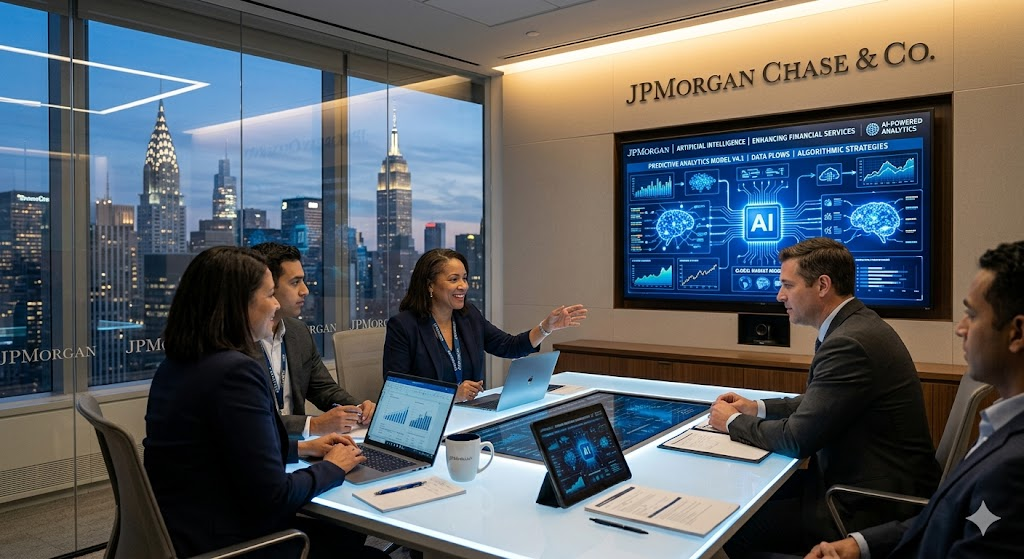
JPMorgan Chase CEO Jamie Dimon stepped onto a stage in Shanghai this week and casually mentioned that the biggest bank in America will be hiring more AI engineers and fewer bankers going forward. He also said, and this is a direct quote, that AI "will reduce our jobs down the road." Wall Street, predictably, has decided this is fine and absolutely nothing to worry about.
Speaking at JPMorgan's China Summit on May 21, 2026, Dimon told Bloomberg Television that the firm will be "hiring more AI people and fewer bankers in certain categories" as the technology accelerates across the bank's operations. The remarks landed at a moment when nearly every major global lender is openly rewiring its workforce around large language models, agents, and automation. For traders watching how all of this lands in equities and rates, see our ongoing coverage in pre-market and business. Bloomberg

What Dimon Actually Said
The direct quote is the part that matters. Dimon told Bloomberg that "there will be all different types of jobs, and I think we will be hiring more AI people and fewer bankers in certain categories, and it will make them more productive," then added the line that got every banker on the floor refreshing their LinkedIn: "I think it will reduce our jobs down the road." He framed the transition as gradual rather than guillotine-style, leaning on JPMorgan's roughly 10% annual attrition rate, somewhere between 25,000 and 30,000 employees a year, as the cushion that lets the firm shrink certain functions without staging a public massacre. Reuters
This is a tonal shift from where Dimon was four months ago. At Davos in January, he admitted JPMorgan will likely employ fewer workers in the next five years but warned that rushing into AI-driven layoffs without safeguards could trigger "civil unrest," and said he would even welcome government bans on replacing masses of workers with AI. Same CEO, same bank, considerably less hedging this time around. The Shanghai version is what happens when you stop talking to the World Economic Forum and start talking to shareholders. Fortune
The CFO Doing the Quiet Cutting
While Dimon handles the rhetoric, CFO Jeremy Barnum is handling the spreadsheets. On the Q3 2025 earnings call, Barnum told analysts the bank has "a very strong bias against having the reflexive response to any given need to hire more people," citing "definitely productivity tailwinds from AI" that allow managers to push back on headcount requests. At the bank's May 2025 investor day, Consumer & Community Banking CEO Marianne Lake had already projected a roughly 10% reduction in operations and account-services headcount as AI absorbs the workload in fraud monitoring, account servicing, and back-office processing. Banking Dive
This shows up clearly in the headline numbers. JPMorgan's Q3 2025 earnings showed profit jumping 12% year-over-year to $14.4 billion while headcount rose just 1% to 318,153 employees — a restrained pace Barnum attributed to deliberate strategy rather than market conditions. In a blockbuster year for trading and investment banking revenue, the world's largest bank chose to stop hiring. That is not a normal cyclical signal. Bloomberg
JPMorgan's AI-Driven Workforce Shift at a Glance
| Metric | Detail |
|---|---|
| Annual AI spend | ~$2 billion |
| Headcount (Q3 2025) | 318,153 (+1% YoY) |
| Annual attrition | ~10% (25K–30K employees) |
| Expected ops & account-services headcount cut | ~10% |
| Q3 2025 profit growth | +12% YoY to $14.4B |
| Stated hiring posture | "Strong bias against" reflexive hiring (CFO Barnum) |
It Is Not Just JPMorgan
The reason Dimon's comments matter is that they are not unusual anymore. Standard Chartered CEO Bill Winters announced at an investor day in Hong Kong this week that the bank will cut roughly 7,800 back-office roles by 2030, redirecting the savings into AI, and described it in the now-infamous phrasing of replacing "lower-value human capital" with technology (he later apologized for the phrasing, but not the plan). Goldman Sachs President John Waldron has called traditional back-office work a "human assembly line" ripe for automation, and HSBC CEO Georges Elhedery has flatly said AI will "destroy" certain jobs. PYMNTS
The Challenger jobs report flagged AI as the top reason for layoffs in March 2026, and tech layoffs surpassed 150,000 by April with nearly half explicitly attributed to AI and automation. This is not Wall Street acting in isolation. It is Wall Street finally catching up to a pattern that started in tech and is now spreading into the highest-margin white-collar work in the country. For more on how automation is reshaping market structure, see our coverage in AI and day trading. Reuters
The Junior Analyst Problem
The part of the Wall Street pyramid most exposed to all of this is the bottom. Big firms including Goldman Sachs and Morgan Stanley have reportedly weighed cutting incoming junior investment-banking analyst classes by as much as two-thirds, with the remaining hires potentially commanding lower salaries because their work is now AI-assisted. The pitchbook-formatting, comp-table-building, footnote-checking work that defined the analyst role for decades is exactly what large language models are best at. Fortune
The Productivity-vs-Headcount Math
Wall Street's enthusiasm for AI comes down to one number: return on equity. Banks have always been able to grow revenue by hiring more bankers, but hiring more bankers means paying more bankers, and bankers are expensive. AI changes the equation by letting existing staff produce more without the proportional cost. Goldman Sachs Research economist Elsie Peng has estimated that AI has reduced monthly US payroll growth by roughly 16,000 jobs over the past year and lifted the unemployment rate by 0.1 percentage point — the first formal attempt by a major Wall Street research desk to isolate AI's direct labor effect from offshoring and cyclical contraction. Goldman Sachs Research
The diagram below shows how the financial logic flows from AI investment through productivity gains to the labor outcome the banks are actually optimizing for.
Flow: AI investment becomes productivity, which becomes a hiring freeze, which becomes lower headcount, which becomes higher ROE.
Roles Most and Least Exposed
Not every Wall Street job is equally at risk. The split is roughly between work that produces standardized outputs from structured inputs (high risk) and work that requires judgment, relationship-building, or client accountability (lower risk).
| Risk Level | Roles | Why |
|---|---|---|
| High | Junior investment-banking analysts, operations clerks, fraud reviewers, account-servicing reps, back-office compliance, low-level equity research | Repetitive, document-heavy, rule-based; AI agents handle the workflow end-to-end |
| Medium | Mid-level associates, sell-side analysts, risk modelers, HR generalists | Augmented heavily by AI; fewer humans needed per unit of work |
| Lower | Managing directors, client-facing bankers, M&A deal leads, financial advisors, traders running discretionary capital, AI/ML engineers | Relationships, judgment, fiduciary accountability, or building the tools doing the cutting |
The cruel irony for the industry is that the roles most at risk are also the traditional on-ramp to the roles least at risk. You used to become an MD by surviving three years as an analyst. If banks stop hiring analysts, the senior pipeline narrows accordingly. Goldman Sachs Research's broader analysis estimates AI could displace 6–7% of the US workforce during the adoption transition, with a baseline 0.6 percentage-point bump to the unemployment rate over roughly a decade. For broader context on how this reshapes career-stage thinking, our education and trading psychology sections cover the human side of the transition. Goldman Sachs Research
So, Massive Wall Street Layoffs — Yes or No?
The honest answer is: not in the form most people picture. There will probably not be a single Friday afternoon when JPMorgan announces 30,000 layoffs in a press release. Dimon was explicit on this point — the bank intends to use its ~10% annual attrition (25,000 to 30,000 departures a year) to absorb the headcount reduction through hiring freezes, internal redeployment, retraining, and early retirement packages. That is mathematically a massive workforce change without any single news cycle of pink slips. It is layoffs by withholding the next job, not by ending the current one. Bloomberg
But across the industry, when you add up the explicit cuts at Standard Chartered, HSBC, Coinbase, and back-office reductions at Citi and Wells Fargo, and stack them against the implicit cuts from hiring freezes at JPMorgan, Goldman, and others, the cumulative effect over the next three to five years looks like a meaningful contraction of Wall Street's labor force. Goldman Sachs Research has noted in a separate report that workers displaced by technology don't just struggle in the short term — its analysis of four decades of data finds real earnings for technology-displaced workers grow nearly 10 percentage points less than for never-displaced workers over the following decade. The macro effects compound. Fortune
What It Means for Markets
For traders, the second-order effects matter more than the headlines. A few worth tracking. First, bank operating leverage: if JPMorgan and peers can hold revenue flat while reducing comp expense, return on equity rises and bank stocks re-rate higher. Second, credit risk: if AI displaces meaningful white-collar employment over the next two to three years, consumer credit and middle-market loan books face deteriorating borrower quality, which is bad for the same banks doing the cutting. Third, the labor data itself becomes a Fed input, with the central bank watching whether AI-driven displacement softens wage growth enough to justify cuts. None of these are priced in cleanly yet. For more on how Fed expectations are shifting, see futures and post-market coverage. Goldman Sachs Research
Bottom Line
JPMorgan is not going to fire half its workforce. It is going to stop hiring replacements for the half that leaves on its own, push productivity through AI agents in the meantime, and end up with a smaller, more technical, and more expensive-per-head workforce in five years. The same playbook is running, at varying speeds and with varying degrees of CEO bluntness, across every major bank on Wall Street. The question is not whether AI will reduce financial-sector headcount. It already is. The question is whether the workers being phased out will get retrained in time, and whether the broader economy can absorb the displacement without forcing the Fed to act. On both counts, the early data is not particularly reassuring.


