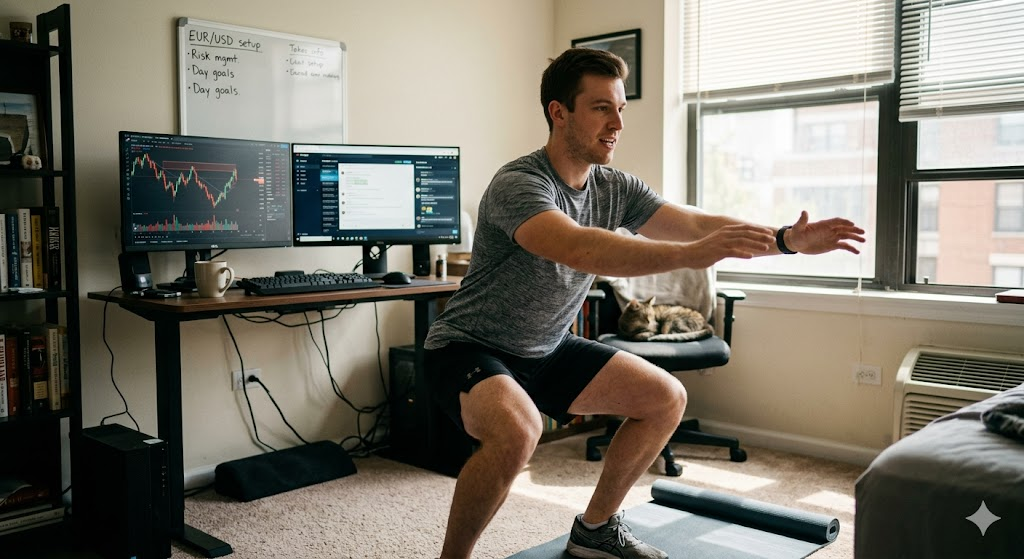
Healthy Lifestyle for Traders: How Diet, Exercise, and Sleep Sharpen Your Trading Mindset
You can have the cleanest setup, the tightest stop, and the prettiest chart on TradingView — but if you trade on four hours of sleep and a Red Bull, you're basically donating money to someone who slept eight hours and ate breakfast. Trading edge isn't only built on charts. It's built on biology.
Most traders obsess over indicators, entries, and exits while completely ignoring the operating system running all of it: the brain. And the brain, unfortunately, is not impressed by your strategy if it's been fed junk, denied sleep, and parked in a chair for fourteen hours. This article breaks down what the research actually says about how diet, exercise, and sleep affect the decisions you make in front of the screen — and what to do about it without turning into a wellness influencer.

Why Your Lifestyle Is a Trading Strategy
Trading is a sustained, high-stakes, decision-heavy activity — the kind of cognitive work that drains mental fuel fast. Even moderate sleep restriction leads to increased negative affect, greater impulsivity, and a proclivity for risk-prone choices, with neuroimaging studies showing diminished connectivity within prefrontal and reward networks that underpin both impaired valuation and altered emotional regulation. In plain English: when the body is under-rested and under-fed, the brain regions responsible for weighing risk and reward stop talking to each other properly. Nature Index research summary on sleep and decision-making.
Translation: every time you skip lunch, pull an all-nighter to "study charts," or replace cardio with another hour of scrolling X for sentiment, you're not being hardcore. You're degrading the only piece of equipment that actually matters. Harvard Medical School clinicians describe cognitive fitness as the product of an integrated lifestyle — optimal nutrition, exercise, stress reduction, social interaction, sleep, and stimulating activities — and note that these proven approaches together can spur and protect the brain functions that trading actually depends on. Harvard Health Publishing — A Guide to Cognitive Fitness.
The Trader Performance Stack
Nutrition: Your Brain Runs on What You Feed It
Glucose isn't just calories — it's the literal fuel your prefrontal cortex burns to make decisions. The peer-reviewed evidence is clear that dehydration impairs performance in tasks requiring attention, psychomotor function, and immediate memory, with cognitive deficits emerging at roughly 2% body-mass loss in healthy adults. Translation: your 2 p.m. impulse trade after skipping lunch and ignoring your water bottle for four hours might actually be a glucose-and-hydration problem dressed up as conviction — and if you want to fix it where it starts, build it into your pre-market routine. British Journal of Nutrition — Effects of hydration status on cognitive performance and mood.

What Actually Helps Cognition
The peer-reviewed picture is reasonably clear. Diets rich in antioxidants like vitamins C and E, and phytochemicals from fruits and vegetables, are associated with better cognitive performance, while diets high in saturated fats and refined sugars have been linked to cognitive deficits because they induce oxidative stress, inflammation, and insulin resistance. Multinutrient approaches combining B vitamins and omega-3 PUFAs show synergistic effects on episodic memory, and omega-3 fatty acids in particular may improve mood and reduce depressive symptoms — both of which matter when a red candle just blew through your stop. [MDPI Nutrients]
One sport-nutrition study on visual perceptual-cognitive performance even found that participants who consumed more than 40% of calories from carbohydrates, plus more than 2,000 µg/day of lutein and zeaxanthin or more than 1.8 mg/day of vitamin B2, performed significantly better on visual cognitive tasks than those who consumed less. Translation for traders: leafy greens, eggs, and not living on protein bars helps your eyes-and-brain pipeline keep up with price action. [Frontiers in Nutrition]
| Food / Nutrient | Why It Matters for Traders | Easy Sources |
|---|---|---|
| Omega-3 (DHA/EPA) | Brain & heart health, mood, memory, focus during long sessions | Salmon, sardines, flaxseed, walnuts |
| Complex carbs | Stable glucose for sustained decisions, no crashes | Oats, quinoa, sweet potato, whole grains |
| Lean protein | Steady amino acids, no post-meal energy slump | Chicken, eggs, Greek yogurt, legumes |
| Antioxidants (Vit C/E) | Reduce oxidative stress that erodes cognition over time | Berries, citrus, nuts, leafy greens |
| Water | Even 1–2% dehydration measurably impairs focus | Water. Just… water. |
| Limit: refined sugar, fried food | Glucose crashes, inflammation, brain fog | The vending machine. Avoid. |
Exercise: The Most Underrated Trading Tool
You don't need to deadlift twice your body weight to trade well. You just need to not be sedentary for the entire session. Harvard Medical School research shows that aerobic exercise improves cognitive speed, auditory and visual attention, motor control, and executive function, and that even moderate-intensity aerobic activity three days a week increased hippocampal volume — the brain region involved in memory and learning — by 2%, enough to offset one to two years of age-related brain changes. All qualities you'd reasonably want before clicking "Sell to Close" on a six-figure position. Harvard Health Publishing — Aerobic exercise and cognitive fitness.

What "Enough" Looks Like
The goal isn't fitness for fitness's sake — it's prefrontal cortex maintenance. Harvard Medical School research highlights that regular physical exercise improves cognitive functions like memory recall, problem solving, concentration, and attention to detail, while also strengthening neural connections and building the cognitive reserve that protects judgment under pressure. A brisk 20–30 minute walk before the open isn't a wellness trend — it's neuroscience. Harvard Health Publishing — Train your brain.
The brain also operates in roughly 90-minute ultradian cycles — what sleep researcher Nathaniel Kleitman originally identified as the basic rest-activity cycle, with peer-reviewed studies of EEG, mood, and task performance confirming fluctuations every 90–100 minutes during waking hours. Translation for traders: step away after morning-session intensity, walk, stretch, breathe. Sitting in your chair for nine straight hours staring at a 1-minute chart is not "dedication" — it's how revenge trades get born, especially in fast-moving day trading sessions where decision fatigue compounds by the minute. PubMed — Ultradian rhythms in task performance, self-evaluation, and EEG activity.
Sleep: The Edge Nobody Talks About
If diet is fuel and exercise is maintenance, sleep is the entire overnight system reboot. And the research on sleep and financial decisions is genuinely brutal: a 2011 fMRI study published in the Journal of Neuroscience by Venkatraman, Huettel, Chuah, Payne, and Chee found that a single night of total sleep deprivation evoked a strategy shift during risky decision-making, such that healthy volunteers moved "from defending against losses to seeking increased gains," correlated with elevated activation in the ventromedial prefrontal cortex and ventral striatum to gains but attenuated anterior insula activation to losses. In plain English, tired traders chase upside and ignore downside — at the neural level. Sound familiar? Journal of Neuroscience — Sleep Deprivation Biases the Neural Mechanisms Underlying Economic Preferences.

The Hard Data on Sleep-Deprived Trading
It gets worse. Across laboratory and ecological studies, even modest restriction of sleep leads to increased negative affect, greater impulsivity, and a proclivity for risk-prone choices, with neuroimaging showing diminished connectivity within prefrontal and reward networks. One ecological study of online poker players demonstrated that sessions undertaken while sleep-deprived produced increased emotional and behavioral tilt, a higher number of hands played, and poorer financial results. Replace "poker hands" with "scalps on SPY" and you have a perfect description of every blown account on Reddit. [Nature Index]
The kicker: research published via The Conversation by financial economists found that an index built from daily Google search activity on sleepiness terms was negatively related to US stock market returns — meaning that "when investors lack sleep, stock market returns are relatively low," a pattern most pronounced on high-uncertainty days. The mechanism: sleep deprivation increases anxiety and risk aversion, distorts loss processing, and makes the brain less receptive to corrective feedback. So when you tell yourself "I trade better tired," what you actually mean is "I trade with more confidence and less self-awareness." Those aren't the same thing. The Conversation — Sleep-deprived financial traders make lower stock market returns.
A controlled study on deliberative decision-making found something even more uncomfortable: under sleep loss, people who are habitually more reflective and cautious become more impulsive and prone to risk-taking, and prolonged sleep restriction is actually more detrimental than a single night of total sleep deprivation. The cautious trader who carefully waits for setups becomes the YOLO trader after five nights of poor sleep — without ever realizing the personality change, which is exactly the kind of silent drift that sinks otherwise solid trading psychology. [PMC / Sleep Deprivation Study]
How to Actually Sleep Like a Trader Who Wants to Stay Solvent
- Anchor your wake time. Same time every day, including weekends. The market opens at the same time — your circadian rhythm should know.
- Cut screens 60 minutes before bed. Blue light at night suppresses melatonin. Your overnight thesis can wait.
- Cool, dark, quiet bedroom. Bedrooms are for sleeping. Your trading desk is the office, not the bed.
- Caffeine cutoff by early afternoon. Caffeine has a 5–6 hour half-life. That 4 p.m. espresso is still in your bloodstream at 10 p.m.
- Aim for 7–9 hours. Not 6. Not 5. Not "I'm a high-performer." The data does not care about your self-image.
Putting It Together: The Trader's Daily Operating System
Mastering the trading mindset isn't a one-time event — it's a daily commitment built on consistent biology. The CDC recommends adults aged 18–60 sleep at least 7 hours per night, noting that insufficient sleep impairs cognitive performance and increases the likelihood of accidents, medical errors, and loss of work productivity — the kind of failure modes that translate directly into blown-up accounts when the work in question is making leveraged decisions on a price chart. CDC MMWR — Prevalence of Healthy Sleep Duration among Adults.
| Time | Habit | Why It Matters |
|---|---|---|
| 10:30 p.m. | Screens off, lights low | Protects melatonin & sleep onset |
| 11:00 p.m. | Sleep (target 7–9 hrs) | Restores prefrontal cortex & loss-aversion |
| 6:30 a.m. | Wake, hydrate, 20–30 min walk | Lowers cortisol, raises focus, primes mood |
| 7:15 a.m. | Real breakfast (protein + complex carb + fat) | Stable glucose through the open |
| 9:30 a.m. | Market open — trade your plan | You're operating at full capacity, not 60% |
| 11:00 a.m. | 10-min break, stretch, water | Resets ultradian focus cycle |
| 12:30 p.m. | Balanced lunch, away from screens | Prevents afternoon decision fatigue |
| 3:00 p.m. | End-of-session walk & journal | Decompresses, locks in lessons |

Mindset Tools That Stack On Top
Once the biology is in place, the psychology tools actually work. Harvard Medical School notes that meditation and similar contemplative practices appear to increase cognitive reserve — the brain's buffer against decline and stress — and that brain-fitness programs typically combine physical exercise, cognitive training, good nutrition, better sleep, and meditation rather than relying on any single intervention. For traders, that translates into a simple stack: deep breathing or short meditation sessions to calm the nervous system, plus mental rehearsal of setups to reduce anxiety and improve execution under pressure. Harvard Health Publishing — A workout for your brain.
Pair that with a trading journal — an external record that captures decisions, outcomes, and the reasoning at the time of the trade. Nobel laureate Daniel Kahneman and Amos Tversky's foundational work in Science on judgment under uncertainty established that human decision-making is systematically vulnerable to heuristics and biases, and that decisions made under time pressure are particularly susceptible to errors that an after-the-fact written review can catch. The same way a trailing stop externalizes exit discipline so you don't have to fight your emotions on every tick, a journal externalizes learning so you don't have to fight your memory either. If you want to take that exit-discipline piece further, the Education archives on Trailing Stop Loss are a solid place to keep building. Science — Judgment under Uncertainty: Heuristics and Biases (Tversky & Kahneman, 1974).
The Honest Conclusion
Here's the part nobody wants to hear: the trader who sleeps eight hours, eats real food, walks every morning, and journals every evening will, over a long enough timeline, almost always beat the "grinder" running on three hours of sleep, energy drinks, and chair-shaped posture. Not because they have better strategies. Because they have a better brain to run those strategies on. The American Academy of Sleep Medicine and Sleep Research Society's joint consensus is unambiguous: sleeping less than 7 hours per night on a regular basis is associated with impaired immune function, impaired performance, increased errors, and greater risk of accidents — outcomes that translate directly into degraded trading performance and bigger drawdowns. AASM/SRS Joint Consensus Statement — Recommended Amount of Sleep for a Healthy Adult.
You don't need to become a monk. You just need to stop sabotaging the only tool you actually trade with. Sleep, eat, move, repeat. Then click buy.
- Sleep deprivation increases risk-taking and reduces loss-aversion — the two most expensive cognitive failures in trading.
- Stable glucose from balanced meals supports hours of decision quality; refined sugar & skipped meals destroy it.
- 20–30 minutes of daily movement reduces stress hormones and improves focus more than any indicator stack.
- Take a 10-minute break every 90 minutes — ultradian rhythm, not optional.
- Mindset tools (journaling, breathing, visualization) work better when the body underneath isn't running on fumes.


