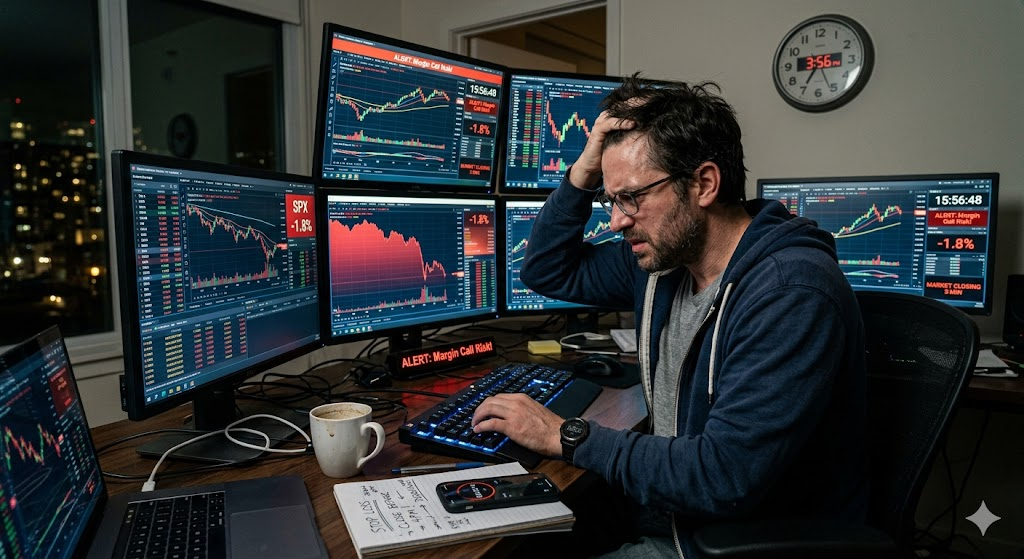
Here is an uncomfortable truth nobody puts on a YouTube thumbnail: most blown accounts are not killed by the market. They are killed by traders who sat down with twenty minutes to spare and decided to "just grab one quick trade" before the school run, the meeting, or the dog walk. The market does not care that your schedule is tight. It will absolutely take your money on its own timeline, thank you very much. If you cannot dedicate the time the strategy demands, the highest-EV move is not trading at all — and that applies whether you are scalping futures or swinging crypto.
Why Rushed Sessions Fail (It Is Not Bad Luck)
When you sit down feeling rushed, your brain is already running a stress response. Cognitive load goes up, working memory shrinks, and you start defaulting to gut instinct instead of your plan. Industry educators consistently flag this as a primary failure mode: high cognitive load under time pressure leads to rushed decisions where traders rely on instinct rather than data. The "feeling watched, feeling rushed" mindset is also one of the top reasons traders fail funded account challenges — fear-based decisions, hesitation, and sloppy entries follow almost automatically. Kanak Capital Markets
It compounds, too. A rushed entry leads to a stop placed at a "round-ish" level instead of an actual invalidation point. That stop gets tagged, you feel cheated, and now you are revenge trading with even less time on the clock than you started with. Lightspeed's trading psychology guide frames nearly every psychological mistake as stemming from two primal emotions: fear and greed, including FOMO entries where traders chase a move late because they cannot stand to watch it run without them. Time pressure is basically rocket fuel for both. Lightspeed
The Anatomy of a "Quick Session" Disaster
| What You Skip | What It Actually Costs You |
|---|---|
| Pre-market prep (news, levels, watchlist) | Trading blind into earnings, Fed minutes, or a CPI print |
| Defining invalidation before entry | Mental stops that magically widen when price moves against you |
| Position sizing math | "Eyeball" size that is 2–3x your actual risk budget |
| Patience for your A+ setup | Forcing B and C grade setups because the clock is ticking |
| Post-trade review | Repeating the same mistake tomorrow, but faster |
None of those skipped steps feel catastrophic in the moment. That is exactly the problem. Professional educators recommend 20–30 minutes of pre-market preparation specifically because rushed mornings produce emotional trades, while a structured routine produces consistency — and consistency, not speed, is what the market rewards. Trade Momentum
You Start Hunting Entries Instead of Letting Them Come to You
This one deserves its own section because it is the quietest killer in the whole list. When you have proper time blocked off, you sit, you wait, and you let the setup come to you. When you are rushed, you flip the polarity entirely — now you are hunting. You start scanning charts looking for something, anything that vaguely resembles a setup, because the clock is running and you "have to" get a trade in. That is not trading. That is just paying the spread to feel productive.
The problem is that hunting mode creates its own feedback loop of stress. You force a trade, it does not look right two minutes in, your body knows it, your cortisol spikes, and now every subsequent decision is being made by a slightly panicked version of you. Trading is hard enough when you are calm and patient — adding self-inflicted time pressure on top of it is like trying to thread a needle on a roller coaster. Educators consistently warn that this is when sloppy entries, missed stops, and overtrading show up, because you stopped asking "is this my setup?" and started asking "can I make this be my setup?" Top Trading Firms
The fix is mindset, not mechanics. A real edge means most of the session is spent doing nothing. If you walked away from a session with zero trades because nothing qualified, that is a good session — you protected capital and kept your discipline intact. Rushed traders cannot tolerate that, which is precisely why they bleed out one forced entry at a time. Build the muscle of waiting, and pair it with the day trading habits that keep you out of trades more often than they put you in.
The Physiology Piece Nobody Talks About
Here is where it gets uncomfortable. Rushed trading is not just a psychology problem — it is a physiology problem, and the two are not the same thing. When you sit down stressed and time-pressured, your body launches the full stress cascade: cortisol and adrenaline spike, heart rate climbs, breathing gets shallow, and blood flow shifts away from the prefrontal cortex (the part doing your actual analysis) toward the parts that just want to fight, flee, or freeze. You are quite literally trading with a different brain than the one that wrote your plan on the weekend.
- Tunnel vision — you stop seeing the full chart and fixate on price ticks
- Time distortion — 30 seconds in a losing trade feels like 5 minutes
- Impaired risk assessment — you stop calculating, you start hoping
- Reduced impulse control — the "just one more" trade becomes irresistible
- Decision fatigue accelerates — you burn out in an hour instead of three
This is well-documented in the trading psychology literature. High cognitive load under time pressure causes traders to abandon data-driven analysis and default to gut instincts, which is a polite way of saying your nervous system hijacks your strategy. Decision fatigue compounds it — your mental sharpness degrades through the session, and a rushed start means you are already running on fumes by the time a real setup actually appears. Kanak Capital Markets
The cruel irony is that your body remembers. Stack enough rushed, stressful sessions together and you build a conditioned response — just sitting down at the desk starts triggering the stress cascade before you have even opened a chart. Now you are not just fighting the market, you are fighting your own physiology, and you will lose that fight every single time. This is why traders who take care of the unsexy stuff (sleep, hydration, actual breaks, time blocking) consistently outperform the guys who treat themselves like a machine that can be willed into focus. Building structured pre-market routines and journaling your emotional state before each session is one of the most evidence-backed interventions for this. For Traders
How Much Time Do You Actually Need?
It depends on your style, but here is a realistic floor. Day traders need roughly 60–90 minutes before the open for prep and the same again post-close for review, plus the actual session window. Swing traders can get away with 20–30 focused minutes daily if their setups are well-defined. Scalpers need uninterrupted, no-distractions blocks — which means no Slack, no texts, no "back in five." If you cannot reliably carve out those blocks, you are better off building a watchlist for the weekend and taking positional trades that do not require staring at a 1-minute chart. New York City Servers
The honest move is to match your strategy to your actual life, not the life you wish you had. Plenty of profitable traders only take swing setups precisely because their day job will not allow proper intraday focus. That is not a downgrade — it is risk management applied to your schedule. Pair it with solid trading psychology habits and you will outlast the guys who try to scalp between Zoom calls.
A Simple Rule to Steal
Before you sit down, ask one question: "Do I have enough uninterrupted time to execute my plan, manage the trade, and review it afterward?" If the answer is no, the session is closed. Not "I'll just watch." Not "maybe one tiny size." Closed. The traders who survive long-term are the ones who treat their time the same way they treat their capital — finite, valuable, and not to be lit on fire because they were bored or impatient. The funded-trader playbooks all converge on the same idea: professionals think in terms of many trades, not the one in front of them, and they protect their discipline by stepping away when conditions (including their own mental state) are not right. Top Trading Firms
The market will be there tomorrow. Your account, on the other hand, only gets to be there tomorrow if you do not torch it on a rushed Tuesday morning trade you took because you "had a feeling." Trade when you have time. Walk away when you don't. That is the whole game.


