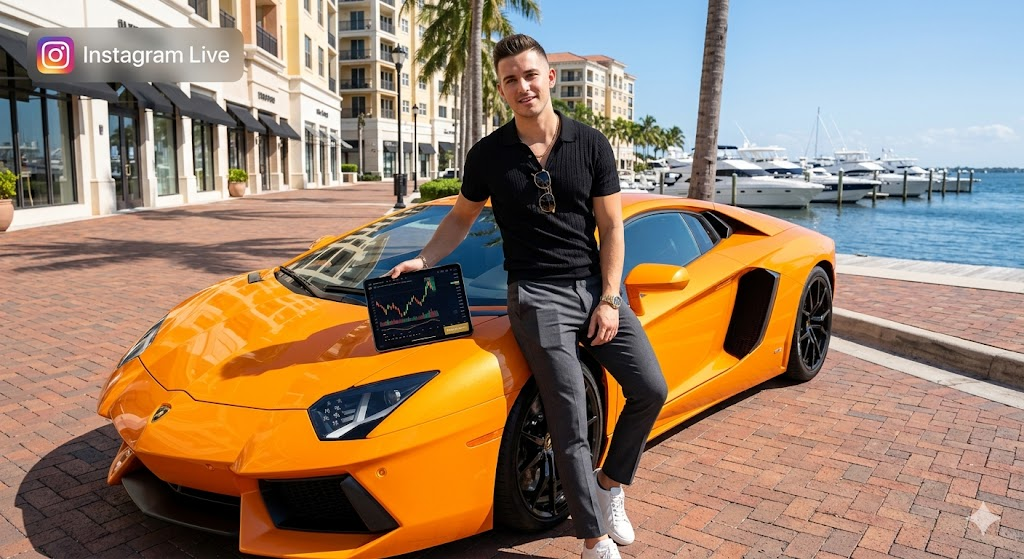
The Hilariously Tragic Truth About Day Trading: Why 97% of People Quietly Lose Money Pretending to Be the Wolf of Wall Street
Day trading promises Lamborghinis, infinity pools, and a life of unbothered freedom. The data, unfortunately, promises Tuesday-night ramen and a thousand-yard stare at a candlestick chart. Here's what the research actually says — sources cited, sarcasm included, no refunds.
Somewhere out there, right now, a guy named Brayden is on TikTok screaming about "price action" in front of three borrowed monitors, wearing a hoodie that says "EAT SLEEP TRADE REPEAT," and offering you a $1,997 course on how to escape the rat race. Brayden does not appear to have escaped the rat race. Brayden appears to have purchased a more expensive rat race. The actual numbers on day trading are so consistently grim across every market researchers have studied that the only mystery left is why anyone is still surprised. A landmark Brazilian study tracked every individual who began day trading equity index futures between 2013 and 2015 — and of those who stuck with it for more than 300 trading days, 97% lost money. Only 1.1% earned more than the Brazilian minimum wage. The very top earner made $310 per day, with a standard deviation of $2,560, which is a polite mathematical way of saying "this person's income was a Mariah Carey vocal run."
Source: Chague, De-Losso & Giovannetti, "Day Trading for a Living?" (SSRN, 2020)The Numbers Nobody Posts on Instagram
Let's talk about the part of day trading that doesn't fit on a vision board. Roughly 40% of new day traders quit within their first month, only 13% are still active after three years, and just 1% remain profitable over a five-year horizon — which, to be clear, means out of every 100 people who try this, ninety-nine of them eventually stop or stay losing. FINRA data shows about 72% of day traders end a given year underwater. The much-loved gym-bro mantra "90% lose 90% of their funds within 90 days" gets thrown around so often it sounds like marketing, except the empirical research basically agrees with it.
Source: Unbiased — Day Trading Statistics & QuantifiedStrategies — Day Trading Statistics 2026Here is the part that should genuinely worry every aspiring trader: the same Brazilian researchers also looked for evidence that people improved with experience. You know, the classic "I just need 10,000 hours and I'll be a wizard" argument that every aspiring trader uses to justify another Tuesday of getting financially housed by an algorithm built in 2009. They found no such evidence. None. Traders did not get measurably better over time. The ones who kept trading simply kept losing, just with more conviction.
Source: "97% of Day Traders Lose Money" — BitFinance Substack analysisYour Brain on Candlesticks: A Casino in a Hoodie
The uncomfortable truth — the one that gurus selling "alpha" courses tend to gloss over — is that day trading and gambling tap into the exact same reward circuitry in your brain. UCLA's Dr. Timothy Fong, who co-directs the UCLA Gambling Studies Program, has pointed out that the impulses behind short-term financial speculation share cognitive, motivational, and personality parallels with classical gambling disorder. Both activities thrive on uncertainty, intermittent rewards, and dopamine — the neurotransmitter that does not care whether your $40 came from a roulette wheel or a 5-minute SPY scalp. Your brain treats them identically. Your brain is, frankly, a bit of an idiot.
Source: UCLA Health — How the Impulses Behind Gambling Disorder Parallel Investing AddictionWhat makes day trading especially dangerous, behaviorally speaking, is something psychologists call intermittent reinforcement — the same conditioning mechanism slot machines exploit. You don't win every trade. You win just enough trades to keep believing your edge is real. That unpredictable hit of "I was right!" dopamine is more addictive than a guaranteed reward would be. It is why the same person who would never set foot in a casino will happily sit in their kitchen, in pajamas, doing the exact same thing for nine hours a day on a Bloomberg-themed dashboard they paid $50 a month for.
Source: Prescott House — Is Day Trading Gambling?The Costs Nobody Wants to Do the Math On
"Commission-free trading" is one of the great pieces of marketing of the last fifteen years, in the same hallowed category as "free shipping" and "no hidden fees." Day traders typically think their costs are zero because Robinhood doesn't charge a per-trade commission. The actual cost stack is bid-ask spreads, slippage, payment-for-order-flow disadvantages, data subscriptions, platform fees, and — the silent killer — short-term capital gains tax, which in the US is treated as ordinary income at rates up to 37%. A trader in the 24% bracket who clears $50,000 day trading hands roughly $12,000 of it directly to the IRS. The same gains, if held over a year, might cost $7,500. That is a $4,500 penalty for the exact same return, just because you couldn't sit still.
Source: Medium — I Reviewed Every Major Day Trading Study from the Last 25 YearsThe Real Cost Stack (a.k.a. Where The Money Actually Goes)
| Cost Category | What It Actually Is | Sneakiness Level |
|---|---|---|
| Bid-Ask Spread | You buy at the high price, sell at the low. Forever. | Medium |
| Slippage | Your "click price" and your "fill price" are not the same price. | High |
| Short-Term Cap Gains Tax | Ordinary income rates. Up to 37% in the US. | Brutal |
| Data & Platform Fees | $50–$300+/month before you've placed a single trade. | Medium |
| Opportunity Cost | The S&P 500 you didn't buy and hold like a normal person. | Existential |
Why You're Almost Certainly Not in the 1%
Every aspiring day trader reads the 97% statistic and thinks the same thing: "Sure, but I'm different." This is the same thought process that powers every casino in Nevada, every multi-level marketing pitch, and most disastrous romantic decisions. Psychologists have a name for this: illusory superiority. About 80% of drivers believe they're above-average drivers. Approximately 100% of day traders believe they're going to be in the profitable minority. The math, sadly, is fixed. By definition, most people cannot be above average. Especially not when they're competing against high-frequency trading firms with co-located servers, PhDs in stochastic calculus, and access to data measured in microseconds. Brayden's three monitors are not in this fight.
Source: Trade That Swing — The Day Trading Success RateEven at well-resourced proprietary trading firms — places that hand new traders capital, mentorship, and structured training — only roughly 4% of trainees go on to make a real living from day trading, and another 10–15% make some side money that doesn't really justify the hours. And these are people with mentors, with capital backing, with peers, and with a structured environment. The retail trader at home, learning from YouTube tutorials titled "I MADE $50K IN ONE DAY (NOT CLICKBAIT)," is operating on a noticeably different playing field.
Source: DayTrading.com — Day Trading Facts & StatisticsThe Survivorship Bias Cinematic Universe
If day trading is so devastatingly unprofitable, why does every social media feed make it look like a printer that prints money in 4K? Welcome to the most powerful illusion in personal finance: survivorship bias. The handful of traders who got lucky during a once-in-a-generation bull market make YouTube videos. The thousands who blew up their accounts do not make YouTube videos. They delete their apps, change the subject at Thanksgiving, and quietly take a job they hate. The visible "evidence" you see online is a non-random sample of a non-random sample. It is, in the strict statistical sense, lying to you.
Source: HighStrike — 30 Day Trading Statistics Every Day Trader Should KnowSo Should You Day Trade?
Here's the thing: nobody can stop you, and a small handful of disciplined humans really do pull this off. But "I might be one of them" is not a financial plan; it's an aspiration, in the same way "I might be drafted to the NBA" is an aspiration. If you genuinely want to try, paper trade for at least six months first, never deploy capital you can't afford to fully incinerate, and accept that the most honest version of "trading education" is the part where you lose money and learn to stop. For the other 99% of people, the boring strategy — broad-market index funds, dollar-cost averaging, and a savings rate north of 15% — quietly beats the day-trading dream in basically every long-term study ever conducted. There has never, in fact, been a 20-year rolling period where the S&P 500 lost money.
Source: Yahoo Finance — The Dangers of Day TradingThe dream that day trading sells you — quitting your job, escaping the rat race, being your own boss while sipping cold brew on a Tuesday morning — is genuinely seductive. The numbers underneath it are simply not on your side. You can absolutely build wealth in the markets. You can absolutely buy your time back. You just probably won't do it by clicking buttons faster than the algorithms. Now if you'll excuse me, Brayden has another livestream starting, and he just bought a new ring light.
Source: For Traders — Is Day Trading Still Profitable in 2025?


