Thursday, May 14, 2026: Records Fall, Cisco Throws an AI Pivot Party, and the Strait of Hormuz Stays Stubbornly Closed
The S&P 500 and Nasdaq punched through to fresh all-time highs, the Dow muscled back over 50,000, Bitcoin bounced off the lows, and oil stayed wedged above $100 because, well, the world's most important shipping lane is still a parking lot.
The Scoreboard
What Happened: The Big Picture
If you were watching a screen today and squinting through the geopolitical fog, you saw something pretty remarkable: the S&P 500 closed above 7,500 for the first time in history, and the Dow casually reclaimed the 50,000 mark like it had just stepped out for coffee. The S&P 500 gained 0.77% to 7,501.24, the Nasdaq Composite added 0.88% to 26,635.22, and the Dow popped 370 points (0.75%) to 50,063.46. The Russell 2000 tagged along for +0.61%. (Source: CNBC)
The driver was a familiar one — AI infrastructure stocks roared back to life, dragged higher by a 13%+ rip in Cisco shares after a blowout earnings report. Add in optimism around the Trump–Xi summit in China and the fact that oil didn't actually break $110 today (a low bar, but here we are), and bulls had enough to push everything to new highs. Cisco, Nvidia, and Amazon have together quietly carried the Dow's recent run, with Cisco up roughly 47% over the past two months. Yes, Cisco. The 1999 cover band is headlining the 2026 tour. (Source: CNBC)
Equities: Movers and Shakers
Cisco's Greatest Hits, AI Remix Edition
The headline name of the day was unambiguously Cisco (CSCO), which surged roughly 13% in regular trading after delivering Q3 FY2026 results that beat on every line that matters. Revenue came in at a record $15.84 billion (vs. $15.56B expected), adjusted EPS hit $1.06 (vs. $1.04 expected), and the company raised its full-year revenue outlook. Networking orders accelerated to more than 50% growth, and Cisco lifted its fiscal 2026 AI infrastructure order target to $9 billion from $5 billion. (Source: CNBC)
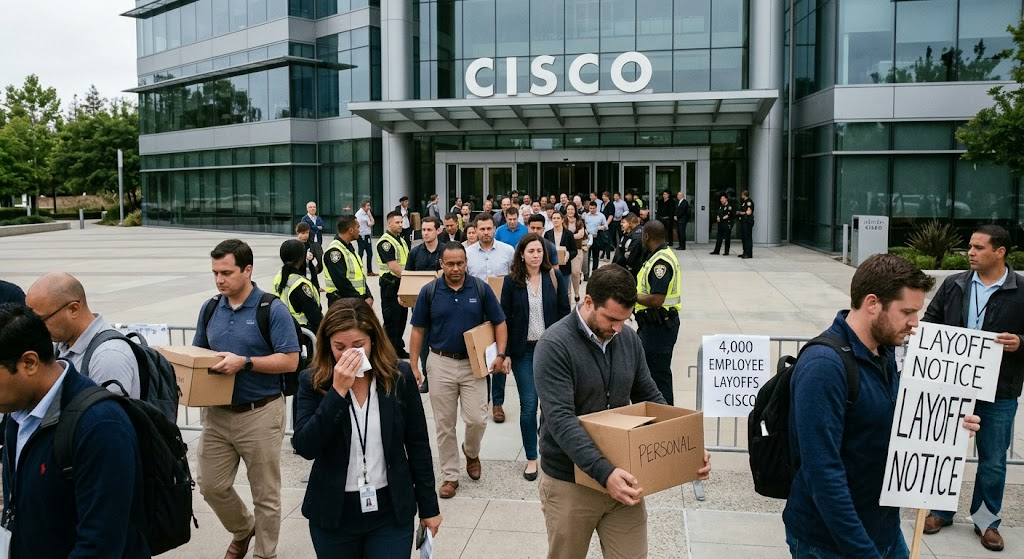
The catch — there is always a catch — is that Cisco simultaneously announced it's cutting roughly 4,000 jobs (about 5% of its workforce), with most notifications beginning today, May 14. Management framed it as a "reallocation" toward silicon, optics, security, and enterprise AI, with restructuring costs estimated at up to $1 billion. Or, translated from corporate-speak: record revenue, record layoffs, and a stock price that rallied because investors really, really like efficiency. (Source: The Tech Portal)
Top Gainers and Losers
| Ticker | Company | Move | Why |
|---|---|---|---|
| CSCO | Cisco Systems | +13% to +16% | Earnings beat, AI orders raised, 4K layoffs |
| OTIS | Otis Worldwide | +4.2% | Sector strength |
| MSCI | MSCI Inc. | +3.2% | Financials bid |
| HSY | Hershey | -5.1% | Consumer staples weakness |
| QCOM | Qualcomm | -4.3% | Chip rotation |
| INTC | Intel | -3.8% | Lagging the AI trade |
Source: TheStreet
Worth noting: even as the headline indexes ripped to records, breadth was lousy — the majority of stocks actually closed lower on the day. So this was very much a megacap-and-AI rally, not a broad-based melt-up. BTIG's chief market technician, Jonathan Krinsky, flagged that the recent rally is "not necessarily in good shape." Nothing reassures bulls like the technical guys whispering about thin internals at the highs. (Source: CNBC)
The Visual: Index Performance Today
Futures Markets: Stickier Than a Movie Theater Floor
Equity futures were modestly higher heading into Thursday's session and remained constructive into the close — Nasdaq 100 futures added about 0.2% and Dow futures rose roughly 110 points (0.2%) overnight, reflecting investor willingness to look through the Iran-shaped cloud and chase AI earnings momentum. Coming into the day, the setup was cautious: the S&P 500 was down about 0.2% in pre-market and Dow futures hovered near flat after Trump rejected Iran's peace proposal as "totally unacceptable" and Tehran defended its demands. Brent briefly jumped above $104–$105 on renewed Strait of Hormuz fears, but easing rhetoric and risk-on sentiment helped futures stabilize. (Source: CNBC)
Commodities futures told the real story of inflation pressure:
| Contract | Settle | Change | Note |
|---|---|---|---|
| WTI Crude (June) | $101.40 | +0.42% | Stuck above $100, again |
| Brent Crude (July) | $106.30 | +0.61% | Hormuz premium baked in |
| Gold | $4,701.40 / oz | -0.11% | Risk-on rotation |
| Silver | $87.37 / oz | -2.2% | Sold with industrials |
Source: TheStreet
The 10-year Treasury yield firmed near recent highs and the dollar index gained about 0.1%, as investors continued shifting to safe-haven assets amid US-Iran tensions and oil volatility. Last week's CPI print of 3.8% — the hottest reading since 2023 — has essentially erased 2026 rate-cut expectations from the curve, which means "higher for longer" is no longer a forecast, it's the weather. (Source: Blockchain Reporter)
Crypto: Bitcoin Picks Itself Up Off the Mat
Bitcoin had a rough first half of the week — it broke below $80,000 earlier in the session before clawing back to roughly $80,900 by the close, a gain of about 2.7% off the lows. Ethereum followed a similar pattern, opening lower for the fourth straight day this week before stabilizing. The all-time high for Bitcoin remains $128,198.07 from October 6, 2025, so the world's largest crypto is still operating about 37% below the peak. Hodlers, your patience is being tested. (Source: Yahoo Finance)
The catalyst on the upside today was political, not technical. The Senate Banking Committee was expected to vote through the landmark Digital Asset Market Clarity Act ("CLARITY Act") on Thursday, with all 24 Republicans on the committee reportedly lining up behind it. The bill would push digital assets one step closer to a clear regulatory home in mainstream finance — which is exactly what institutional capital has been waiting for. (Source: Yahoo Finance)
The headwinds, though, are still doing the heavy lifting on the other side. US spot Bitcoin ETFs recorded $635 million in net outflows on May 13, led by BlackRock's IBIT with $285 million in outflows — the structural demand floor that supported BTC through Q1 has been cracking. Combined with sticky inflation, no rate cuts on the horizon, and the fact that Jerome Powell is wrapping up his last day as Fed Chair today (he chaired his final FOMC meeting on April 30 at 3.50%–3.75%, the third hold in a row), risk assets are running on earnings fumes rather than liquidity tailwinds. (Source: Blockchain Reporter)
The War: Hormuz Is Still Closed, and That's the Whole Story
You can summarize the geopolitical backdrop of this entire market environment in one sentence: the Strait of Hormuz is still effectively blockaded, and roughly 20 million barrels of oil per day — about 20% of global seaborne oil trade — is not flowing the way it used to. Iran closed the strait in response to US and Israeli strikes earlier this year, then selectively opened it for ships flagged in friendly nations (China, Russia, India, Iraq, Pakistan), then closed it again. Trump's "Project Freedom" naval escort mission, launched May 4, was paused two days later on hopes of a deal that hasn't materialized. (Source: Wikipedia — 2026 Strait of Hormuz crisis)
Today's wrinkle: President Trump met with Xi Jinping in China for two hours and 15 minutes at the start of their two-day summit, and per Secretary of State Marco Rubio, the Iran war was a major topic of discussion. The two sides agreed that the Strait of Hormuz must remain open and that Iran should not be allowed to impose payments on shipping traffic. Treasury Secretary Scott Bessent told CNBC that China — which imports about 10% of its oil from Iran and over half from the broader Middle East — has "a much bigger interest in reopening the strait than the U.S. does" and would work behind the scenes with Iranian leadership. Rubio, however, was careful to note the U.S. was not formally asking China for help with Iran, which is a fascinating diplomatic dance to watch in real time. (Source: TheStreet)
The market reaction was muted but real. Oil came down from a Brent print near $107 earlier in the day to about $106 by the close, and the easing of supply-disruption fears was a meaningful contributor to the equity rally. The bigger backdrop remains ugly: crude oil prices are up roughly 50% since the war began, U.S. consumers have shouldered an estimated $32 billion in extra fuel costs as of early May, gas tops $4 per gallon nationally (and over $6 in parts of California), and fertilizer disruptions from blocked LNG and Persian Gulf chemical exports are now squeezing American farmers before planting season. The geopolitical risk premium isn't going anywhere until ships start moving freely. (Source: House Oversight Democrats letter)
"It takes both sides to unblock — not just one. Either party can signal that they are willing to let certain ships through, but unless the other side accepts that in practice, it doesn't materially change the reality on the water." — Bjørn Højgaard, CEO of Anglo-Eastern, on Project Freedom. (Source: CNN Business)
Also worth flagging from the summit: Xi reportedly warned Trump that mishandling Taiwan would cause "clashes and even conflicts, putting the entire relationship in great jeopardy." So we now have two simultaneous geopolitical pressure cookers being negotiated by the same two men, while the market is hitting all-time highs. Make of that what you will. (Source: TheStreet)
Economic Data: Mixed Signals
Two data points worth chewing on from this morning. First, April retail sales climbed 0.5% month-over-month — down from March's hot 1.6% reading and just under the 0.6% consensus. Translation: consumers are still spending, but the pace is decelerating, which is what you'd expect when gas is north of $4 a gallon. The figures are adjusted for seasonal swings but not inflation, so the real-volume picture is a bit grimmer than the headline. (Source: TheStreet)
Second, initial jobless claims for the week ended May 9 ticked up by 12,000 to 211,000, above the 205,000 consensus and the prior week's revised 199,000. Continuing claims rose to roughly 1.78 million. Neither figure is recessionary, but the labor market is showing more give than it was three months ago — and on a week where Cisco just announced 4,000 layoffs, expect a few more prints like this. (Source: Yahoo Finance)
Other Stuff Worth Mentioning
Nvidia gets some breathing room in China. CNBC reported that the U.S. has cleared around 10 Chinese firms to buy Nvidia's second-most powerful AI chip, the H200, though no deliveries have actually been made yet. Coming during the Trump–Xi summit, the timing is not subtle. (Source: TheStreet)
Whirlpool downgraded. Goldman Sachs cut Whirlpool to neutral from buy with a $53 price target (about 27% downside from yesterday's close), citing ongoing industry and macro pressures. The company is in the middle of pushing through its largest price increase in 30+ years to offset margin pressure. Appliance inflation: still a thing. (Source: CNBC)
Powell's exit. Today is Jerome Powell's last day as Fed Chair. His final FOMC meeting on April 30 held rates at 3.50%–3.75% — the third consecutive hold. Whoever follows him is inheriting 3.8% CPI, a war-driven oil shock, and a market priced for AI-driven nirvana. Fun starter kit. (Source: Blockchain Reporter)
The Takeaway
Today's tape is a near-perfect snapshot of where we are in 2026: AI-related earnings are still strong enough to push indexes to records even as breadth thins, geopolitical risk is real but tradeable around the edges of headlines, oil is the inflation toll booth nobody can route around, and crypto is bouncing on regulatory hope rather than liquidity. The Dow's return to 50,000 looks great on a chart and means relatively little until the Strait of Hormuz reopens and the Fed gets cover to cut. Until then, every record close has an asterisk attached, and the asterisk is shaped like an oil tanker.
Tomorrow brings PPI on Friday morning, the second day of the Trump–Xi summit, and continued Hormuz watch. Buckle up.


