The 30-second close
- Stocks: S&P 500 −0.67% to 7,353.61, third straight loss; Dow −0.65%, Nasdaq −0.84%.
- Yields: 10-year Treasury closed near 4.66%, a 15-month high; 30-year above 5.1%.
- Crypto: Bitcoin sank to a three-week low near $76,500; Ethereum dipped under $2,115.
- Metals: Gold tumbled 1.7% to $4,489/oz; silver got obliterated for 5.6%, settling near $73.36.
- Iran: Trump shelved a planned Tuesday strike after Gulf-state appeals; oil eased but stayed above $108 WTI.
- On deck: Nvidia earnings Wednesday after the bell, then FOMC minutes Thursday.
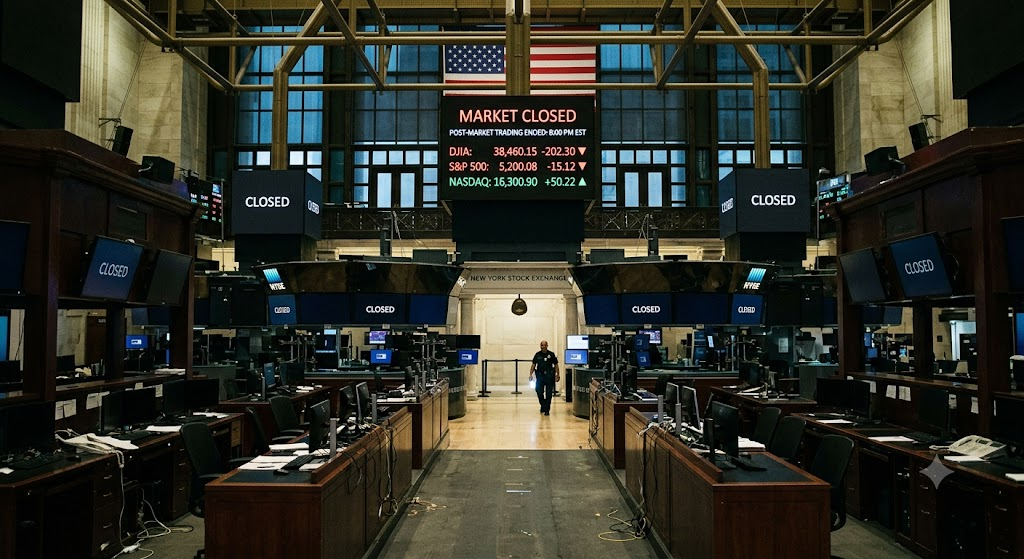
Wall Street wrapped up another grind-it-out session on the wrong side of zero, with the post-market tape reflecting exactly what bulls have been pretending isn't happening for two weeks: yields keep climbing, inflation keeps surprising hot, and the Fed's new chair appears to be in no mood to throw a parade for risk assets. The S&P 500 closed down 0.67% at 7,353.61, the Dow shed 322 points to 49,363.88, and the Nasdaq Composite gave back 0.84% to 25,870.71, marking the index's third consecutive decline and the longest losing streak since the March bottom. CNBC
Equities: the "buy the dip" reflex finally gets tested
If you've been wondering when the post-March 15% rip would actually have to digest something, today qualified. Twenty-three of 30 Dow components closed red, breadth was sloppy, and the Russell 2000 underperformed by another 0.65% — small caps continue to wear the Fed's higher-for-longer wardrobe like a wool sweater in July. The VIX, predictably, did not panic, finishing only modestly higher in the high teens, because of course the fear gauge waits until everyone is already on fire before sounding the alarm. Zacks
The market is now grappling with what Bank of America strategists described this week as a meaningful repricing: market-implied odds of a Fed rate hike before year-end have climbed to roughly 40-45%, up from essentially nothing a month ago. For a market that spent the first half of the year debating cuts, that is what reality TV writers call a plot twist. Investors trying to time the next leg can check our day trading coverage for tactical reads. Intellectia analyst note
The earnings micro-story: Home Depot lands fine, market shrugs
Home Depot turned in a beat-but-don't-celebrate quarter that summed up the consumer setup nicely: revenue of $41.77 billion (+4.8% YoY) topped estimates, adjusted EPS of $3.43 cleared the $3.41 bar, and management reaffirmed full-year guidance. Comparable sales rose just 0.6% with U.S. comps at +0.4%, and the average ticket climbed to $92.76 even as transactions dipped 1.3%. Translation: fewer people are coming through the door, but the ones who do are getting clipped harder. CEO Ted Decker leaned into the now-familiar refrain about "consumer uncertainty and housing affordability pressure," which is corporate-speak for "the 30-year mortgage just touched 6.68% and nobody's renovating anything." Shares finished modestly higher despite the broader tape. StockStory
The main event arrives tomorrow
Everything reset around Nvidia's Q1 print due after the close Wednesday. Consensus is calling for EPS of $1.78 (+120% YoY) on revenue of $79.2 billion (+79.5% YoY) — numbers that sound absurd until you remember the company is currently the load-bearing wall of the entire S&P 500. HSBC bumped its target to $325 and Morgan Stanley to $285 into the print, which is the analyst equivalent of writing "no pressure, buddy" on the locker room whiteboard before the championship. A miss here, or even a guide that doesn't visibly accelerate, and the AI-trade-as-market-prop argument gets a much harder look. TheStreet
Bonds: the actual story
If equities are the noise, the bond market is the signal, and the signal is screaming. The 10-year Treasury yield closed near 4.66%, the highest level in roughly 15 months, while the 30-year held above 5.1% after Friday's seven-basis-point lurch higher. The 2-year sits near 4.11%. The proximate causes are no mystery: April CPI ran hotter than forecast (3.8%), import prices jumped 1.9% for the month and 4.2% year-over-year on the back of energy, and producer prices hit their highest reading since December 2022. CNBC
Layer in new Fed Chair Kevin Warsh — whose hawkish reputation precedes him — and you have a market actively pricing the once-unthinkable. Bank of America now sees no cuts until the second half of 2027, a startling downshift from the two-cuts-this-year base case that prevailed just a few months ago. The CME FedWatch tool is showing roughly 40% odds of an additional 25 bp hike before year-end, which is the kind of probability that doesn't really let portfolio managers sleep. Trading Economics
Why this matters: Rising real yields are mechanical poison for long-duration assets. Every uptick in the 10-year compresses the present value of distant future cash flows, which is precisely why hyper-growth tech is bleeding while energy is up 1.8% on the sector tape. Rising yields are also why mortgage rates just retraced to their highest level since July 2025. None of this is hard to model — it's just unpleasant.
Crypto: risk-off finds the usual victim
The largest crypto by market cap continued its multi-day slide. Bitcoin opened the session at $76,952, traded to roughly $76,565 by 9:30 a.m. ET, and spent the rest of the day testing whether the $76,000 zone — what some traders are calling Tom Lee's line in the sand — will hold into the monthly close. Ethereum followed bitcoin's playbook, dipping below $2,115 and sitting at its lowest opening price since April 7. Roughly $500 million in long liquidations cleared the deck during overnight Asian trading following weekend escalation chatter, which is the polite way of saying leverage cosplayers got margin-called again. Yahoo Finance
Crypto-correlated equities slid in tandem at the open, though the move was modest by 2025 standards. The longer-term setup remains messy: some sell-side analysts are now penciling in a $58,000-$65,000 BTC retest in Q2 before any meaningful recovery, while others — Fundstrat's Sean Farrell among them — still see year-end targets near $115,000. Pick a lane; both can be wrong. Our crypto coverage tracks the structural setups in more detail. CoinDesk
| Asset | Price (intraday) | Move | Notable |
|---|---|---|---|
| Bitcoin (BTC) | $76,565 | −0.6% | Lowest opening since May 1 |
| Ethereum (ETH) | $2,115 | −0.6% | Lowest opening since April 7 |
| BTC dominance | — | flat | Mkt cap ~$1.33T |
Metals: the day silver remembered it's volatile
Precious metals took the biggest beating across asset classes. Gold spot tumbled 1.7% to $4,489.21/oz, while silver shed a brutal 5.62% to settle at $73.36/oz — one of the uglier single-session prints since the asset class started getting attention as the meme-trade-with-fundamentals earlier this year. The selloff was a textbook macro repricing: hotter inflation data drove real yields higher, the dollar firmed, and President Trump's hint at "serious negotiations" with Iran took the geopolitical bid out of bullion. USAGOLD market report
Some context on the silver move, because it deserves it: silver is still up more than 100% year-to-date and over 120% year-over-year, with an all-time high of $121.64 set on January 29. Today's drop is noise on the long-term chart but very much not noise if you levered into it last week. The gold/silver ratio has been compressing from 80:1 down to around 55:1, which historically signals industrial demand strength rather than safe-haven panic — a reasonable hypothesis given solar PV and electronics consumption, even if the World Silver Survey 2026 is forecasting a 19% PV demand drop this year. Silver Institute / Metals Focus
| Metal | Spot close | Daily move | YoY |
|---|---|---|---|
| Gold | $4,489.21 | −1.70% | +41.0% |
| Silver | $73.36 | −5.62% | +122.9% |
Futures & energy: Iran headline whiplash, again
The session's most market-moving headline wasn't economic data — it was Trump's Monday-evening Truth Social post announcing he had "called off" a scheduled Tuesday strike against Iran after appeals from Saudi Arabia, Qatar, and the UAE. The April 8 ceasefire technically remains in place, even though the U.S. blockade of Iranian ports continues and the Strait of Hormuz remains effectively closed to commercial vessel traffic. As of mid-day, WTI crude held near $108.59 and Brent traded around $110.60, both off intraday highs but still roughly 54% above pre-war (Feb. 28) levels. CNBC
For perspective on how concentrated this risk premium has become: the average U.S. gallon of regular gas closed Monday at $4.48, up $1.54 since the war began on February 28. That's not just a market story — it's the inflation story, the consumer-confidence story, and increasingly the Fed-policy story all rolled into one. Anyone trading energy spreads or the futures complex has had a tradable headline-driven tape every single session. ABC News
The geopolitical wrinkle worth flagging: Reporting indicated that an account in the president's name purchased between $220 million and $475 million in oil, defense, and gold-related "Magnificent Seven" positions in the days surrounding the recent Iran developments. Whether that's a coincidence, optics problem, or something requiring an Insider Trading filing depends entirely on which cable network you watch. Either way, it's the kind of detail that ends up in market-moving headlines down the line.
What moved the tape today, in one chart
Anything else worth sharing
- Power-sector M&A: Dominion Energy and NextEra continued to digest news of NextEra's $67 billion acquisition of Dominion — the largest deal in U.S. utility history. Worth tracking if you trade utilities or the AI-power thesis.
- Mortgage rates: The 30-year fixed touched 6.68% Monday, the highest since July 31, 2025. Bond yields and mortgages remain tightly coupled, so a sustained 10-year above 4.65% keeps the housing market frozen.
- Musk vs Altman: A federal court ruled against Musk in his OpenAI suit on a procedural deadline. Musk plans to appeal to the 9th Circuit. Not market-moving today; potentially relevant for AI valuations later.
- Sector standout: Energy was the only S&P sector to close materially green (XLE +1.8%), a logical reaction to elevated crude even as the broad tape sagged.
What to watch Wednesday
Three things matter: (1) Nvidia earnings after the close — the AI trade's report card; (2) April pending home sales — a real-time read on the rate-hit housing market; and (3) any Iran headline at all, because oil is still the inflation tail wagging the Fed dog. Thursday brings the FOMC minutes, which under Warsh's tenure now carry meaningfully more event risk than they did six months ago. For ongoing pre-market setup and futures action, our pre-market briefings will be live before the open. TheStreet