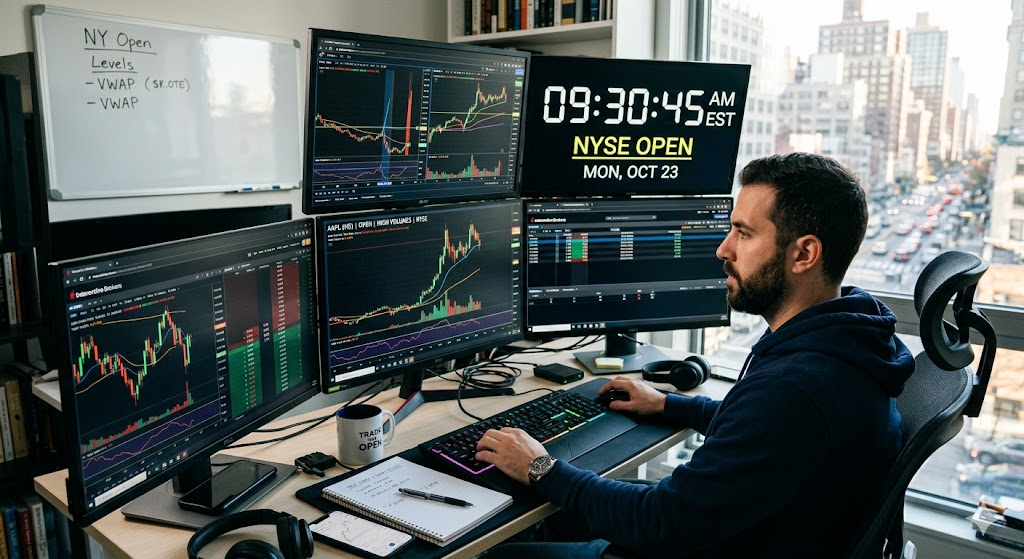
Why You Should Only Trade the Session You Backtested: The New York Open vs Power Hour Trap
There is a particular flavor of pain reserved for the trader who builds a profitable edge at the New York open, watches it print money for weeks, and then decides — for reasons that always sound rational at the time — to "just try it" during the power hour. The strategy stops working. The trader blames the strategy. The strategy was fine. The trader took a Ferrari to a tractor pull.
If you have back and forward tested a strategy at the 9:30 AM ET open, that is the only window you should be trading it. Not because the rest of the day is forbidden territory, but because the market you tested in is not the same market that exists three, four, or six hours later. Different volatility, different participants, different liquidity, different everything. Your edge is session-specific whether you like it or not.
The New York Open and the Power Hour Are Two Different Markets
Both windows get called "power hours" in trading literature, which has confused traders for years. The morning session runs roughly from 9:30 AM to 10:30 AM ET and is characterized by violent reactions to overnight news, earnings releases, and economic data — trading activity is frantic as traders make their initial moves. The afternoon session from 3:00 PM to 4:00 PM ET is a different animal entirely: institutional repositioning, end-of-day hedging, and a tendency toward mean reversion rather than directional breakouts. Investopedia
The morning open is where overnight order flow finally gets to express itself. Gaps fill or extend, news gets priced in, and the first 30 to 60 minutes typically produce the widest ranges of the day. Day traders gravitate to the open precisely because volatility and volume cluster there — academic research on intraday equity markets has consistently documented a U-shaped pattern in both trading volume and volatility, with the highest activity concentrated at the open and close and a clear lull through midday. This finding traces back to seminal work by Wood, McInish, and Ord (1985) and Admati and Pfleiderer (1988) and has been replicated across NYSE stocks, the SPDR S&P 500 ETF, and global exchanges. International Journal of Business and Social Science (peer-reviewed)
The afternoon close, by contrast, is driven by institutional flow rather than retail reaction. Hedge funds, pension funds, and other large players step in to close their daily positions and make their final moves before the bell. That creates volume, sure, but the character of that volume is fundamentally different — it tends to be position-squaring rather than directional conviction, which means the same breakout pattern that exploded at 9:35 AM might fizzle and reverse at 3:35 PM. Investopedia
A Visual: How Volatility and Volume Move Across the Trading Day
Notice the asymmetry. The morning peak is taller and sharper. The afternoon peak is broader and shallower. Between 11:30 AM and 2:00 PM ET the market typically slows down — this midday lull sees reduced trading activity and more stable price movements. A breakout strategy designed to exploit open-session expansion will produce false signal after false signal in that flat zone, and even the afternoon return-of-volume does not match the morning's directional intensity. Investopedia
Why a Strategy That Works at the Open Falls Apart Later
The mechanics matter here. At 9:30 AM, you have institutions executing overnight orders, retail traders reacting to pre-market news, algorithms front-running expected flow, and earnings or economic data being absorbed in real time. The result is wide spreads narrowing fast, large directional moves, and the kind of volatility that lets a properly sized breakout or momentum strategy reach a profit target before lunch.
By 3:00 PM, the catalyst stack has thinned out. Most economic data was released hours ago, the FOMC has long since spoken, and the participants left in the market are largely either closing positions or hedging. There is volume, but it is less likely to produce the meaningful directional move that your morning strategy was built to capture. The volatility that does show up tends to be choppier, more two-sided, and more prone to fake-outs.
Session-by-Session Comparison
| Characteristic | NY Open (9:30–10:30 ET) | Midday (11:30–2:00 ET) | Power Hour (3:00–4:00 ET) |
|---|---|---|---|
| Volatility | Highest of the day | Lowest | Moderate, choppier |
| Volume profile | Heavy, directional | Thin | Heavy, position-squaring |
| Dominant participant | Retail + algos + news flow | Algos only | Institutions closing books |
| Best for | Breakouts, momentum | Mean reversion, range | Reversal, MOC flow |
| Common failure | Overtrading the chop after 10:30 | Forcing trades in dead tape | Mistaking volume for trend |
If your strategy was built for the top row of that table, the bottom rows are not bonus territory. They are different problems requiring different solutions, and asking your morning playbook to handle them is like asking a hammer to do a screwdriver's job — possible, ugly, expensive.
What Backtesting Best Practice Actually Says
This is not a controversial opinion in the world of professional strategy development. The standard guidance for serious backtesters is unambiguous: a strategy must be tested under the same conditions in which it will be deployed, and stitching together performance across heterogeneous market regimes — including different intraday sessions — invites backtest overfitting, where a strategy appears to work because random patterns in a noisy sample have been mistaken for a persistent edge. Bailey, Borwein, López de Prado, and Zhu, writing for the Royal Statistical Society's Significance journal, identify this as a primary reason quantitative strategies that look profitable on paper disappoint in live trading. Significance (Oxford Academic, Royal Statistical Society)
The same principle applies in reverse. When tracking backtest results, the time of day of each entry should be logged, and any entry that would have fallen outside your active trading window should be removed from the sample. Aggregating across the day washes out the very effect you need to see. The intraday market is statistically non-stationary — volume, volatility, spreads, and the mix of informed-versus-uninformed traders all shift systematically through the session, as formalized in the foundational intraday-patterns theory of Admati and Pfleiderer published in The Review of Financial Studies. A strategy showing a 60% win rate across all sessions might be 72% at the open and 48% at the power hour. The aggregate number is a lie that protects you from neither outcome. The Review of Financial Studies (Oxford Academic)
Time-based performance — specifically which sessions perform best — is one of the core insights proper backtesting is supposed to deliver. The fact that a strategy might thrive in one session and die in another is a feature of the data, not a bug, and the appropriate response is to trade only the session where the edge actually exists. Investopedia
The Discipline Problem (This Is Really What This Is About)
Here is the honest part. Most traders who drift from their tested session do not do it because they have new data suggesting the strategy works at other times. They do it because they are bored, because they missed the open, because they want to "make back" a loss, or because the market is doing something that looks like their setup at 3:15 PM. None of these are edges. All of them are emotional decisions wearing the costume of analysis.
This connects directly to the broader concept of position management and emotional control that underlies every consistent trading approach. The hardest skill in trading is not finding setups; it is doing nothing when your tested setup is not present. Walking away at 10:30 AM when you have no signal is the same discipline as letting a winner run with a properly placed trailing stop instead of cutting it early — both require trusting your process over your feelings.
How to Actually Apply This
- Define your session in minutes, not vibes. "The open" is not a strategy. "9:30 AM to 10:45 AM ET" is.
- Backtest only within that window. Tag every trade with its entry time and filter the sample. Anything outside the window does not count.
- Forward test only within that window. Live paper trading is just backtesting with worse data — same rules apply.
- Compute session-specific metrics. Win rate, average R, max drawdown, and expectancy all need to be calculated on the filtered sample, not the full day.
- Close the laptop after your session ends. Genuinely. The afternoon is not a bonus round. It is a different game you have not qualified for.
- If you want to trade another session, treat it as a new strategy. Re-test, re-validate, re-forward-test. Same rules, different sample, different conclusions.
The Bottom Line
A trading edge is a statistical claim about a specific set of market conditions. If you tested only the New York open, your claim is only about the New York open. Taking the strategy to the power hour is not flexibility — it is an unvalidated extrapolation, and unvalidated extrapolations are how profitable traders blow up perfectly good edges.
The market at 9:35 AM and the market at 3:35 PM share a ticker and a timezone, and that is about it. Different volatility, different participants, different liquidity dynamics, different reasons price moves at all. Your morning strategy does not care that the afternoon also has volume. Your morning strategy cares about the morning. Let it.
Trade the session you tested. Skip the rest. The edge you built is real — it just lives in one specific hour, and that is the only hour where it works.
For more on building and protecting an intraday edge, explore the Day Trading, Trading Psychology, and Education categories on Trailing Stop Loss.


