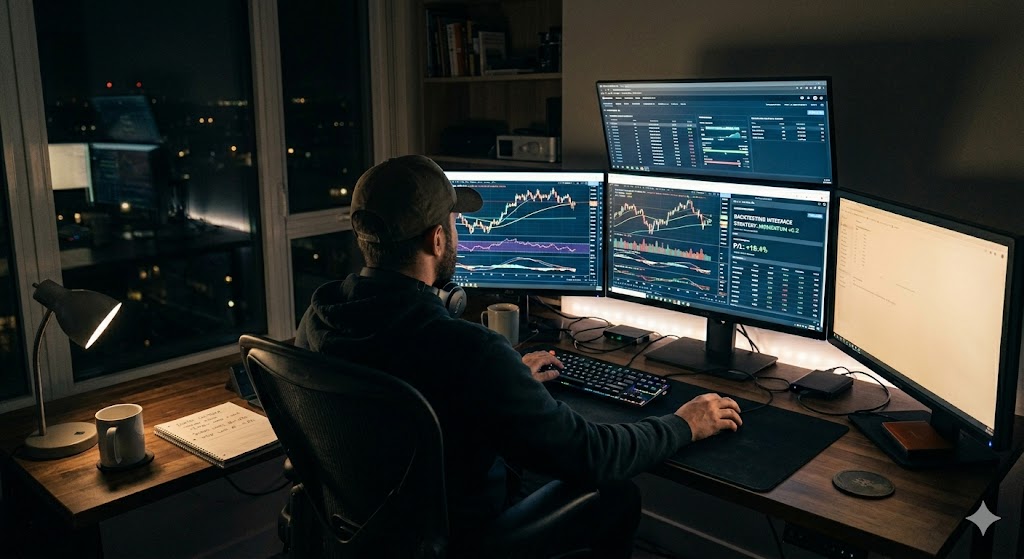
Backtesting vs Forward Testing: Why Smart Traders Use Both (And the Tools That Actually Help)
A backtest tells you if your strategy has an edge. A forward test tells you if you can actually trade it. Here's why skipping either one is the fastest way to blow up an account.
Forward testing your strategy is, in my opinion, is better than backtesting. The conditions are just not the same. When you're backtesting, you can take your time. You can pause the chart, walk away, grab a coffee, refresh the candle, and contemplate the meaning of life before clicking "buy." When you're dealing with live market data, there is more to consider, like the fact that the candle does not care about your coffee.
Live markets bring spreads that widen at the worst possible moment, slippage on stops during news events, the heart-rate spike when your entry actually fills, and that mysterious force that makes your finger hover over the mouse for ten seconds longer than your backtest ever assumed. Studies show that live trading results typically degrade to roughly 60-70% of what your backtests show, and that 30-40% drop almost always comes from the friction a historical chart can't simulate.
Source: TradingView Hub – TradingView Backtesting Guide
That said, throwing backtesting in the trash is a mistake. Both methods have a job to do, and they don't do the same job. Let's break down what each actually measures, why you need both, and which tools won't waste your time.
What Backtesting Actually Tells You
Backtesting is the process of running your trading rules against historical price data to see how the strategy would have performed. Done right, it's the analytical phase where you check whether your system has a statistical advantage before risking a single dollar. The output is a database that tells you what to expect from the strategy, including win rate, drawdown, profit factor, and how it handled bull, bear, and sideways conditions.
Source: EverTrader – Backtest vs Forward Test
The strength of backtesting is speed and scale. You can crunch a decade of data in minutes, test hundreds of parameter variations, and identify whether your edge is real or a coincidence dressed up in a Sharpe ratio. The catch? A backtest exists in a sanitized universe. Backtests typically assume trades execute at the signal price with minimal slippage, ignore spread widening, latency, news-event volatility, and the fact that you're a human being with feelings. So when your perfect 60%-win-rate EUR/USD crossover hits a Fed announcement live, the gap between fantasy and reality gets very obvious very fast.
Source: PineConnector – Backtesting vs Live Trading
Source: FX Replay – Why a Perfect Backtest Often Means a Flawed Strategy
What Forward Testing Actually Tells You
Forward testing, also called paper trading or live simulation, is when you run your strategy on real-time market data, usually through a demo account, without committing actual capital. Backtesting tells you if the system has an edge; forward testing tells you if you can trade the system. One tests the strategy. The other tests the trader.
Source: TradingWithRayner – Backtesting vs Forward Testing
This is where reality sneaks up on you. Forward testing exposes the actual spreads, slippage, and market conditions that exist in real time, not the clean historical data backtests rely on. Stops trigger at slightly worse prices. Entries fill a few ticks off. Your bracket order gets partially filled and you find yourself staring at half a position wondering what just happened. None of that shows up in a Strategy Tester report.
Source: Zaye Capital Markets – What Is Forward Testing
More importantly, forward testing tests you. Watching positions move in real time reveals psychological challenges that backtesting cannot reproduce, including the emotional strain of drawdowns and the discipline required to follow strategy rules. Did you actually take the trade, or did you hesitate? Did you move your stop because the candle "looked weird"? Did you double down after two losses? A backtest assumes you execute like a machine. You are not a machine. Forward testing is how you find out.
Source: TradersPost – What Is Forward Testing in Trading
Side-by-Side: How the Two Compare
| Factor | Backtesting | Forward Testing |
|---|---|---|
| Data | Historical (past) | Live, real-time |
| Speed | Fast (years in minutes) | Slow (real-time pace) |
| Tests the strategy? | Yes | Yes |
| Tests the trader? | No | Yes |
| Includes slippage / spread | Rarely accurate | Real, observable |
| Includes emotion | None | Partial (more with real $) |
| Risk of overfitting | High | Near zero (unseen data) |
| Best for | Ideation, parameter validation | Execution, psychology, confirmation |
The validation pipeline. Backtest validates the math. Forward test validates the trader. Both feed live execution.
Why You Need Both (Not Just One)
Treating these as competing methods is the wrong frame. They're sequential. Backtesting is the screening process. Forward testing is the interview. You don't hire a candidate based on a resume alone, and you don't trade a strategy based on a backtest alone.
What Backtesting Gets You
- Statistical proof of edge (or lack of it)
- Parameter optimization at scale
- Drawdown expectations across regimes
- Quick iteration on ideas
- Confidence in the system's logic
What Forward Testing Adds
- Real spreads, slippage, fills
- Execution discipline under live pressure
- Identification of emotional weak points
- Schedule and lifestyle fit check
- Genuinely unseen, out-of-sample data
The hybrid approach is what separates traders who survive year three from the ones who deposit, blow up, and quit. A 2024 quant survey found that integrating both methods slashed false positives by roughly 30%. Translation: half the strategies you think are gold will fail forward testing, and you'd much rather find that out on a demo account than after wiring funds to a prop firm.
Source: PickMyTrade – Forward Testing vs Backtesting 2025 Guide
If you want to dig deeper into the mental side of execution, check out our coverage of trading psychology and routine building over on the site. The forward-test phase is where psychology either shows up or sandbags you, so it's worth reading before you start.
Internal: TrailingStopLoss – Trading Psychology
The Best Backtesting Tools in 2026
The tool you use matters less than how you use it, but some platforms make the job dramatically easier than others. Here are the ones worth your time.
TradingView (The Default for Most Traders)
TradingView is where most traders already chart, so its built-in Strategy Tester is the path of least resistance. You write strategies in Pine Script (now on version 6), apply them to any chart, and get instant results with an equity curve, trade list, and performance metrics including net profit, total trades, percent profitable, profit factor, and max drawdown. The community is also unmatched: thousands of open-source Pine Script strategies are published on the platform, and you can load someone else's, study it, modify it, and backtest your version, a shortcut not available on most other platforms.
Source: TradeZella – Best Backtesting Software 2026
TradingView's Strategy Tester layout: chart with buy/sell markers up top, Overview tab below with the key metrics and the equity curve. (Illustration)
TradingView offers two flavors of backtesting: regular and deep. Regular backtesting uses only the price data on the chart you're looking at, while deep backtesting uses price data from the beginning of the date range you specify, giving you a far more complete dataset. There's also Bar Replay, which lets you step through historical price action candle by candle to practice discretionary decisions, which is closer to a manual backtest than an automated one.
Source: NewTrading.io – Best Backtesting Software 2026
Bar Replay hides future price action so you can make decisions blind — the closest thing to live trading without the live consequences. (Illustration)
The limitations are real, though. TradingView's backtester does not model realistic slippage well, especially for crypto futures where funding rates affect P&L, and there's no walk-forward optimization, Monte Carlo simulation, or portfolio-level backtesting. It's a fantastic starting point. It's not the final answer for institutional-grade testing.
Source: TradeZella – Best Backtesting Software 2026
TradingView's Strategy Tester, Bar Replay, and 20M+ user community are still the easiest on-ramp to backtesting in 2026. The free plan is enough to get started; paid tiers unlock deeper historical data and more concurrent indicators.
Get Started on TradingViewTradovate (Built for Futures Traders)
If you trade futures, Tradovate deserves a hard look. It's a cloud-based platform with flat-rate or unlimited commission structures, depth-of-market tools, TPO profile charts, and full integration with TradingView and Jigsaw for charting. All Tradovate's live funded accounts also include unlimited simulated trading, so you can keep forward testing even after going live. That's a feature most futures brokers either charge for or quietly remove after 30 days.
Source: Tradovate – Platform Page
For backtesting specifically, Tradovate has a Market Replay add-on that enables strategy replay for previous time periods, letting you see how your ideas would have performed in past market conditions. Combined with their TPO Profile Charts (free) and depth-of-market tools, it's a strong package for anyone trading ES, NQ, CL, GC, or the micros.
Source: Tradovate – Simulated Trading
Other Backtesting Tools Worth Knowing
| Tool | Best For | Coding Required? | Notes |
|---|---|---|---|
| NinjaTrader | Futures, automated systems | Optional (Strategy Builder is no-code) | Free backtesting; strong futures execution |
| QuantConnect | Quants & developers | Yes (Python or C#) | Tick data, options chains, institutional-grade engine |
| MetaTrader 5 | Forex & CFDs | Yes (MQL5) | Free via broker; MQL5 Cloud for parallel optimization |
| TrendSpider | Technical chartists | No | AI pattern recognition, automated trendlines |
| FX Replay | Manual forex backtesting | No | Uses TradingView charting; dedicated replay tool |
| TradeZella | Backtesting + journaling combined | No | Closes the loop between testing and live journaling |
| Forex Tester 6 | Manual forex muscle memory | No | ~$100 one-time fee; industry standard for manual testers |
Sources: TradeZella, BrokerAnalysis, Backtrex
Specialized Tools for When You Outgrow the Basics
The tools above cover 90% of what most traders need. Once you start asking harder questions — portfolio-level drawdown across 50 symbols, walk-forward optimization, true tick-by-tick realism — you'll need something heavier. Here are the niche platforms worth knowing when you graduate beyond Strategy Tester.
ProRealTime (ProBacktest) is the closest thing to live trading realism a backtest can offer, capturing every price movement with tick-by-tick historical data rather than simplified OHLC bars, and factoring in market depth, execution mechanics, and variable commissions. Pricing starts around $29/month with a two-week free trial, and it integrates with Interactive Brokers, Saxo Bank, and IG so you can push strategies from backtest to live without rewriting them.
Source: NewTrading.io – Best Backtesting Software 2026
AmiBroker is the veteran's choice for portfolio backtesting and walk-forward optimization. If you're running a rotational strategy that rebalances monthly across 100 ETFs with volatility-based position sizing, AmiBroker handles it. The Professional version can run 32 CPU threads in parallel during optimization, which matters when you're testing thousands of parameter combinations. The trade-offs: it doesn't include data (you'll need a Norgate, Tiingo, or IQFeed subscription), the interface looks like Windows 98 had a baby with Excel, and it runs locally only.
Source: TradeZella – Best Backtesting Software 2026
StrategyQuant X takes a totally different approach: instead of building one strategy, it generates thousands of random ones, tests them, and filters for the ones that pass your criteria. Walk-forward analysis and Monte Carlo simulation are built in. It's strategy mining rather than strategy testing, and it's mostly used by algo traders looking for robust expert advisors. Pricing is steep at $1,990 one-time (or AlgoWizard, the simpler version, from $490).
Source: Backtrex – 7 Best Backtesting Tools 2026
Soft4FX turns MetaTrader 4 into a manual simulator, so you can click Buy/Sell on historical data and build muscle memory the way you would with Bar Replay, but with full MT4 indicators and EA support. It's the industry standard for serious manual forex testers who want 99% modeling quality on tick data, and it pairs with the Tick Data Suite to fix MT4's notoriously bad default data quality.
Source: BrokerAnalysis – Best Forex Backtesting Software 2026
TradeStation has been at this since 1995 and uses EasyLanguage, which is friendlier than Pine Script or NinjaScript for non-coders. You get extensive historical tick, minute, and daily data, in-depth performance reports with risk metrics, optimization with walk-forward analysis, and the ability to flip a tested strategy straight into live execution through the same platform.
NinjaTrader Market Replay deserves a callout separate from the broader NinjaTrader listing. The Replay feature lets you re-trade past markets tick by tick, with rewind, pause, and fast-forward. It's basically a trading simulator with instant replay, and it captures the stress of fast breakouts and volatile stop-loss moments in a way that automated backtesting can't reproduce. Free version covers basics; advanced features need a license.
Source: Dev.to – Best Backtesting Platforms 2026
Bookmap is in a category of its own and deserves serious attention if you trade futures, day trade equities, or scalp crypto. While everything else on this list replays price action, Bookmap's Replay Mode preserves the entire order book — every limit order, every cancellation, every iceberg, every sweep — overlaid on its signature liquidity heatmap. You're not just rewinding the chart, you're rewinding the auction itself. That makes it uniquely valuable for order-flow traders, scalpers, and anyone whose strategy depends on reading large players adding or pulling liquidity rather than waiting for the candle to close.
Source: Bookmap – Features
Bookmap runs in three modes: Simulation (paper trading on live data), Trading (real execution), and Replay (recorded market depth for backtesting). The free Digital plan covers crypto and delayed stock/futures data, which is enough to evaluate the interface, but full-depth real-time CME futures or Nasdaq TotalView require Global or Global+ tiers plus a market data feed like Rithmic or CQG. It's not cheap once you stack the plan and the data, but for order-flow strategies it's the only tool that lets you forward test and backtest the same way you'd actually trade. Bonus: the platform integrates with TradingView and supports custom add-ons via API.
Source: Bookmap – Step-by-Step Trading Guide
Python libraries (Backtrader, Zipline, vectorbt) are the institutional-grade option if you can code. They're free, infinitely customizable, and have no ceiling on what you can test, but the learning curve is real. If you don't already know Python, this is a six-month side quest, not a weekend project. Worth it if you're heading into quant work or want to integrate alternative data (sentiment feeds, on-chain metrics, options flow) into your testing pipeline.
Source: BrokerAnalysis – Best Forex Backtesting Software 2026
Prop Firm Evaluations as Forward Testing
Here's an underrated angle: prop firm evaluation accounts double as a forward-testing environment with skin in the game. Firms like Topstep, Apex, FTMO, MyFundedFutures, and Goat Funded Trader give you simulated capital with real rules, real drawdown limits, and a real payout at the end if you pass. The pressure is closer to live trading than a pure demo because failing the evaluation costs you the entry fee, which is exactly the kind of friction that exposes execution weaknesses a free demo won't.
Source: Goat Funded Trader – Free Backtesting Trading Strategies 2026
It's not a replacement for a free demo, but it's a fantastic intermediate step between Tradovate sim and live capital. You forward test, you build a track record, and if the strategy survives, you end up with funded capital instead of just confidence. If it doesn't survive, you're out an evaluation fee, not a margin account.
Forward Testing for Free: The Tradovate Demo
Backtesting tools are everywhere. The harder thing to find is a clean, no-strings-attached forward-test environment with real-time futures data. This is where Tradovate genuinely shines.
Tradovate offers a free two-week trial with total access to the platform in a risk-free, simulated trading environment. You get real-time market data, unlimited simulated trades, customizable account balances, and the same tools live traders use, including depth-of-market, TPO charts, and bracket orders. After the demo, all live funded accounts also include unlimited simulated trading, so the forward-test environment never disappears once you go live.
Start Free Tradovate DemoSource: Tradovate – Free Trial & Tradovate Support – Free Trial Terms
This is exactly the kind of setup forward testing was built for. You can run your backtested ES or NQ strategy through live market hours, log every entry, see real fills with real slippage, and find out within a week whether the strategy works the same way when the clock is ticking. Tradovate's simulation lets you trade with real-time market data in a risk-free environment, and you can adjust the simulated account balance to match what you'd actually be trading, so the position sizing feels realistic instead of fantasy.
Source: Tradovate – Simulated Trading
How to Actually Run a Forward Test (Without Wasting Your Time)
A bad forward test is almost worse than no forward test, because it gives you false confidence. FTMO's academy recommends approaching forward testing with the same emotional discipline you'd use in live trading, recording each trade in detail, including entry, exit, rationale, screenshots, and your emotional state. Skip that part and you'll learn nothing.
Source: FTMO Academy – Forward Testing of Trading Strategies
A few rules that will save you months:
- Use a duration that covers different conditions. Adequate forward testing typically requires at least 3-6 months to capture various market conditions. Two weeks is a vibe check, not a validation.
- Don't change the rules mid-test. If you tweak parameters every time the strategy hits a losing streak, you're not forward testing, you're discretionary trading with extra steps.
- Track emotions, not just P&L. Note hesitations, broken rules, and the trades you skipped. That's the actual data.
- Bridge to live with micro size. Demo emotions are not live emotions. Once forward testing looks clean, transition to the smallest live size possible to feel real money on the line.
- Compare forward vs backtest stats. If your forward test win rate is 20 points below the backtest, something is broken, either the data, the strategy, or your execution.
Source: TradersPost – What Is Forward Testing in Trading
The Bottom Line
Backtesting and forward testing aren't a "pick one" debate. They're two phases of the same process, and serious traders run both. The backtest proves the math. The forward test proves the trader. Skip the first and you're trading on hope. Skip the second and you're trading on a fantasy version of yourself who never hesitates, never deviates, and never gets stopped out on a news spike.
Build the strategy. Backtest it on TradingView with deep history and realistic commission settings. Then forward test it on a free Tradovate demo, journal every trade, and only scale to live capital when the forward-test results survive a few months of actual market noise. That's not the shortcut. That's the only route that doesn't end in a closed account and a Reddit post titled "What did I do wrong?"
- Code or load your strategy on TradingView and run a deep backtest with realistic commissions.
- Open a free demo at Tradovate and forward test for 30-90 days.
- Journal every trade, including the ones you skipped.
- Scale to live capital with the smallest size your broker allows.