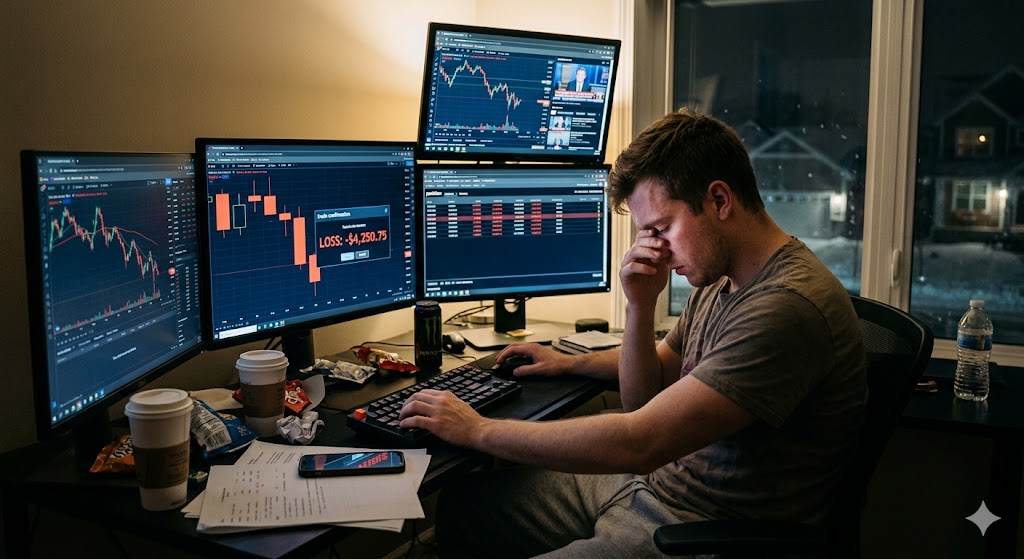
How to Deal With Loss in Trading: Accept It, or Blow Your Account
If you trade, you lose. Sometimes a little, sometimes a lot, sometimes on a Tuesday for no apparent reason other than the market doesn't care about your mortgage. The question is never whether you'll take a loss. The question is what you do in the ninety seconds after one — because that's where accounts are saved or lit on fire.
Losing Is Not a Bug. It's the Whole Job.
Let's get the painful part out of the way first: nobody — not your favorite trading influencer with the rented Lamborghini, not the hedge fund manager on CNBC, not Paul Tudor Jones — wins every trade. Professional traders typically operate with win rates somewhere between 45% and 60%, and some profitable strategies win less than 40% of the time. They print money anyway because their winners are bigger than their losers.
Source: Trade Ideas — Why a 90% Win Rate Isn't the Flex You Think It Is
The metric that actually matters is expectancy, not win rate. Expectancy is the average dollar amount you can expect to make (or lose) per trade across hundreds of trades. A strategy with a 40% win rate, a $300 average winner, and a $100 average loser has a positive expectancy of $80 per trade — meaning a trader who loses six out of every ten trades is still very profitable. Win rate alone is a vanity metric. Expectancy is the truth.
Source: TradeZella — Trading Expectancy Explained
So when you take a loss, you have not failed at trading. You have done trading. The next loss is already coming. The one after that, too. Internalize this now, or the market will eventually internalize it for you with a much larger bill.
What Actually Happens in Your Brain When You Lose
A losing trade isn't just an entry in your P&L — it's a small, controlled act of biological violence against your nervous system. When you take a hit, your amygdala (the brain's fear center) lights up and your prefrontal cortex (the part responsible for "maybe I shouldn't 5x my position right now") gets effectively muted. Stress hormones like cortisol and adrenaline flood in, and your brain processes the financial loss similarly to physical pain.
Source: Charles Schwab — Trading Psychology: Recovering From Big Losses
On top of the biology, loss aversion kicks in: humans feel the pain of a loss roughly twice as intensely as we feel the joy of an equivalent gain. A $500 loss doesn't feel like the inverse of a $500 win — it feels like it requires at least a $1,000 win to "make right." This is the exact urge that drives traders to size up after losing, which is exactly the wrong move at exactly the worst time.
Source: CrossTrade — Revenge Trading
None of this makes you weak. It makes you human. The traders who survive aren't the ones who never feel the urge to revenge trade — they're the ones who built systems that kick in before their lizard brain gets the steering wheel.
The Loss Spiral: How One Red Trade Becomes a Blown Account
Almost every blown account in trading history has the same final chapter, and it isn't titled "bad strategy." It's titled "revenge trading." Here's the loop, which you've either lived through or will, eventually:
Source: CrossTrade — Revenge Trading
What makes the loss spiral especially evil is that it occasionally rewards you. Sometimes the third revenge trade does recover the previous two losses. Your brain files this away as proof that revenge trading "works," which is exactly the same intermittent reinforcement schedule that makes gambling addictions stick. One accidental win inside a losing pattern is psychologically more powerful than dozens of consistent, moderate wins.
Source: Trader's Second Brain — How to Stop Revenge Trading
The Positive Way to Deal With a Losing Trade
Healthy loss management is boring. That's a feature, not a bug. The pros aren't doing anything heroic — they're following a routine designed to keep them from doing anything heroic. Here's the playbook.
1. Reframe the Loss as a Cost of Doing Business
A retail shop owner doesn't get emotionally hijacked when a single product doesn't sell. They don't smash the cash register, double their inventory order out of spite, and call their accountant in tears. They restock and move on, because losses on individual items are baked into the business model. Trading is no different — every loss that adheres to your plan is just rent paid to the market for the chance to take the next trade.
Source: MultiBank Group — Overcoming Trading Losses
2. Use a Mandatory Cooldown
After any loss that's outside your normal daily variance, or after two consecutive losses, step away from the screen for at least 30 minutes. Not "minimize the window" — physically away. Take a walk, do four rounds of 4-4-4-4 box breathing, eat a sandwich, anything that activates your parasympathetic nervous system and gets your prefrontal cortex back online. The market will still be there. So will the setups. There is no trade so urgent it cannot wait until your head is clear.
Source: ACY — How to Stop Revenge Trading: The 4-4-4-4 Reset
3. Set a Hard Daily Loss Limit — and Honor It
A common professional rule is to stop trading for the day after losing 2–3% of your account, or after losing 3x your normal per-trade risk — whichever comes first. The point isn't the specific number; the point is that the decision is made before you're emotional, when your judgment is still functional. Personal rules tend to fail under emotional pressure, so the best traders automate enforcement: prop firms do this with hard daily max-loss thresholds, and tools like broker-side daily loss limits can flatten positions and block new orders for you.
Source: CrossTrade — Daily Loss Limits and Kill Switches
4. Run Anti-Martingale, Not Martingale
The revenge trader's instinct is to double size after a loss — also known as the martingale strategy, also known as the fastest way to liquidate any account ever opened. Do the opposite. Cut your position size in half after any losing trade, and only return to normal size after two consecutive winners. This does two things: it limits damage during the inevitable losing streaks every strategy goes through, and it psychologically shifts your focus from "I need to recover" to "I need to rebuild with small wins."
Source: Trader's Second Brain — Anti-Martingale After Losses
5. Journal the Trade — Especially the Emotion
Every losing trade should get written down: entry, exit, setup rationale, plan adherence, and — critically — your emotional state before, during, and after. After a few weeks of this, patterns emerge that are completely invisible in the moment. Maybe your worst trades cluster on Friday afternoons. Maybe you only revenge trade after losses larger than $X. Maybe your "8/10 emotion" trades lose 70% of the time. Once you can see your patterns in data, walking away becomes a rational decision rather than a willpower contest.
Source: Plancana — Trading Journal for Emotional Discipline
6. Zoom Out
One trade doesn't matter. Ten trades barely matter. Your edge plays out over hundreds of trades, the same way a poker pro's edge plays out over thousands of hands. Evaluate performance weekly and monthly, not by what happened in the last 45 minutes. A trader fixated on the P&L of any single day is a trader who will eventually do something stupid on a bad one.
Source: DayTrading.com — How to Deal With Trading Losses
The Healthy Response vs. the Account-Killer Response
| Situation | Account Killer | Pro Response |
|---|---|---|
| Stop gets hit on a clean setup | Re-enter immediately at a worse price | Wait for the next valid signal at the original size |
| Two losses in a row | Double size to "make it back" | Halve size or stop trading for the day |
| Big loss outside plan | Hide from journal, refuse to review | Write it down, identify what broke, take a day off |
| "This setup is obviously going to bounce" | Cancel stop, add to losing position | Leave the stop. Cancel yourself instead. |
| End of a losing week | Sunday-night revenge plan to "go aggressive Monday" | Backtest, journal review, normal Monday open |
⚠️ The Kill-Switch Rule
If you realize mid-session that you're already in a revenge spiral: close all positions immediately. Take whatever loss is on the table right now. It will always be smaller than the loss you'd take if you keep going. Then log out — physically log out, not minimize — and walk away. Tomorrow is a new session. Today is over.
The Risk Management Side: Make Losses Smaller in the First Place
The single best way to handle losses well is to make sure they're small enough that handling them doesn't require superhuman emotional control. A controlled, expected loss inside your plan is far less likely to trigger a revenge-trading meltdown than an oversized, unexpected one. This is why per-trade risk limits, stop-losses, and daily caps aren't just risk management tools — they're psychological stabilizers.
Source: Plancana — Risk Management as Psychological Stabilization
A widely used baseline: risk no more than 1–2% of account equity per trade, with a hard daily loss cap of 2–3%. Use predefined stop-losses set before you enter the trade, when your judgment is clear. And — this is the part most traders skip — once that stop is set, resist the urge to move it further out when the trade goes against you. Moving a stop in your favor is good trade management; moving it against you to avoid the pain of being right about your own rules is how accounts die.
Source: LuxAlgo — How to Avoid Panic and Revenge Trading After a Loss
✅ A Simple Post-Loss Ritual
- Acknowledge: yes, that was a loss. It is not a referendum on your worth as a human.
- Step away from the screen for 30 minutes minimum.
- Box breathe: 4 seconds in, 4 hold, 4 out, 4 hold. Four cycles.
- Journal the trade objectively — setup, plan adherence, emotion.
- Mentally rehearse what you wish you'd done differently.
- Return only when calm. If you're still not, the day is over.
Source: Axi — Post-Loss Ritual (Steve Ward / Jeffrey Hodges)
A Personal Note: Funded Accounts Don't Forgive "One More Trade"
Here's the part where the lesson gets specific, because I've paid this tuition more times than I'd like to admit: I've blown countless funded accounts not because my strategy stopped working, but because I refused to walk away on the day it didn't. Every single one of them died from the same wound — a normal red day, a perfectly survivable loss, and then the conviction that this next trade was the one that would fix it. It never was. It was always the one that violated the daily loss limit and ended the account.
Funded accounts make this particular flavor of self-destruction uniquely expensive. On a personal account, a bad day costs you money. On a prop firm account, a bad day can cost you the entire account in a single afternoon — most firms enforce a hard 4–5% daily max loss, and breaching it doesn't get you a warning, it gets you a termination email. The math is brutal: you can be up for the entire month and erase all of it (plus the account itself) in one Tuesday session where you refused to close the platform.
Source: Trader's Second Brain — Why Revenge Trading Is Uniquely Dangerous on Prop Firm Accounts
The lesson I keep relearning, apparently because I'm a slow study: the trade you don't take on a bad day is worth more than any trade you do. Walking away at -2% with the account intact means you trade tomorrow, next week, next month. Pushing for the "comeback trade" at -2% means you might not trade that account ever again. There is no setup so beautiful that it's worth your funded status. There is no loss so unfair that revenge against the market will collect on it. The market doesn't even know you're there.
If You're Reading This Mid-Spiral
If you're staring at a losing funded account right now and the urge to "make it back today" is screaming in your head — close the platform. Don't finish reading this paragraph. Close it, walk outside, and let the day end. The account you save will be the one you're sitting in front of. The accounts I didn't save are why this section exists.
The Bottom Line
You will lose trades. You will lose them this week, next week, and in twenty years when you're still trading. The pros aren't pros because they figured out how to avoid losses — they're pros because they figured out how to take losses without losing their minds. The actual edge isn't in the entry; it's in what happens in the ninety seconds afterward, when every instinct in your body is screaming at you to do something destructive.
Accept the loss. Take the break. Stick to the plan. The market isn't out to get you — it's just indifferent, and it will be there tomorrow whether you have an account or not. Your only job is to make sure you still have one.