I Answer Reader Emails. Here’s What Makes a Question Answerable.
I don’t sell a course, run a Discord, or take on students, which means email is the only way anyone reaches me — and it also means I can answer honestly, because there’s nothing for me at the end of it. Most of what arrives is about psychology rather than setups, which is the right instinct. Here’s what I can help with, what I can’t, and one question answered in full.
The questions I can answer have one thing in common: they’re about a decision, not about a prediction.
Why I bother
Trading psychology is the part I got wrong for years, and the part almost nobody writes about honestly because it doesn’t sell anything. You can’t package “size smaller and stop looking at your P&L” as a course. So the space fills up with method instead — order blocks, liquidity sweeps, supply and demand zones — and a new trader ends up with an elaborate vocabulary for entries and no framework at all for the thing that will actually determine whether they survive.
When someone emails a specific question about that, they’ve usually worked out on their own that the problem isn’t their entry. That’s worth twenty minutes of my evening.
What I can answer
Anything about a decision you control, where the answer doesn’t depend on knowing your account, your market view, or your future.
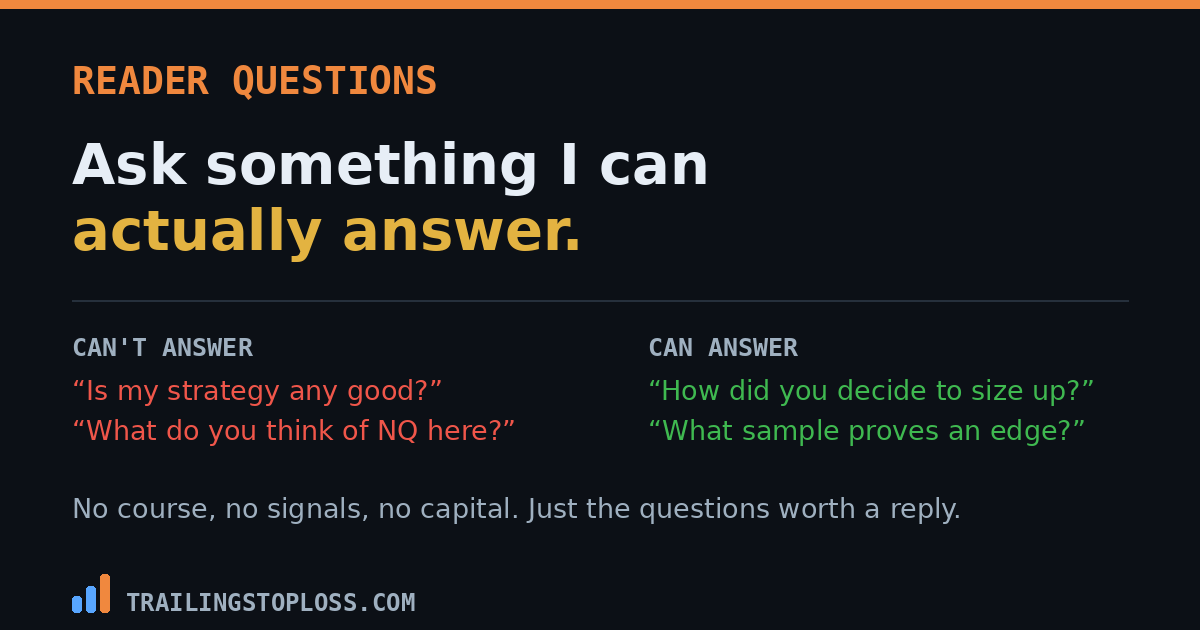
- “How did you decide when to size up?” — a process question with a real answer.
- “How many trades before I know if this works?” — arithmetic, and the number is usually far larger than people expect.
- “I keep moving my stop. What actually stops that?” — structural, and fixable without willpower.
- “Is my position size sane for this drawdown?” — a division problem, and the most valuable question on this list.
- “Why do I cut winners but let losers run?” — well documented, and not a character flaw.
- “Should I take a break after a losing streak?” — depends on the streak length, and the math is knowable.
What I can’t
Not out of caginess. These genuinely have no honest answer from where I sit.
- “What do you think of NQ here?” — I’d be guessing, and you’d weight my guess more than it deserves because it arrived in writing.
- “Is my strategy any good?” — nobody can tell you from a description. Only a sample can, and the sample needs to be bigger than you’d like.
- “Which prop firm should I use?” — this one I answer on the site rather than by email, because the honest version is a table rather than a name, and because I take affiliate commission from some of them. The true-cost rankings are the answer, and the flagged list is the part that costs me money.
- “Can you look at my chart?” — I’d be pattern-matching to my own approach, which tells you about me rather than about your trade.
- Anything about capital. I don’t manage money and don’t want to.
A question I answered this week
A student wrote asking how I decided when I was ready to size up or add an instrument, rather than just trading longer hours on the same setup. It’s a good question because it’s about the decision rather than the outcome, so here’s the answer in full.
I sized up on sample size, not on time or on feeling ready. The trigger was a stretch where execution had gone boring — same setup, same stop placement, no hesitating and no improvising. Past 100 trades, not 20. Over twenty trades, a genuinely profitable strategy still shows a loss about a quarter of the time, so nothing you conclude that early is reliable.
Second condition: the bigger size still had to fit the account. I want roughly 20 to 25 losing trades of room inside my maximum drawdown. If sizing up cuts that to ten, I’m not ready — a normal losing streak ends the account regardless of whether the setup works. This is the one that removes most people, and it’s arithmetic rather than judgment.
On adding an instrument, I’d delay as long as possible. A new instrument resets your sample to zero. You go from roughly knowing what your setup does to guessing again, and you can’t tell whether a bad month is the market or the new symbol.
On trading longer hours, I’d avoid it. Most edges are session-specific. Extending your hours usually means running an untested version of the same idea in conditions it was never measured in, and you find out slowly and expensively.
And the part I added at the end, which wasn’t what he asked: losing is the job. Most of your trades will lose. You’ll have losing weeks with nothing wrong. A strategy that works still spends about 82% of its life below its own best-ever equity, and most retail traders never make money at all. Almost nobody gets comfortable with that — professional futures traders tested for loss aversion showed more of it than students, not less. The ones who last aren’t the people who stopped feeling it. They’re the people who built rules that hold while they’re feeling it.
How to write one that gets a proper reply
Not rules, just what makes the difference between a real answer and a polite two lines.
- Ask one thing. A single question gets a considered answer. Six get a summary.
- Say what you’ve already tried. “I keep moving my stop and I’ve tried journaling it” is answerable. “How do I stop being emotional” isn’t.
- Include the constraint, not the chart. Account size, drawdown type and how often you trade tell me far more than a screenshot does.
- Make it about a decision you control. If the answer depends on what the market does next, I can’t give it.
- Don’t apologize for it being basic. The basic questions are the ones with answers. The sophisticated ones usually don’t have any.
Nothing is published with your name on it unless you want it there. Anything that appears here is stripped of identifying details, and the question above is paraphrased rather than quoted. I don’t add anyone to a mailing list, because I don’t have one.
The honest limits
I’m one trader with about five years of live experience, not a researcher. Where I can point at evidence I do, and most of what I’d tell you about psychology comes from published studies rather than from my own results. Where I’m just describing what worked for me, I’ll say so.
I answer when I can, not always quickly. This runs alongside a full-time job. Some weeks I’m a fortnight behind.
And I might be wrong. I’ve published corrections on this site — including reclassifying a firm we’d flagged incorrectly — and I’d rather be told than agreed with.
The short version
I answer reader emails because trading psychology is what I got wrong for years and the part almost nobody writes about honestly, since it can’t be packaged as a course. The questions I can answer are about decisions you control — when to size up, how large a sample proves an edge, why you cut winners, whether your size fits your drawdown. The ones I can’t are predictions, chart reads, and judgments on a strategy from a description. Best answer I gave this week: size up on sample size rather than on time or on feeling ready, past 100 trades, and only if the larger size still leaves 20 to 25 losing trades of room inside your drawdown. Ask one specific thing, say what you’ve already tried, and include the constraint rather than the chart.
Frequently asked questions
What kinds of trading questions can you actually answer?
Anything about a decision you control where the answer doesn’t depend on predicting the market: when to increase position size, how many trades are needed before a result means anything, why cutting winners early happens and what stops it, and whether a given position size is survivable against a particular drawdown. Those have real answers. Market calls, chart reviews and judgments on a strategy from a written description don’t.
How do you decide when to size up?
On sample size rather than on time or confidence. The trigger is a stretch of trades where execution has become boring — same setup, same stop placement, no hesitation and no improvising — somewhere past 100 trades rather than 20, since a genuinely profitable strategy still shows a loss over twenty trades about a quarter of the time. The second condition is that the larger size still leaves roughly 20 to 25 losing trades of room inside the maximum drawdown.
Why focus on trading psychology rather than strategy?
Because it’s the part that decides whether most people survive, and the part almost nobody covers honestly — you can’t sell a course on sizing smaller and looking at your P&L less often. That leaves the space filled with method, so new traders end up with detailed vocabulary for entries and no framework for the behavior that actually ends accounts.
Will my email be published?
Not with your name unless you want it there. Questions that appear here are anonymized and paraphrased, with identifying details removed, and I’ll ask first before quoting anyone directly. Nobody gets added to a mailing list, because there isn’t one.
Related on this site: why you’ll never get comfortable with losing · why most traders blow their accounts · the odds of becoming profitable · watching your P&L costs you money
Nothing here is financial advice, and nothing in a reply to an email is either. I don’t manage money, sell signals, or take students. Futures trading carries substantial risk of loss.