Premarket Brief · Friday, June 19, 2026
Premarket Brief: There Is No Premarket — Juneteenth Closes the Tape While a Hawkish Fed, a Wobbly Iran Deal, and Crude in Freefall Set Up Monday
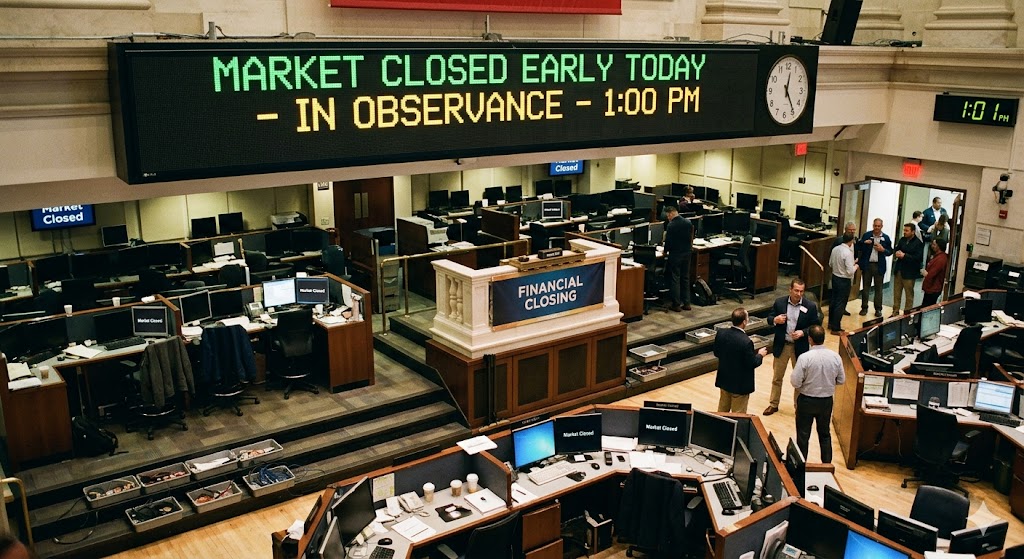
Welcome to a premarket brief for a day with no market. The NYSE and Nasdaq are dark for Juneteenth, so consider this less a “what’s moving” and more a “here’s the loaded spring you’re walking back into Monday.”
TL;DR. U.S. equities are closed today for Juneteenth and reopen Monday, June 22. The last live session (Thursday) ripped higher to undo a hawkish-Fed selloff. The Fed held rates but its dot plot now leans toward a hike this year — the opposite of what 2026 started pricing. Crude is collapsing as the Strait of Hormuz reopens, but the weekend’s “peace” plot just thickened: the US–Iran implementation talks in Switzerland were abruptly cancelled. Crypto is the only thing trading, and it’s bleeding anyway. Bring a helmet to Monday’s open.
First, the obvious: the tape is closed
Both the NYSE and Nasdaq are shut Friday for Juneteenth, and so are the U.S. bond market, the Fed’s payment rails, and DTC settlement. Regular trading resumes Monday, June 22, at 9:30 a.m. ET. So if you came here for an opening bell, there isn’t one — go touch grass, then come back Sunday night. Source: EBC Financial Group.
One quirk worth flagging for the futures crowd: CME contracts follow their own holiday schedule rather than the equity calendar, so sessions are thinned and product-specific rather than fully dark. Translation: don’t read too much into anything a sleepy holiday futures print tells you — liquidity is the kind of thin that turns a stray order into a “level.” Source: Yahoo Finance.
Equities & futures: a rebound that papered over a hawkish week
Thursday — the last live session before the holiday — was a broad-based melt-up. The Russell 2000 led at +2.12% to 2,979.77, the Nasdaq Composite added 1.91% to 26,517.93, the S&P 500 gained 1.08% to 7,500.58, and the Dow managed +0.14% to 51,564.70. Chips and cyclicals did the heavy lifting, with a modest dip in Treasury yields giving small caps room to run. Source: TheStreet.
That green close is more flattering than the week deserves. On Wednesday, the same indexes were down roughly a percent into the close after the Fed’s statement landed — the rebound just bought back the dip a day later. The S&P and Nasdaq finished higher heading into the holiday, propped up by tech, after chip stocks staged the recovery from the hawkish-Fed wobble. Source: Schwab Market Update.
Levels into Monday — S&P 500 (ES proxy)
- Pivot: 7,500 — Thursday’s close and a round number. Holding above it keeps the rebound intact; losing it on the reopen flips the bias.
- Support: ~7,420 (Wednesday’s post-Fed close zone), then 7,383 (the early-June low shelf).
- Resistance: a clean reclaim of 7,500 puts the prior-week highs back in play; that’s the bulls’ burden of proof.
Levels into Monday — Nasdaq Composite (NQ context)
- Pivot: the 26,000–26,500 shelf — Thursday’s +1.91% put price back on top of it.
- Support: 26,000 round number, then ~25,700 (the early-June flush low).
- Caveat: a two-day gap on a hawkish Fed and a fragile ceasefire means Monday can open with a gap that ignores Thursday’s levels entirely. Let the first range build before you trust it.
The Fed: Warsh’s debut went full hawk
The headline was “no change” — the Fed left its target at 3.50%–3.75% — but the subtext did the damage. In new Chair Kevin Warsh’s first meeting, the dot plot showed nine of eighteen officials now pencil in at least one rate hike this year, and several of those want more than one. The 2026 rate cut that markets entered the year expecting has been quietly deleted. Source: TheStreet.
Warsh also torched the forward-guidance security blanket, telling reporters he couldn’t give markets any steer on the next move — a refreshingly honest “we’ll wing it” that traders, predictably, hated. Bloomberg data had the market fully pricing a quarter-point hike by year-end after the projections dropped, with the firmer jobs market and energy-driven inflation cited as the culprits. Source: Yahoo Finance.
The nuance that keeps this from being a one-way bet: the split among officials was roughly even, and if oil keeps cratering, the inflation case that’s forcing the hawkish lean starts to soften. The Fed removed the cut and floated hikes — but it didn’t commit to one. That tension is the whole story for the back half of the summer. Source: Edward Jones.
Crypto: the only market open, and it’s still in the red
Since crypto never clocks out, it’s the one asset class actually live on Juneteenth — and it’s not using the spotlight well. Bitcoin opened Thursday near $64,450 and slid to roughly $63,980, with Ethereum around $1,744, both leaking lower despite the signed US–Iran deal. The market is reading the hawkish Fed louder than the ceasefire. Source: Yahoo Finance.
One bright spot in the gloom: Ether is outperforming Bitcoin by about 6.6% on the week, helped by returning spot-ETF inflows and steady accumulation. BTC, meanwhile, steadied near $63.9K with the Fear & Greed Index sagging to 15 — “extreme fear” territory, which contrarians will tell you is where bottoms get made and everyone else will tell you is where bottoms get made right before they aren’t. Source: BlockchainReporter.
For context on how far off the highs this is: Bitcoin’s record was $126,198 back in October 2025, so spot near $63K is roughly a 50% haircut from the top. The next real catalyst on the crypto calendar is the CLARITY Act, sitting on the Senate floor with a July 4 target — if it passes, XRP finally gets a commodity classification codified, with positive spillover for the broader altcoin complex. Source: CoinDesk.
Metals: gold and silver caught in a tug-of-war
The Hormuz deal sent metals up earlier in the week — gold jumped about 3% to roughly $4,345 and silver popped 4.6% — as cheaper oil trimmed the rate-hike bets that had been weighing on them. When the Fed is the boogeyman, anything that softens the inflation story is a tailwind for the shiny stuff. Source: TS2.
Here’s the rub: the same hawkish dot plot that’s pressuring crypto is gold’s natural enemy. Rising real yields make a zero-yield asset look worse by comparison, and as long as the market keeps pricing at least one hike, that caps gold’s ceiling no matter how dramatic the geopolitics. A single down day in crude doesn’t undo a structural rate problem. Source: Discovery Alert.
Silver’s wrinkle is supply: the Silver Institute is forecasting a deficit of roughly 67 million ounces in 2026, several years into a running shortage, which gives it a floor that pure macro doesn’t fully explain. It’s the rare metal that gets to be a monetary hedge and an industrial input at the same time — twice the demand drivers, twice the volatility. Source: TradingKey.
Oil & the Iran wildcard: the weekend’s only real headline risk
Crude is the cleanest story on the board and the messiest under the surface. Brent slid below $78 — its lowest since early March — as tankers began moving through the Strait of Hormuz again after the US and Iran reached their interim agreement. WTI is hovering around $77, and oil has now shed roughly 38% from its April four-month high. Goldman cut its Q4 Brent forecast to $80 and expects Gulf exports back to pre-war levels by the end of July. Source: Trading Economics.
And now the plot twist that lands right on your weekend: the implementation talks scheduled for Friday in Obbürgen, Switzerland were abruptly cancelled after Israeli airstrikes on Lebanon, with VP JD Vance’s trip called off so suddenly his staff were already in motion. The MOU was digitally signed Wednesday and opened a 60-day window — but the central route of Hormuz is reportedly still closed, with an estimated 80 mines to clear, and ships are squeezing through the northern and southern lanes instead. Source: The Irish Times.
This is the one thing that can gap your Monday. “Peace deal signed, oil’s falling” is the comfortable narrative; “implementation talks collapsed over the weekend, Israel and Lebanon are trading fire, and the mined chokepoint isn’t actually open” is the version that reprices crude — and by extension the Fed’s inflation math — in a single Sunday-night session. Watch the headlines, not the calm. Source: CBS News.
Weekend & week-ahead calendar
| When | Event | Why it matters |
|---|---|---|
| This weekend | US–Iran implementation fallout | Talks cancelled, strikes on Lebanon, Hormuz only partially open — the live gap risk for Monday’s crude and equity opens. |
| Mon, Jun 22 | U.S. markets reopen, 9:30 a.m. ET | First cash session to digest the hawkish Fed + the weekend’s geopolitics in one shot. Expect a gap; let it settle. |
| Jun 30–Jul 4 | CLARITY Act (Senate floor) | White House targeting a July 4 signing; codifies XRP’s commodity status — the big remaining crypto catalyst. |
| Mid-July | July CPI print | If cheaper oil cools inflation, it gives Warsh’s “data-dependent” Fed a reason to walk back the hawkish dots. |
Calendar catalysts via BlockchainReporter and Investing.com.
Bottom line
You’re not missing a session today — you’re getting a free 72 hours to plan one. Thursday’s rebound made the screen look calm, but the setup underneath is anything but: a Fed that just deleted its rate cut and floated hikes, a “peace deal” whose implementation talks just fell apart, and a crude market betting the calm holds. Monday’s open is the first chance to vote on all of it at once. The S&P’s 7,500 and the Nasdaq’s 26,000 shelf are your line-in-the-sand reference points — but if oil or the Middle East gaps the tape over the weekend, those levels are suggestions, not rules. Trade the open you get, not the one you drew Friday.
FAQ
Is the stock market open on Juneteenth 2026?
No. The NYSE, Nasdaq, the U.S. bond market, and settlement infrastructure are all closed Friday, June 19, 2026 for Juneteenth. Regular trading resumes Monday, June 22 at 9:30 a.m. ET. CME futures run reduced, product-specific holiday sessions rather than closing fully.
What did the Fed actually decide at the June 2026 meeting?
It left rates unchanged at 3.50%–3.75%, but the updated dot plot turned hawkish: nine of eighteen officials now project at least one rate hike in 2026 (several want more than one), and the previously expected 2026 cut was removed. New Chair Kevin Warsh also dropped formal forward guidance. Markets moved to fully price a quarter-point hike by year-end.
Why is oil falling if there’s still conflict in the Middle East?
The US–Iran interim deal began reopening the Strait of Hormuz, so stranded crude started flowing again and supply fears eased. Brent fell below $78 and WTI sits near $77, down roughly 38% from April’s high. The risk: implementation talks were cancelled this weekend and the strait’s main route reportedly remains mined and closed, so the “supply’s back” trade is fragile.
What are the key S&P 500 and Nasdaq levels into Monday?
The S&P closed Thursday at 7,500.58 — 7,500 is the pivot, with support near 7,420 then 7,383. The Nasdaq Composite closed at 26,517.93, sitting on a 26,000–26,500 shelf with support near 25,700. After a two-day holiday gap on a hawkish Fed and shaky ceasefire, expect the open to potentially gap past these levels — let the first range form before trusting them.
Is crypto trading during the Juneteenth holiday?
Yes — crypto trades 24/7, so it’s the only major market open on Juneteenth. Bitcoin is hovering near $63.9K and Ethereum around $1,744, both sliding as the hawkish Fed outweighs the Iran deal. Ether is outperforming Bitcoin on the week, and the Fear & Greed Index has dropped to 15 (extreme fear).
This brief is for information and education only, not investment advice. Trading futures, crypto, and equities involves substantial risk of loss. Prices and levels referenced are as of the last available data before the Juneteenth close and may move sharply once markets reopen. Do your own research.