Pre-Market Briefing: Tuesday's Jobs Math Meets Monday's Missiles — June 1, 2026
Futures are nudging higher into record territory, Bitcoin is doing its best impression of a brick, gold is parked above $4,500, and the U.S. and Iran spent the weekend trading proposals and missiles. Welcome to June.
Wall Street opens June the way it closed May: at all-time highs and somehow unbothered. All three major indexes printed fresh records on Friday, capping a month where the Nasdaq Composite tacked on more than 8%, the S&P 500 added roughly 5%, and even the sleepy Dow managed nearly 3% — with the S&P riding its longest weekly winning streak since 2023. The engine, as always, was Big Tech, plus a steady drip of optimism that the U.S. and Iran might actually agree to stop shooting at each other. If you trade the NQ after the New York open, the setup this week is straightforward to describe and miserable to navigate: a market priced for good news, sitting on top of a powder keg, three days before the jobs report. CNBC
Futures: Green, but Politely
E-mini (ES)
E-mini (NQ)
YM
Treasury
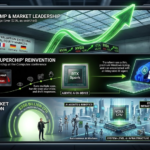
Index futures are higher across the board pre-bell, with S&P 500 contracts up about 0.3%, Nasdaq-100 futures up roughly 0.2%, and Dow futures adding a couple hundred points. The headline mover is Nvidia, up around 2% after CEO Jensen Huang used the Computex stage to unveil the N1X, a new processor built with Microsoft that he—in characteristically modest fashion—called as big a deal as the smartphone. Dell and HP rode the coattails higher; Intel, the company that used to own the PC chip and now mostly owns the headlines about losing it, dropped more than 6%. Yahoo Finance
There's M&A in the mix too: Taylor Morrison Home popped about 22% pre-market after Berkshire Hathaway agreed to buy the homebuilder for $6.8 billion in cash, one of the first big swings from Greg Abel since taking the wheel from Warren Buffett. Add a Chicago PMI that ripped to a four-year high of 62.7, and the growth backdrop looks firm — which is exactly the problem if you're hoping for rate cuts, because firm growth plus sticky prices keeps the Fed parked. For day traders, a 0.2% gap and a strong-but-not-screaming tape usually means the open does the heavy lifting and the rest of the morning is a coin flip. CNBC
Equities: A Record Built on a Maybe
The uncomfortable truth under the all-time highs is that a meaningful chunk of May's rally was bought on the rumor of a U.S.-Iran peace deal that, as of this morning, still doesn't formally exist. Strong tech earnings (Dell led the charge) gave the move real legs, but sentiment is leaning hard on a diplomatic outcome that keeps slipping its deadline. That makes this a momentum tape with a soft underbelly: lovely while it lasts, violent when the narrative cracks. If you're managing a funded account through this, it's worth reviewing how news-day volatility interacts with daily loss limits before you find out the hard way — our breakdown of prop firm true costs and rules covers where those landmines hide. TheStreet
Crypto: The Asset Class That Didn't Get the Memo
While stocks partied to record highs for nine straight weeks, crypto stood in the corner holding a drink it didn't order. Bitcoin is changing hands around $73,300, and the Crypto Fear & Greed Index is sitting at "extreme fear" — a notable mood given equities are at records. Ether is the real horror story: trading near $2,025 and on track for a third consecutive monthly loss, reportedly a first in its history, down roughly 32% on the year. ETF demand has cooled, including a single $1.26 billion block sale of BlackRock's IBIT, the kind of order that doesn't exactly scream "accumulate." CoinDesk
There's a regulatory subplot worth tracking: JPMorgan's Jamie Dimon publicly took aim at Coinbase's Brian Armstrong and warned the current CLARITY Act framework could fail, as banks and crypto firms scrap over whether stablecoin issuers should be allowed to pay yield that looks suspiciously like a bank deposit. None of that is an intraday catalyst, but it's the backdrop for why institutional crypto flows are hesitant. For NQ traders, the read-through is simple: crypto is no longer acting as a risk-on confirmation signal, so don't treat a green Bitcoin candle as your permission slip to buy stocks. More in our crypto coverage. CoinDesk
Metals: Gold's Expensive Nap
Spot /oz
Spot /oz
Gold is doing almost nothing, which after this year counts as exciting — spot is steady around $4,541 an ounce, essentially flat on the day and still up roughly 34% versus a year ago. Silver is holding above $75 and just booked a 3%-plus monthly gain. Both metals are well off their January moonshots (gold cleared $5,000 and silver briefly punched above $100 before reality set in), but they remain historically elevated, propped up by three things: the on-again-off-again closure of the Strait of Hormuz, relentless central-bank buying, and a Federal Reserve that one analyst bluntly described as "trapped." Trading Economics
Here's the part that matters for rates: April CPI came in at its hottest in three years, markets have fully priced out cuts for 2026, and a few brave souls are now betting on a hike before year-end. Normally that combination would flatten gold. It hasn't — which is exactly why the stagflation comparisons to the 1970s and '80s keep getting louder, and why metals are refusing to break despite a strong dollar and high yields. If gold is shrugging off rate-hike odds, the market is telling you something about how much it trusts the inflation story. CBS News
The War: Proposals by Day, Missiles by Night
The Middle East war is now in its fourth month, and the weekend was peak whiplash. The conflict escalated dramatically after U.S. and Israeli strikes on Iran earlier this year, Iran's declaration that the Strait of Hormuz was "closed," and a fragile ceasefire that's been honored mostly in the breach since April. Over the weekend, Washington and Tehran exchanged proposals to amend a draft accord that would extend the ceasefire for 60 days and reopen the strait — while also exchanging actual fire. The U.S. struck Iranian command-and-control sites after an American drone was downed over international waters. Diplomacy and drone strikes, same news cycle. The National
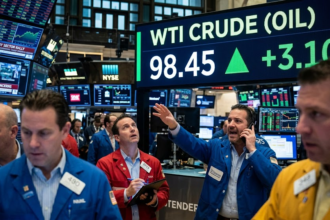
Oil jumped more than 3% on the news, with Brent near $94 and WTI around $90, because roughly a fifth to a quarter of the world's seaborne oil normally squeezes through that one waterway. President Trump has not signed off on the proposed terms, and Vice President JD Vance said it's too early to call whether a deal lands. For traders, the mechanism to watch is the chain reaction: Hormuz headline → oil spikes → inflation fears return → Fed stays hawkish → growth and tech get nervous. That's the transmission line that can turn a quiet NQ morning into a fast one, so keep a hard stop and don't get cute fading a geopolitical gap. Trading Economics
High-Impact News This Week
It's a holiday-shortened, labor-market-heavy week that builds to Friday's jobs report. The PMIs bookend the front half, and Thursday is mercifully quiet. All times Eastern. FinancialJuice
| Day | Time | Release | Impact |
|---|---|---|---|
| Mon Jun 1 | 9:45 | S&P Manufacturing PMI (final, May) | Med |
| Mon Jun 1 | 10:00 | ISM Manufacturing PMI (May) | Med-High |
| Tue Jun 2 | 10:00 | JOLTS Job Openings (Apr) | Med |
| Wed Jun 3 | 8:15 | ADP Employment Change (May) | Med-High |
| Wed Jun 3 | 9:45 | S&P Services & Composite PMI (final) | Med |
| Wed Jun 3 | 10:00 | ISM Services PMI (May) | High |
| Thu Jun 4 | 8:30 | Weekly Jobless Claims | Low |
| Fri Jun 5 | 8:30 | Employment Situation / Nonfarm Payrolls (May) | High |
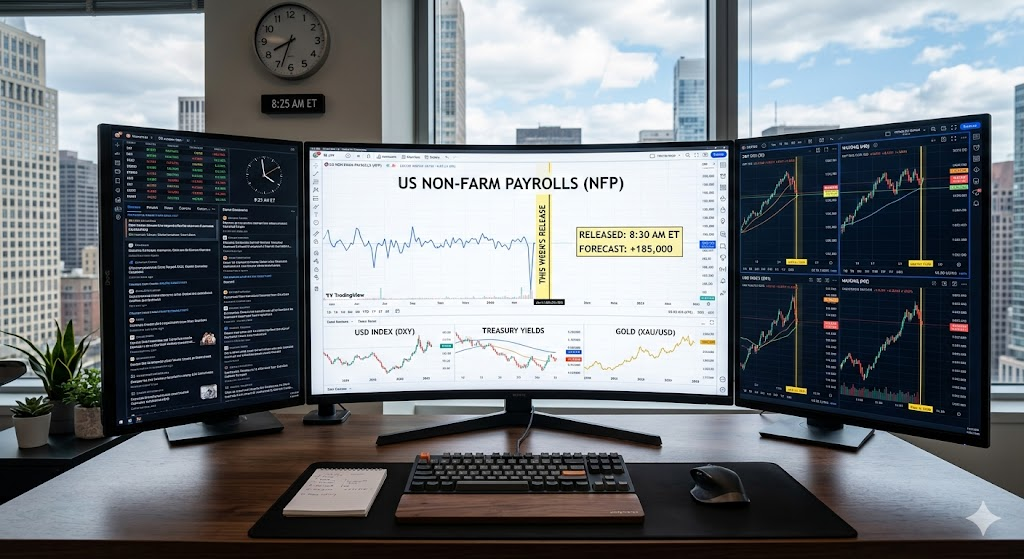
The week's main event: Friday's jobs report. Last month delivered about +165K payrolls, a 4.3% unemployment rate, and wage growth of +0.3% m/m (3.4% y/y). A hot print revives "higher for longer" and pressures rate-sensitive tech; a soft print rekindles cut hopes. Either way, 8:30 AM Friday is not the moment to be married to a position.
The NQ Trader's Bottom Line
Setup: Records + a green gap + geopolitical risk + a jobs report Friday. Translation: momentum is intact, but the tail risk is fat and the calendar is loaded.
For a continuation scalper working the open, the playbook writes itself: respect the trend (it's up), but size for the headlines (they're unpredictable). The two things most likely to inject volatility are a Hormuz/oil shock and Wednesday's ISM Services print, with Friday's NFP as the real boss fight. None of that requires you to predict anything — it requires you to keep stops mechanical and avoid holding size into the 8:30 and 10:00 releases. As the impatient among us know all too well, the fastest way to give back a good morning is to overstay it. Manage the risk, let the open come to you, and remember that "the market is at all-time highs" has never once been a stop-loss. More setups in our pre-market briefings.
FAQ
Why are stocks at record highs if there's a war going on?
May's rally was driven largely by strong Big Tech earnings and growing optimism that the U.S. and Iran would reach a ceasefire and reopen the Strait of Hormuz. Markets are pricing in a diplomatic outcome; the risk is that the deal keeps slipping while flare-ups continue, leaving equities exposed if the peace narrative cracks.
What's the most important economic release this week?
Friday's Employment Situation report (Nonfarm Payrolls) at 8:30 AM ET is the headliner. Wednesday's ISM Services PMI at 10:00 AM ET is the secondary high-impact event. Both can move index futures sharply, so position sizing around those windows matters.
Why is crypto falling while stocks rise?
Crypto has decoupled from the equity rally: Bitcoin is near $73,300 with sentiment at "extreme fear," and Ether is on track for a third straight monthly loss. Cooling ETF demand and large block sales have weighed on flows, so crypto is no longer acting as a reliable risk-on confirmation signal for stocks.
How does the Iran conflict affect index futures?
Through oil. Roughly a fifth to a quarter of seaborne crude moves through the Strait of Hormuz, so escalation spikes oil, which revives inflation fears, which keeps the Fed hawkish and pressures rate-sensitive tech. A Hormuz headline can turn a quiet NQ session into a fast one within minutes.