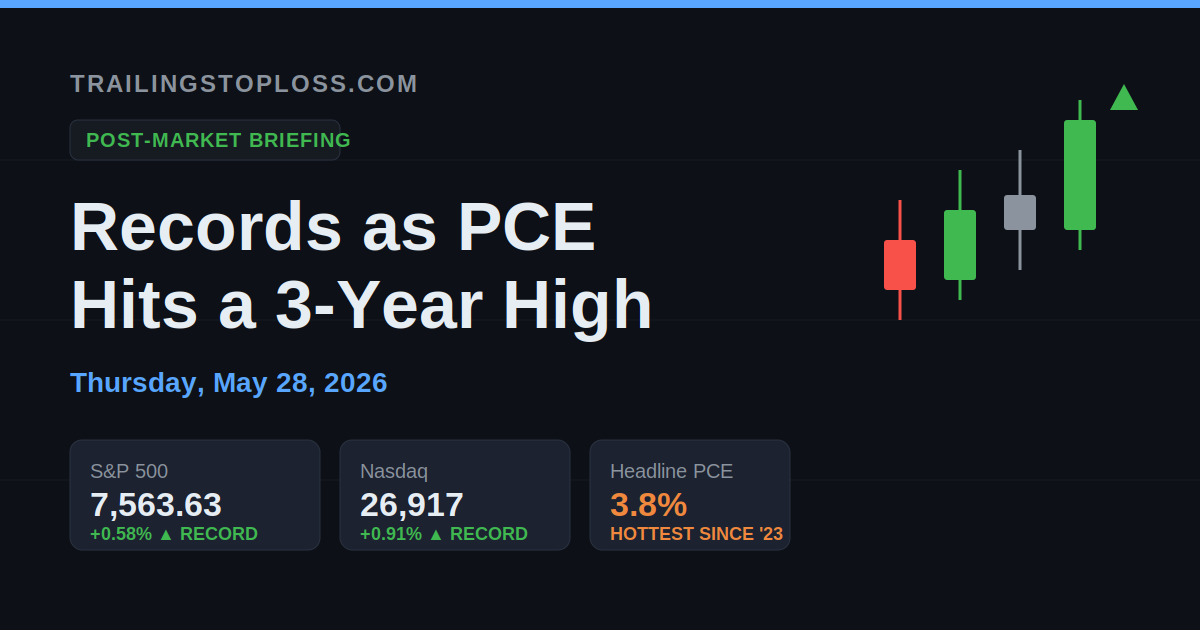
Markets pulled off a masterclass in selective hearing today. The Fed's favorite inflation gauge printed its hottest reading in nearly three years, the economy got revised weaker, and a fresh round of missiles flew in the Middle East — so naturally, the S&P 500 and Nasdaq closed at brand-new record highs. Because of course they did.
Equities: Records, Again
The broad market kept the party going on Thursday. The S&P 500 climbed 0.58% to a record 7,563.63 and the Nasdaq Composite added 0.91% to a record 26,917.47, while the Dow Jones Industrial Average barely showed up to its own party, inching 0.05% higher to 50,668.97 as health-care and energy names dragged. Both the S&P and Nasdaq also notched fresh intraday all-time highs along the way. (CNBC)
The fuel was the usual suspect: the AI trade roared back to life. A strong outlook from Snowflake — headlined by a reported $6 billion commitment from Amazon Web Services for its in-house Graviton chips — reignited enthusiasm across the semiconductor complex, where memory names have been on a tear and chip valuations keep crossing the trillion-dollar line like it's a participation trophy. If you've been tracking the broader setup in our futures market coverage, none of this momentum will surprise you. (CNBC)
The after-hours headliner was Dell, which reported fiscal Q1 results that made the AI-server bulls look downright reasonable: revenue of roughly $43.8 billion blew past the ~$35.8 billion consensus on 88% year-over-year growth, and management hiked full-year revenue guidance to a $165–$169 billion range from $138–$142 billion — on top of a freshly announced $9.7 billion Pentagon software contract. That's the kind of print that sets a constructive tone for index futures heading into Friday. (CNBC)
Cross-Asset Scoreboard
| Asset | Level | Day | Read |
|---|---|---|---|
| S&P 500 | 7,563.63 | +0.58% | Record close |
| Nasdaq Composite | 26,917.47 | +0.91% | Record close |
| Dow Jones | 50,668.97 | +0.05% | Barely green |
| WTI Crude | $88.90 | +0.25% | Whipsawed |
| Brent Crude | $93.71 | -0.62% | Faded the strikes |
| Bitcoin | ~$73,300 | -2% to -3% | Risk-off |
| Ethereum | ~$2,115 | ~flat | Range-bound |
| Gold (spot) | ~$4,411 | -$21 | Dollar squeeze |
| Silver (spot) | ~$74 | -0.9% | Followed gold |
Futures & the Macro Print
Here's the thing the equity tape conveniently ignored: April's headline PCE accelerated to 3.8% year-over-year — the highest since May 2023 — while core PCE, the Fed's preferred gauge, edged up to 3.3%, its hottest since late 2023. So why did stocks rally? Because traders chose to focus on the month-over-month figures, which actually came in cooler than feared: headline rose 0.4% versus the 0.5% forecast, and core rose just 0.2% versus the 0.3% consensus. In other words, the headline number was ugly, the fine print was a relief, and the market decided the fine print was the part worth trading. (Benzinga)
The same data dump delivered a downbeat growth side. Q1 GDP was revised down to a 1.6% annualized pace from the initial 2.0% estimate, and the personal savings rate slipped to 2.6% — its lowest since 2022 — a quiet hint that households are getting squeezed. With the average gallon of gas now around $4.42, up roughly 48% since the war began in late February, that squeeze isn't exactly a mystery. (AP via WEIS)
The War & Oil
The Middle East provided the day's adrenaline. The U.S. and Iran traded military strikes Thursday — Iran's Revolutionary Guard said it hit a U.S. air base in the early morning, and U.S. Central Command reported intercepting ballistic missiles launched toward Kuwait. Then, in classic 2026 fashion, the script flipped: negotiators reportedly reached a 60-day memorandum of understanding to extend the fragile ceasefire and kick off talks over Iran's nuclear program, pending President Trump's approval. Shoot first, negotiate by lunch. (CNBC)
Oil rode that whiplash all day. Crude rallied on the strikes, then surrendered the gains once the ceasefire-extension headlines hit, leaving Brent down 58 cents at $93.71 and WTI up a token 22 cents at $88.90. The Strait of Hormuz — the chokepoint that handles roughly a fifth of global oil — remains the wildcard nobody has actually solved, which is precisely why energy traders can't put their coffee down. (CNBC)
Crypto: Took the Risk-Off Stocks Ignored
Digital assets did the worrying that equities couldn't be bothered with. Bitcoin opened around $74,300 — down about 2% from Wednesday — and slid toward the low-$73,000s through the morning as the overnight strikes on Iranian targets soured risk appetite, while Ethereum hovered near a sleepy $2,115. It's a tidy little divergence: the same geopolitical headlines that crypto traded as a reason to de-risk, the stock market treated as background noise on its way to new highs. More on the digital-asset backdrop in our ongoing crypto market coverage. (Yahoo Finance)
Metals: Gold Caught in a Squeeze
Gold had every reason to shine — fresh missiles, a three-year-high inflation print — and instead it sagged, trading near $4,411 an ounce, down about $21, after dipping to roughly $4,390, its weakest level since late March. The culprit was a rare double-whammy: the U.S.-Iran escalation pushed crude and the dollar higher at the same time, and a stronger greenback mechanically compresses the dollar price of non-yielding bullion. Silver tagged along lower near $74 (-0.9%) and palladium dropped about 2.6%. The takeaway worth filing away: gold is currently trading the rate-expectations story, not the geopolitics story — when yields and the dollar firm up on hot inflation, the shiny rock loses its seat at the table. (Fortune)
One More Thing: A New Sheriff at the Fed
Worth keeping on your radar: there's a new Fed chair in the building. Kevin Warsh, sworn in May 22 after Jerome Powell wrapped his term mid-month, has been openly reform-minded and wants to meaningfully shrink the central bank's roughly $6.7 trillion balance sheet — a distinctly hawkish posture. The timing is almost comedic: a tightening-leaning chair takes the reins exactly as inflation reaccelerates to a three-year high and stocks melt up to records on AI euphoria. That tension — easy markets versus a Fed that sounds like it wants the punch bowl back — is the storyline that could define the back half of 2026. We'll keep tracking it in the daily pre-market briefings. (The Motley Fool)


