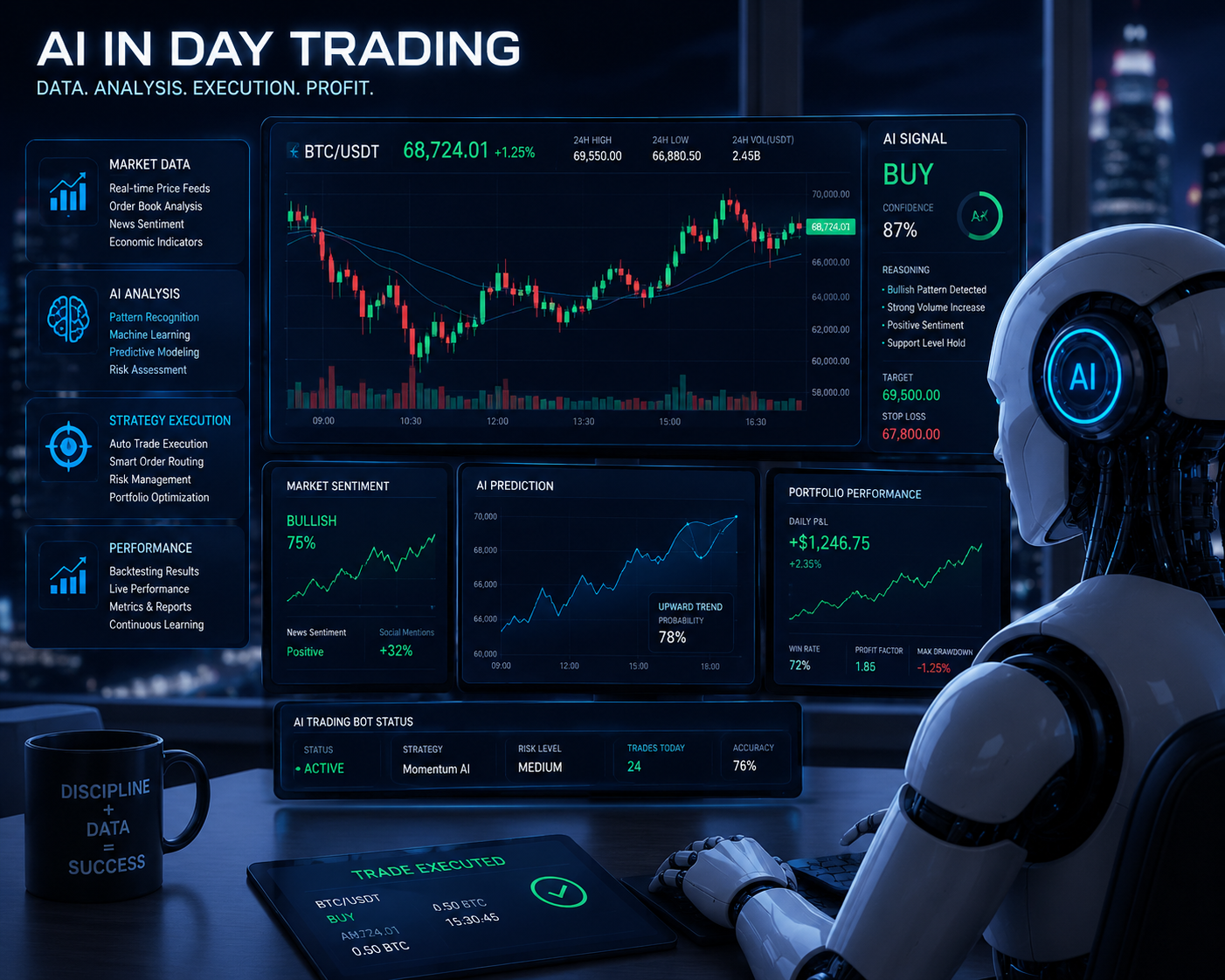
Walk onto any trading floor in 2026 and you will find roughly the same scene as ten years ago — except the humans are now mostly there to supervise machines, sip overpriced coffee, and explain to compliance why their language model just summarized an earnings call in the voice of a pirate. Artificial intelligence has not "transformed" trading in the sci-fi sense. It has done something more boring and far more important: it has quietly become the default. Whether you run a $30 billion hedge fund or trade a $3,000 funded account from your kitchen table, AI is now woven into how prices get analyzed, how orders get routed, and how risk gets managed. For more on how this trend intersects with day-to-day execution, see our day trading coverage.
The headline number that should anchor every conversation about this: a recent Hedgeweek survey of hedge fund managers in 2026 found that exactly zero respondents reported having no plans to use AI. Not "few." Zero. Adoption now splits into three buckets — firms actively deploying AI, firms experimenting with it, and firms preparing to implement it within six months — which means the question "should we use AI?" has been retired in favor of "how much of our process should AI run?" Coverage on this shift comes from Hedgeweek.
The Two Worlds of AI Trading: Institutional vs. Retail
AI in trading is not one thing. It is at least two parallel universes that occasionally borrow from each other. On the institutional side, you have quant hedge funds, prop desks, and market makers running machine learning models trained on petabytes of pricing, order book, alternative, and satellite data. On the retail side, you have everyone from a part-time swing trader using ChatGPT to summarize a 10-K, to subscribers paying for AI-powered scanners like Trade Ideas' "Holly," which runs thousands of strategy backtests each night to surface live setups. Both worlds use the phrase "AI trading." Only one of them is actually doing something that would impress a data scientist. For a primer on the strategy side of all this, the education category has the foundational reading.
The institutional side has done the real heavy lifting. Roughly 86% of hedge fund managers now use generative AI tools somewhere in their investment or risk workflow, and cloud computing adoption across the industry has reached about 85% — because you cannot train a transformer model on a single laptop, no matter how aggressive the RGB lighting. AI-augmented decision-making is expected to deliver 10–12% industry-wide cost savings by the end of 2025, mostly by eating tasks that used to require junior analysts, compliance officers, and the occasional miserable summer intern. Statistics here come from CoinLaw's 2026 hedge fund industry report.
The headline stat retail traders should remember: Greenwich Associates reported that 75% of institutional trading firms now use some form of AI or machine learning, up from 35% in 2019. If you are trading against the market, you are not trading against humans anymore. You are trading against a model that has read more earnings transcripts than you will in your lifetime.
What "AI Trading" Actually Means — Four Levels
The phrase "AI trading" gets thrown around with the same precision as "organic" on a fast-food menu, so it helps to break it into levels of sophistication. A useful framework, popularized in the retail education space, separates AI trading tools into four tiers based on what the technology actually does behind the buzzwords. This kind of hierarchy is also how regulators like the SEC quietly evaluate marketing claims when they decide who is selling software and who is selling a fairy tale.
| Level | What It Is | Examples | Who Uses It |
|---|---|---|---|
| Level 1 | Rules-based automation dressed up in "AI" marketing | Basic alerts, simple screeners, conditional orders | Almost every broker |
| Level 2 | Statistical models, pattern detection, mean-reversion bots | TrendSpider scanners, basic algo platforms | Active retail traders |
| Level 3 | Genuine machine learning that adapts to market conditions | Trade Ideas Holly, institutional quant signals | Quants, advanced retail |
| Level 4 | Large Language Models for research, sentiment, and code | ChatGPT, Claude, Gemini for analysis | Everyone, knowingly or not |
Most "AI trading" products marketed to retail traders are Level 1 or Level 2 with a clever splash page. That is not necessarily a scam — rules-based automation can be genuinely useful — but it is also not what the marketing implies. The actual Level 3 machine learning systems are expensive to build, expensive to maintain, and require continuous retraining as market regimes shift. The honest tools tell you which level they operate at. The dishonest ones use the word "AI" 47 times on the landing page and never explain how it works. Framework adapted from Day Trading Toolkit's 2026 AI guide.
The Algorithmic Foundation Underneath It All
Before AI, there was already algorithmic trading — pre-programmed execution that does not need a model to be smart, just fast and rule-following. That foundation matters because algorithmic and high-frequency strategies now generate roughly 60–75% of total trading volume in U.S. equity markets, European markets, and major Asian markets in 2025. AI sits on top of that infrastructure, not in place of it. The machines were already running the market. AI just made them better at deciding what to do. Volume estimates from QuantifiedStrategies.
The chart below illustrates a stylized version of what an AI-augmented system "sees" during a trading session: not just the candles a human trader watches, but a price action layer enriched with signal probabilities that update continuously. The candles are what you and I look at. The signal band underneath is what the model is doing while you are still trying to draw a trendline.
What Retail Traders Actually Have Access To
The democratization story is real, but it has limits. As of 2026, roughly 60% of major retail platforms offer some AI-powered feature — smart screeners, sentiment dashboards, automated alerts. Retail AI trading tool adoption grew an estimated 340% from 2022 to 2025, mostly riding the coattails of large language models. A trader today can ask Claude or ChatGPT to dissect a 10-Q, generate a Pine Script indicator for TradingView, summarize a Fed statement, or write a Python backtest — tasks that used to require a junior analyst, a developer, and a long weekend. Adoption figures from TradeAlgo.
The accessible toolkit for a serious retail trader in 2026 looks roughly like this: an LLM (ChatGPT, Claude, or Gemini) for research and code generation, a Level 3 scanner like Trade Ideas Holly for signal discovery, a charting platform like TradingView with AI-assisted indicator building, and possibly an AI-powered bot platform for automated execution on the crypto or forex side. None of it is magic. All of it is genuinely useful when paired with a tested strategy. For background on whether automation actually fits your trading style, our trading psychology category covers the part where humans sabotage their own systems regardless of how good the algorithm is.
Reality check from MIT Sloan: a 2025 MIT Sloan Management Review study found that 47% of retail traders who adopted AI tools without understanding their limitations experienced worse returns than their pre-AI performance in the first six months. AI does not save bad strategies. It just executes them faster.
Where AI Actually Adds Value (and Where It Doesn't)
AI in trading earns its keep in a few specific places. It is excellent at data processing at scale — reading every 10-K filed in a quarter, parsing every earnings call transcript, scoring sentiment across thousands of news sources in seconds. It is excellent at pattern recognition in well-defined regimes. It is excellent at generating code, building backtests, and writing the kind of documentation that traders normally avoid. A University of Chicago study from 2024 found that GPT-4 outperformed human analysts in earnings call sentiment analysis by 12%, a margin that is roughly the difference between mediocre and elite on most performance leaderboards. Findings reported via TradeAlgo's 2026 industry summary.
Where AI fails — and where retail traders most often get hurt — is in regime changes, unprecedented events, and contextual judgment calls. A model trained on a decade of low-volatility, low-rate market data is not going to handle a sudden geopolitical shock with grace. It will trade the shock the way it traded every other choppy Tuesday. Models also fail when their training data is stale, when the strategy edge has been competed away, or when the trader using them mistakes confidence for accuracy. The LLM that confidently tells you Tesla is going to $500 is not lying. It is just doing what LLMs do, which is produce fluent-sounding text — and "fluent-sounding" is not the same as "right."
The Quantifiable Edge — What AI-First Funds Are Actually Producing
Performance data on AI-first funds is finally available in usable form. AI-led hedge funds produced cumulative returns of 34% between May 2017 and May 2020, compared to a 12% gain for the broader hedge fund industry in the same window — a roughly 3x relative outperformance during a period that included the COVID crash. By mid-2025, AI adoption has reportedly driven operational efficiencies that cut costs by up to 20%, and over 70% of global hedge funds now use machine learning somewhere in their trading pipeline, with around 18% relying on AI for more than half of their signal generation. Performance data from The Hedge Fund Journal; adoption figures from HedgeThink's 2026 outlook.
The Risks Nobody Wants to Print on the Marketing Page
About 23% of hedge funds report having experienced a data breach involving AI systems, which is the kind of statistic that does not make it onto the homepage of any "Powered by AI!" trading product. There are also subtler risks: model crowding (when too many funds run similar signals, the edge evaporates and exit liquidity disappears at the same time), explainability gaps (regulators increasingly want to know why a model made a trade, and "the matrix said so" is not a defense), and the slow erosion of human skill on desks where AI now does the analytical work. Breach statistics from the Gitnux hedge fund industry report.
Regulators are paying attention. The SEC has issued guidance on AI-related investment claims and "AI washing" — marketing products as AI-powered when they are, charitably, regression models in a hoodie. The SEC also postponed new hedge fund disclosure rules until October 1, 2026, partially in response to industry feedback on how AI use should be disclosed. Expect the next 24 months to bring the first serious enforcement cases against firms that overstated their AI capabilities to investors. For traders following the regulatory side of this, our prop firms category tracks how funded-account programs are adapting their rules to AI-assisted trading.
What This Means for You
If you are a retail trader, the practical takeaway is straightforward: treat AI as a research multiplier, not a strategy. Use an LLM to accelerate work you would have done anyway — summarizing filings, generating code, learning new concepts, parsing dense Fed minutes. Use a Level 3 scanner if your trading style benefits from signal discovery beyond what manual scanning can produce. Avoid any product that promises returns, hides its methodology, or refuses to publish a real backtest. The market in 2026 is not impossible for retail traders. It is just harder to compete in without these tools, in the same way it is harder to compete in office work without email. AI is the new email. Loud, occasionally annoying, but you cannot pretend it isn't there.
If you are running money — even your own — assume the counterparty across the trade is using AI. They probably are. Whether that changes what you do depends entirely on your timeframe. Day traders feel it most. Swing traders feel it less. Long-term investors barely feel it at all, because models are still bad at predicting earnings five years out. They are great at front-running the next 50 milliseconds. Pick your battlefield accordingly.
FAQ
Can AI actually predict stock prices?
Not reliably, and anyone who tells you otherwise is selling something. AI excels at pattern recognition, sentiment analysis, and rapid data processing — not at predicting prices in the conventional sense. Most successful AI trading systems work on probability edges across thousands of trades, not on single-trade forecasts. Even the best institutional models lose money in regime changes and unprecedented events.
What percentage of trading is done by AI in 2026?
Algorithmic trading — which includes both rules-based and AI-enhanced strategies — accounts for roughly 60–75% of total trading volume in U.S. equity markets, European markets, and major Asian markets. On the institutional side, around 86% of hedge fund managers now use generative AI tools in some part of their investment or risk workflow, and over 70% of global hedge funds use machine learning somewhere in their trading pipeline.
What is the best AI trading tool for retail traders?
There is no single "best" tool — it depends on what you are doing. For research and code generation, large language models like ChatGPT, Claude, and Gemini are the most powerful and most accessible (often free). For signal discovery in U.S. equities, Trade Ideas with its "Holly" AI is the long-standing retail leader. For technical analysis automation, TrendSpider's Strategy Lab is widely used. For crypto-specific automation, platforms like ChainGPT and AlgosOne are popular. Match the tool to the task, not the marketing to your hopes.
Is AI trading profitable for beginners?
Statistically, no. A 2025 MIT Sloan Management Review study found that 47% of retail traders who adopted AI tools without understanding their limitations had worse returns in the first six months than they did before adopting AI. AI accelerates whatever process you bring to it. If your process is "buy what looks like it's going up," AI will help you do that faster, including the losing part.
What are the biggest risks of AI in trading?
The most significant risks include model failure during regime changes (markets behaving in ways the model was not trained on), data breaches (about 23% of hedge funds report AI-related breaches), model crowding (multiple funds running similar AI signals, eroding edge and exit liquidity simultaneously), explainability gaps for regulators, and "AI washing" — products marketed as AI that are simply rules-based automation in disguise.
Will AI eventually replace human traders?
It already has in many institutional roles, particularly execution and high-frequency market making. Discretionary portfolio management, macro strategy, and contextual judgment calls still favor humans, often augmented by AI rather than replaced by it. The pattern across hedge funds in 2026 is "AI as baseline, humans for oversight and edge cases" — not full replacement, but a meaningful shift in what human traders are paid to do.


