Best Futures Brokers of 2026: Fees, Execution & Reviews Compared
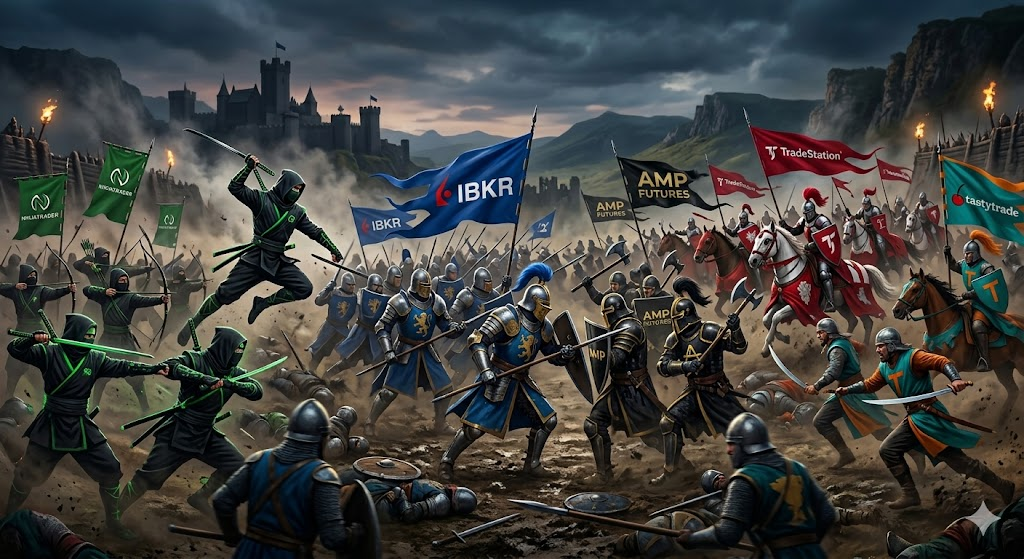
Five brokers actually run the retail futures conversation in 2026 — NinjaTrader, Interactive Brokers, AMP Futures, TradeStation, and tastytrade. Each one is convinced it is the obvious choice. Spoiler: none of them are. Here is what the fees, the fills, and the forum complaints really say.
Why the "Best" Futures Broker Depends Entirely on You
Futures trading sits in a strange corner of the brokerage world. The big commission-free revolution that swept through stocks and options in the late 2010s mostly stopped at the futures door, knocked politely, and went home. Per-contract pricing still rules, exchange and clearing fees still hit your ticket on top, and "free" trading plans almost always mean you are paying somewhere else — usually in a monthly platform subscription, a market data fee, or commission rates that quietly assume you trade more than you actually do. [Source: MetroTrade]
The cost structure typically runs $0.25 to $2.50 per side in commission, plus exchange and clearing fees passed through directly from the futures exchange. Some brokers bundle everything into one number, others itemize every cent. Market data feeds frequently cost extra unless you trade enough to qualify for waivers, which is one of those classic financial-industry sentences where "enough" is conveniently never defined upfront. [Source: StockBrokers.com]
The advertised commission is rarely the whole bill. Non-trade fees do most of the damage to small accounts.
The Quick-Glance Comparison
| Broker | Micro Contract | Standard Contract | Platform Cost | Best For |
|---|---|---|---|---|
| NinjaTrader | $0.09 – $0.39 / side | ~$0.59 / side (Lifetime) | Free / $499 / $1,499 lifetime | Active day traders |
| Interactive Brokers | $0.25 – $0.85 / contract | $0.25 – $0.85 / contract | Free | Global / pro traders |
| AMP Futures | From ~$0.25 / side | Negotiable, "beats quotes" | Free / many add-ons | Cost-focused traders |
| TradeStation | $0.25 – $0.50 / side | $0.50 – $1.75 / side | Free (TITAN X included) | Algo & strategy builders |
| tastytrade | $0.85 / side (futures) | $1.25 / side (futures options $1.25) | Free | Options-focused traders |
Prices reflect public schedules as of May 2026 and exclude pass-through exchange, clearing, and regulatory fees.
NinjaTrader: The Day Trader's Default
NinjaTrader Lowest Commissions
If you have spent any time on a trading forum in the last decade, somebody has told you to use NinjaTrader. The pitch is consistent: a futures-first platform with three pricing tiers, the cheapest commissions in retail, and a charting suite that traders have legitimately built careers around. [Source: StockBrokers.com]
The Lifetime License runs $1,499 up front and drops commissions to $0.09 per side on micro contracts — the lowest publicly available retail rate anywhere. The free plan is $0.39 per side, which sounds friendly until you realize that small price difference, multiplied by a few hundred contracts a month, is exactly how NinjaTrader funds the upgrade-to-Lifetime conversion funnel. [Source: NewTrading.io]
Execution speed is genuinely solid. Live testing has put market orders at the New York open at roughly 20–40ms with minimal slippage outside of major news events, which puts NinjaTrader in the same conversation as Interactive Brokers for raw speed even if it trails by a hair. The SuperDOM order ladder remains a benchmark feature that other platforms imitate but rarely match for one-click order entry. [Source: DayTrading.com]
Pros
- $0.09 / micro on Lifetime plan
- SuperDOM and elite charting
- $50 day-trade margins on micros
- Strong NFA / CFTC regulation
Cons
- $1,499 up front for best pricing
- Free plan commissions add up fast
- Futures-first; weak multi-asset
- Steep learning curve
Interactive Brokers: The Adult in the Room
Interactive Brokers (IBKR) Most Markets
Interactive Brokers is what serious traders graduate to when they outgrow the cute, gamified platforms. IBKR provides access to futures on 30+ exchanges globally, with commissions from $0.25 to $0.85 per contract on its tiered plan, plus desktop, mobile, and web platforms and advanced order types. The tiered structure rewards volume — high-volume traders end up around $0.15 per contract, which keeps it competitive with the discount specialists. [Source: QuantVPS]
The catch is that IBKR's user experience is designed by people who clearly think a flight cockpit is too simple. The new IBKR Desktop application has improved things considerably, but the platform still rewards patience and punishes anyone who expected a polished consumer app. [Source: DayTrading.com]
What you get in exchange is the broadest market access in retail, more than 40 years of operating history, regulation by the SEC, FCA, CIRO, and SFC, and an order routing system that almost everyone agrees is best-in-class for actual execution quality. If you trade anything beyond U.S. index futures, this is your default answer. [Source: DayTrading.com]
Pros
- 150 markets across 33 countries
- Tier pricing scales to $0.15 / contract
- Best-in-class order routing
- Heavily regulated globally
Cons
- Steep UX for beginners
- Activity fees on small accounts (historically)
- Customer support feels institutional
- Web platform less polished than rivals
AMP Futures: The Discount Specialist
AMP Futures Negotiable Pricing
AMP Futures is the broker traders mention in hushed tones once they have stopped being impressed by glossy interfaces. The pitch is simple: very competitive transaction fees, dozens of supported front-end platforms (NinjaTrader, Sierra Chart, MotiveWave, CQG, and so on), and a willingness to publicly state they will beat any written commission quote — which, in an industry that normally hides its pricing behind ten clicks and a phone call, is refreshing. [Source: Good Money Guide]
That flexibility is the appeal and also the warning label. AMP unbundles almost everything, so the cheap commissions you negotiate can be partially offset by service fees, data subscriptions, and platform charges if you are not careful. Independent reviewers have noted that while AMP's fees and research tools are strong, their service fees can be high relative to peers. [Source: BrokerChooser]
AMP also offers an unlimited commission-free trading plan for $1,000 annually, which works out brilliantly for traders running thousands of contracts a year and absolutely catastrophically for people who signed up because they thought it sounded fancy. Read the small print. [Source: QuantVPS]
Pros
- Genuinely low commissions, negotiable
- Works with most major platforms
- Unlimited annual plan available
- "Beats any quote" policy
Cons
- Service fees can stack up
- Platform UX rated below NinjaTrader
- Self-service onboarding heavy
- Less hand-holding for newcomers
TradeStation: The Strategy Builder's Workshop
TradeStation Best for Algo Traders
TradeStation has, for years, been the platform people use when "I want to backtest a strategy" is the first sentence of their broker search. Its EasyLanguage system lets traders code and test strategies without a computer science degree, and the platform supports exhaustive, genetic, and walk-forward optimization — none of which competitors really match at this price tier. [Source: TradingToolsHub]
For 2026, TradeStation rolled out TITAN X, a new flagship platform that finally modernizes the historically dense interface into something Mac and Windows users can use without immediately filing a support ticket. The platform now also features a Claude AI integration, which lets traders plug their brokerage account directly into Anthropic's model for quote fetching, portfolio risk analysis, and natural-language order preview. [Source: StockBrokers.com]
Fees, however, are where TradeStation gets less generous. Regular futures contracts cost $1.75 per side for base-level traders (up to 500 contracts monthly), scaling down to $0.50 per side over 10,000 contracts. Micro futures start at $0.50 and drop to $0.25 at the highest volume tier. Add a $35 annual IRA fee, $50 account closure fee, and a $125 ACAT transfer fee, and the picture gets less rosy if you ever want to leave. [Source: StockBrokers.com]
Pros
- Best-in-class strategy backtesting
- EasyLanguage scripting
- TITAN X redesign is excellent
- Native AI integration in 2026
Cons
- $1.75 base micro commission is high
- $50 inactivity fee under $2k balance
- $125 ACAT transfer-out fee
- Futures account not SIPC protected
tastytrade: The Options Crossover
tastytrade Options-First
tastytrade — formerly tastyworks, because rebrands are a brokerage rite of passage — is the platform options traders end up on, and it has bolted on futures as a logical extension. For futures, tastytrade charges $1.00 per contract to open and $1.00 to close. Futures options trades incur an additional $0.30 clearing fee per contract. That is not the cheapest in the field, but it is dead simple and there are no platform fees layered on top. [Source: Benzinga]
Execution quality is where it gets a little awkward. tastytrade's execution quality sits at 98.41% for one to 499 shares — above the industry average of 97.51% — but the broker does accept payment for order flow (PFOF), which can result in slightly slower or slightly worse-priced fills. For futures specifically, this matters less than for equities, but if you are scalping E-minis it is worth knowing where your orders are going and why. [Source: NerdWallet]
Independent review aggregators have flagged that tastytrade customers complain about slow or inconsistent trade executions, with mixed reactions to customer support responsiveness, based on public opinions and discussions sampled between February and May 2026. Take user reviews with their usual grain of salt, but the consistency of the feedback is worth noting. [Source: BrokerChooser]
Pros
- Clean, modern platform
- $10-per-leg cap on options
- Strong educational content (tastylive)
- No inactivity or account fees
Cons
- $1.00/side futures isn't competitive
- PFOF on equities orders
- User reports of slow fills
- Narrower futures market selection
Execution Quality: The Part Nobody Markets
Commission rates are easy to advertise on a homepage. Execution quality is not, which is precisely why it matters more. For futures, the relevant metrics are fill speed (how fast your order reaches the exchange), slippage (how often you get worse prices than quoted), and routing quality (whether the broker is using order flow arrangements that benefit them at your expense).
Interactive Brokers consistently ranks at or near the top for execution across independent broker testing, in part because it does not accept payment for order flow on futures and routes directly to exchanges. NinjaTrader's execution, while slightly behind IBKR for raw speed, is reliable enough that even active day traders rarely complain about fills outside of major news spikes. [Source: DayTrading.com]
tastytrade and TradeStation accept PFOF on the equities side, which has fewer direct implications for futures but tells you something about their general business model. If sub-tick fill quality is your top priority — and for serious scalpers it absolutely should be — IBKR and the AMP/NinjaTrader-style direct-market-access setups are your best bets. [Source: NerdWallet]
What Real Traders Say (a.k.a. The Reddit Section)
Aggregated independent forum sentiment from early 2026 paints a reasonably consistent picture across the five brokers. NinjaTrader is praised for charting and execution and criticized for the upgrade-pressure pricing model. Interactive Brokers gets near-universal respect for execution and global access, paired with steady complaints about UX and customer service feeling cold. TradeStation traders speak well of TITAN X and the backtesting suite, with frustration about base-tier futures pricing and various account fees. [Source: BrokerChooser]
tastytrade users skew positive on the platform and education but flag execution speed and support response time as recurring pain points. AMP Futures users tend to be the most loyal of any cohort — once people figure out the pricing structure and pick a compatible front-end platform, they typically stay for years. [Source: BrokerChooser]
So Which One Should You Actually Use?
If you trade a lot of micros: NinjaTrader Lifetime ($0.09/side) or AMP Futures with a negotiated rate. The math wins.
If you trade global markets or want institutional execution: Interactive Brokers. Nothing else is close.
If you build and backtest systematic strategies: TradeStation. EasyLanguage and walk-forward optimization are unmatched in retail.
If you mostly trade options and dabble in futures: tastytrade. Just don't pretend the $1/side futures commission is competitive — it isn't.
If you want negotiated, cost-minimized trading with platform flexibility: AMP Futures. Bring your own front-end.
Final Thought
The "best futures broker" question is the kind of search query that brokerage marketing departments love because the honest answer is "it depends on volume, asset focus, and how much you care about UX versus execution." Pick the broker whose pricing structure matches how you actually trade — not how you imagine you will trade after watching three motivational YouTube videos. And read the fee schedule. The whole fee schedule. The footnotes are where the money lives.
This article is for informational purposes only and is not investment, legal, or financial advice. Futures trading involves substantial risk of loss and is not suitable for every investor. Commission structures, platform features, and broker terms change frequently — verify current pricing directly with each broker before opening an account. All pricing and feature data was current as of the publication date noted above.


