FTMO is the firm most people picture when they hear the words “prop firm.” It’s been running since 2015, has paid out more money to more traders over a longer stretch than anyone else, and sits on the largest pile of Trustpilot reviews in the entire industry. If you’re a futures scalper, though, note the fork in the road right now: FTMO is a forex and CFD shop, not a futures firm — no ES, no NQ, no Tradovate. It trades currencies, indices, commodities, and crypto CFDs on MetaTrader and friends. This review covers what it actually costs, how you get paid, the drawdown mechanics people misread, its reputation (the good and the genuinely concerning), and the big 2026 story: FTMO is back in the US. Source: Broker Analysis — FTMO review
FTMO at a glance
FTMO s.r.o. is a Prague-based prop firm founded in 2015 by Otakar Šuffner and Marek Vašíček. It’s served more than 4 million customers across 140+ countries and reports over $500 million in trader rewards paid since inception. Traders trade simulated accounts; the “rewards” are real money. Historically FTMO wasn’t a regulated broker — but that changed in late 2025 when the FTMO Group completed its acquisition of OANDA, a broker regulated across eight jurisdictions including the NFA in the US. That’s a legitimacy layer virtually no pure-play prop firm can match. Source: OANDA — FTMO acquisition
What FTMO is (and how it’s structured)
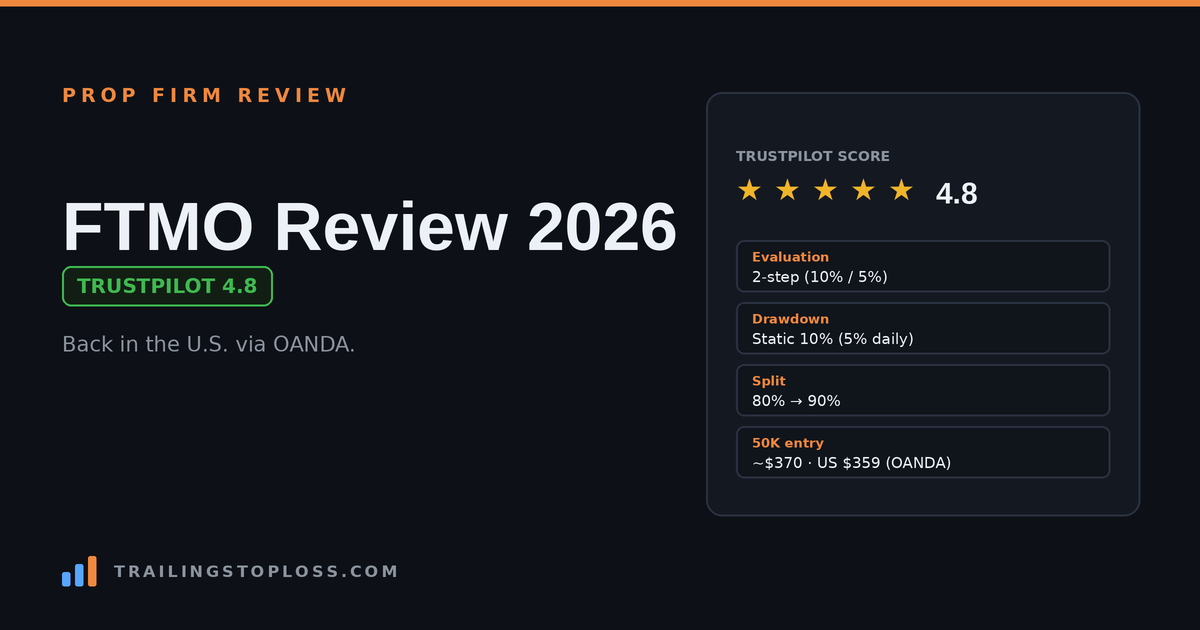
FTMO now runs two parallel evaluation models, and picking the right one matters more than picking the account size. The 2-Step Challenge is the classic route: an FTMO Challenge (10% profit target) followed by a Verification (5% target), both under a 5% daily loss and a 10% static max loss, paying an 80% split that scales to 90%. The newer 1-Step Challenge collapses it to a single 10% target under a tighter 3% daily loss and a 10% trailing max loss, but pays 90% from your very first payout. Same five account sizes ($10K–$200K), same core philosophy, very different risk feel. Source: Prop Trading Vibes — FTMO rules overview
Cost: what you actually pay for every plan
FTMO charges a one-time challenge fee — no monthly subscription, no separate activation fee — and refunds that fee with your first payout on the funded account. Read that carefully: the refund lands with your first profit withdrawal, not when you pass the evaluation. Pass both phases but breach a rule before you ever withdraw, and the “free challenge” wasn’t free. Prices vary by currency and shift with promos, so treat the table below as approximate and confirm the live figure at checkout. Comparing fee-to-capital across firms is exactly what our prop firm true-cost hub is built for. Source: Trader’s Second Brain — FTMO fees
| Account size | 2-Step fee (from) | 1-Step fee (from) | Profit target |
|---|---|---|---|
| $10,000 | €89 | €79 | 10% (2-step: 10% + 5%) |
| $25,000 | €139 | ~€125 | 10% (2-step: 10% + 5%) |
| $50,000 | €289 | ~€250 | 10% (2-step: 10% + 5%) |
| $100,000 | €539 | ~€449 | 10% (2-step: 10% + 5%) |
| $200,000 | €1,080 | ~€999 | 10% (2-step: 10% + 5%) |
The drawdown models: trailing vs static
Here’s the structural difference that decides how each model feels to trade. The 2-Step uses a static 10% max loss: the floor is fixed at 10% below your initial balance and never moves, so as you build profit your cushion grows and never shrinks against you. The 1-Step uses a trailing 10% max loss that rises with your end-of-day balance as the account grows, then locks once you’re profitable — more like the trailing floors at futures firms, and tighter on your buffer while it’s still climbing. Both models also enforce a daily loss limit measured on equity (including open-position floating losses), recalculated at midnight CE(S)T. The diagram shows the contrast. Source: FTMO — trading objectives
Rules at a glance
The two models diverge on the numbers that matter, so here’s the side-by-side. One quirk worth flagging: the 1-Step carries a “Best Day” consistency rule — no single day can be more than 50% of your total profitable-days’ profit when you request a payout — which the 2-Step doesn’t apply during evaluation. Neither model has a time limit; you can take as long as you need. Source: FTMO trading objectives (rules reference)
| Rule | 1-Step Challenge | 2-Step Challenge |
|---|---|---|
| Profit target | 10% | 10% then 5% (Verification) |
| Max daily loss | 3% | 5% |
| Max loss | 10% trailing (EOD) | 10% static |
| Min trading days | Lighter / none | 4 per phase |
| Consistency (Best Day) | Yes — best day ≤ 50% | No (during eval) |
| Profit split | 90% from payout 1 | 80% → 90% via scaling |
Both models come in Standard and Swing variants. Standard restricts trading around major news releases and bans holding over the weekend; the Swing variant removes both limits (handy if your strategy needs overnight or weekend exposure) at the cost of lower leverage — roughly 1:100 on Standard versus 1:30 on Swing. These restrictions apply on the funded account, not during the evaluation. Source: The Payout Report — FTMO variants
Payment methods (paying in)
Per FTMO’s own help center, you can pay for a challenge by bank wire transfer, debit or credit card, cryptocurrency, or Skrill — a broader set than most futures firms offer. Bank transfers specifically aren’t available for payments or withdrawals in a handful of sanctioned countries (Venezuela, Cuba, Sudan, and Ukraine). There’s no deposit or margin to fund beyond the one-off challenge fee; every account is simulated. Source: FTMO — payment methods
Withdrawal methods & payout rules (getting paid out)
Rewards are paid via bank transfer, Skrill, or cryptocurrency — notably, no PayPal, which trips some traders up. FTMO charges no withdrawal fees on its side (your bank or processor may). Minimums run around $20 for bank and $50 for crypto. You can request your first reward on the 14th day (or later) after your first trade, provided the account is in profit with no open or pending positions; after that, withdrawals are essentially on-demand. Processing is genuinely fast — FTMO quotes 1–2 business days and many traders report roughly 8 hours. Source: FTMO — how to withdraw
On the split: the 1-Step pays 90% from your first payout; the 2-Step starts at 80% and reaches 90% through the Scaling Plan. Scaling bumps your balance by 25% every four months if you average at least 10% net profit (with withdrawals) over the period, and lifts you to the 90% tier. FTMO’s public materials describe scaling up toward a $2M ceiling — but that ceiling is FTMO’s biggest knock versus newer firms, several of which scale to $4M+. If maximum capital is your priority, FTMO’s cap will feel low within a year. Source: Lune — FTMO payouts & scaling
Trustpilot & reputation
FTMO’s Trustpilot profile is the industry’s crown jewel: 4.8/5 across roughly 44,000 reviews — the highest review volume of any prop firm on earth, and a rating that’s held remarkably steady. The recurring praise is exactly what you want to hear: payouts arriving on time, fees refunded as promised, and responsive support. On raw reliability, no competitor has a longer or deeper paper trail. Source: Trustpilot — FTMO
Is FTMO available in the US?
Yes — as of August 2025, after years of a hard “no US clients” policy. FTMO returned to the US through a partnership with OANDA (a US-regulated, NFA-member broker), and later completed a full acquisition of OANDA outright. US residents access FTMO through a compliant, US-tailored “FTMO Rewards Account” structure rather than the exact European product, but the core loop — education, challenge-based evaluation, and real-money rewards — is intact. A handful of US states remain excluded, so confirm your state is eligible before buying. For a US-based trader, FTMO’s OANDA-backed regulatory footing is a genuine differentiator against offshore prop firms. Source: Vetted Prop Firms — FTMO US access
Who it’s for — and who should skip it
FTMO fits a disciplined forex or CFD trader who prizes payout reliability and a decade-long track record over the cheapest possible entry or the biggest scaling ceiling, and who wants the reassurance of a now-regulated parent. It’s the wrong firm if you trade futures (wrong asset class entirely), if you need $4M+ scaling, if you run aggressive high-frequency news strategies on the funded account, or if you’re allergic to strict, sometimes opaque risk-review enforcement. It’s also not the cheapest option in a market full of discount challengers. Source: Funded Trading — FTMO verdict
The verdict
FTMO is the benchmark, and mostly earns it: 11 years of continuous operation, $500M+ in documented rewards, the industry’s largest and strongest review base, fast no-fee payouts, a refundable challenge fee, and — new in 2026 — an actual regulated broker (OANDA) under the same roof plus a compliant path back into the US. The debits are real but narrow: it’s forex/CFD only, the scaling ceiling lags newer firms, the pricing isn’t bargain-bin, and the risk department’s “non-genuine trading” terminations are a documented pattern rather than a myth. For a disciplined forex trader who values certainty of payment above all, FTMO remains the safest name in the business — just keep your trading squeaky-clean of anything that could trip the aggregated-risk clause, and verify current rules and US-state eligibility before you buy. Source: Best Funded Accounts — FTMO verdict
Frequently asked questions
How much does FTMO cost?
FTMO charges a one-time challenge fee (no monthly subscription). Approximate prices run from about €79–€89 for a $10,000 account up to roughly €999–€1,080 for a $200,000 account, with the 1-Step model slightly cheaper than the 2-Step. Prices vary by currency and promotions — confirm at checkout. The fee is refunded with your first payout on the funded account, provided you reach that first withdrawal without breaching a rule.
What payment methods does FTMO accept?
You can pay for an FTMO challenge by bank wire transfer, debit/credit card, cryptocurrency, or Skrill. Bank transfers aren’t available in a few sanctioned countries (Venezuela, Cuba, Sudan, Ukraine).
How do FTMO payouts work and how do you get paid?
Rewards are paid by bank transfer, Skrill, or cryptocurrency (no PayPal), with no FTMO-side fees. You can request your first reward on the 14th day after your first trade, with the account in profit and no open positions; after that, withdrawals are effectively on-demand. Processing is fast — 1–2 business days, often around 8 hours. The split is 90% on the 1-Step from payout one, or 80% rising to 90% via scaling on the 2-Step.
What is FTMO’s Trustpilot score?
FTMO holds a 4.8/5 “Excellent” rating across roughly 44,000 reviews — the largest review volume of any prop firm. Praise centers on reliable, fast payouts. A small but consistent minority of 1-star reviews describe funded-account terminations flagged as “non-genuine” trading, usually with limited explanation.
Does FTMO offer futures trading?
No. FTMO is a forex and CFD firm — currencies, indices, commodities, and crypto CFDs on MT4, MT5, cTrader, and DXtrade. It does not offer futures (no ES/NQ, no Tradovate or Rithmic). Futures traders should look at futures-specific firms instead.
Is FTMO available to US traders?
Yes, since August 2025. FTMO returned to the US through a partnership with the US-regulated broker OANDA (which FTMO subsequently acquired), offering US residents a compliant, US-tailored “FTMO Rewards Account.” A handful of US states remain excluded, so verify your state’s eligibility before purchasing.
Transparency: TrailingStopLoss.com has no affiliate relationship with FTMO — we earn nothing whether you sign up or not. This review is for information only, is not financial advice, and trading carries substantial risk of loss. FTMO is a forex/CFD firm, not a futures firm. Rules, pricing, and payout terms change frequently and vary by currency and region; always verify current terms and US-state eligibility on ftmo.com before purchasing.