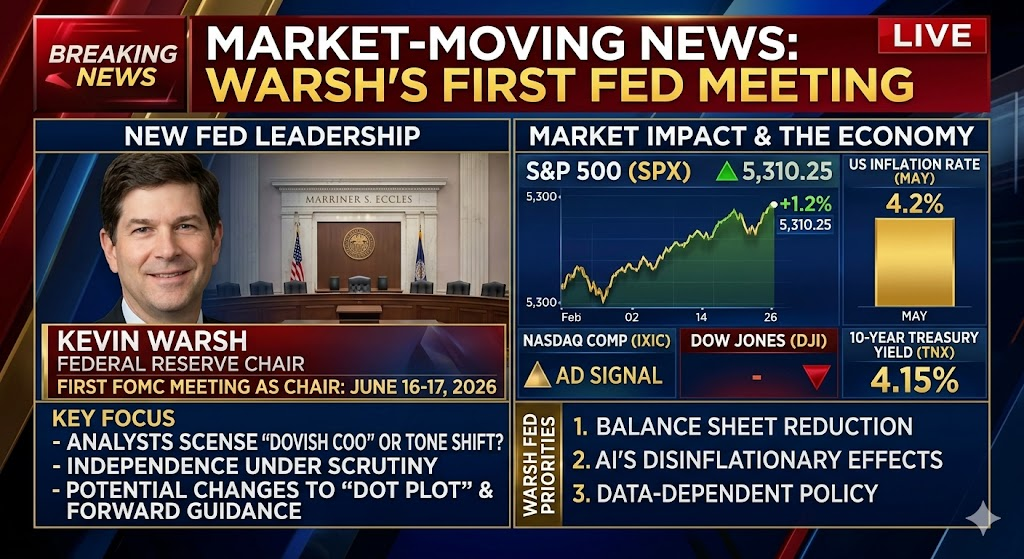
Market-Moving News This Week: Warsh’s First Fed Meeting, Retail Sales & the Iran Oil Wildcard
Trading week of June 15–19, 2026 · pre-market outlook
Three things can swing the tape this week, and two of them collide on the exact same morning. Wednesday hands you May retail sales at 8:30 a.m. and the Federal Reserve at 2:00 p.m. — Kevin Warsh’s first meeting in the big chair. Lurking in the background: a possible U.S.–Iran oil deal that could rewrite the inflation story. Oh, and Friday is closed. So you’ve basically got a four-and-a-half-day week to fit a month’s worth of volatility into.
Stocks limped into the weekend on a high note. The S&P 500 closed Friday at 7,431.46 (+0.5%), the Nasdaq Composite at 25,888.84, and the Dow above 51,000, helped along by SpaceX’s blockbuster debut and growing hope that Washington and Tehran are close to a deal. The catch: the VIX has climbed back above 20, which is the market’s polite way of telling you to keep your stops honest. Source: CNBC, Socrates
1. The Main Event: Warsh’s First Fed Meeting (Wed, 2:00 p.m. ET)
This is the one circled in red on every desk. The FOMC meets June 16–17, and the decision drops Wednesday at 2:00 p.m. ET with a fresh Summary of Economic Projections, followed by Kevin Warsh’s first press conference as Fed Chair at 2:30. Markets are treating the rate itself as a non-event — CME FedWatch puts the odds of “no change” at the current 3.50%–3.75% range around 98%. Nobody’s losing sleep over the number. Source: CoinGape (CME FedWatch), Polymarket
So if the decision is a foregone conclusion, why does it matter? Because the real fireworks are in the dot plot and the tone. The risk has quietly flipped — fed funds futures now lean toward a rate hike, not a cut, as the more likely year-end move, thanks to inflation that refuses to behave. There’s even chatter that Warsh could scrap the dot plot entirely as soon as this meeting. A central banker removing the one chart traders obsess over the most? Bold strategy. Source: Kraken Economic Brief
Why the tone matters more than the rate
J.P. Morgan’s read: the Fed holds in June, holds for the rest of 2026, and makes “an explicit move away from a bias toward easing to a neutral stance.” Translation for traders — the door to 2026 cuts is being quietly nailed shut, and Warsh’s job Wednesday is to say so without spooking everyone. Watch the verbs in the statement and his first answers at 2:30.
Source: J.P. Morgan / ChaseContext for why the Fed is stuck: May headline CPI came in at 4.2% year-over-year, the hottest annual pace in years, with energy prices doing most of the damage. A new chair doesn’t get to rewrite the data — and 4.2% inflation is not a number that buys you a rate cut. Source: Polymarket, Kiplinger
For an NQ or ES trader, the playbook is simple to describe and hard to execute: 2:00 p.m. ET Wednesday is a liquidity grenade. Spreads widen, the algos hunt stops in both directions, and the first move is frequently the fake one. If you want to model how a fast adverse swing chews into a funded account before you size in, run it through the TSL Trailing Drawdown Simulator first — your prop firm’s trailing threshold does not care that “it was Fed day.” Source: Kraken
2. Retail Sales — The 8:30 a.m. Curtain-Raiser (Wed)
Before the Fed even clears its throat, you get May retail sales from the Census Bureau at 8:30 a.m. ET Wednesday — the same morning, hours ahead of the decision. It’s the cleanest read on whether the U.S. consumer is still swiping cards despite 4%+ inflation and pricier gas. A hot print complicates Warsh’s “we’re done cutting” message; a soft one feeds the slowdown narrative. Either way, the Fed will be reading it with the same fresh eyes you are. Source: U.S. Census Bureau, Kraken
This is the rare setup where the warm-up act and the headliner share a stage. A surprise in retail sales can pre-load direction into the morning session, then the 2:00 p.m. decision either confirms or violently reverses it. Translation: don’t blow your whole risk budget on the 8:30 reaction and have nothing left for the actual main event. Source: CNBC
3. The Wildcard: A U.S.–Iran Oil Deal
Here’s the swing factor nobody can put on a calendar with a timestamp. The U.S.–Israel-led war against Iran began February 28 and sent crude soaring, but the last week has been all de-escalation. Brent slid to roughly $87 and WTI to around $85 — down about 6% on the week — on growing hope of a peace deal. A Trump administration official put the odds of signing “in the coming days” at about 80%, with a draft that reportedly reopens the Strait of Hormuz and lifts oil sanctions. Source: Trading Economics, CNBC
If a deal lands
Cheaper oil is disinflationary, which takes pressure off the Fed and is broadly risk-on for equities. Crude is still up more than 20% since the war started, so there’s plenty of “war premium” left to bleed out. That’s the bull case for NQ/ES — and a headwind for energy names.
If it falls apart
Iran’s own media floated different terms, and Tehran has rejected drafts before. A re-escalation — or Hormuz staying blocked past mid-June — and oil spikes right back toward triple digits, re-arming the inflation story the exact week the Fed is trying to sound calm. A headline-driven gap is the tail risk here.
Because this is a headline risk rather than a scheduled release, it’s the one most likely to ruin an overnight position. There’s no 8:30 timestamp to fade — a single Truth Social post or wire flash can gap futures while you sleep. Size your swing exposure accordingly, and keep our live market dashboard handy if you’re holding into the weekend talks. Source: Trading Economics
4. The SpaceX Hangover & the IPO Stampede
The market’s mood music this week is partly set by Friday’s debut. SpaceX (SPCX) priced its IPO at $135, opened at $150, and closed up about 19% near $161 — at a roughly $1.8 trillion valuation, the largest IPO in history. The opening pop juiced sentiment and got Wall Street whispering that maybe other stuff is undervalued too. Source: CNBC
The under-the-hood story matters more for index traders: those wild semiconductor swings this month were partly traders raising cash to make room for the IPO. The iShares Semiconductor ETF (SOXX) whipsawed from nearly -6% one week to +11% the next. With OpenAI and Anthropic reportedly filing IPO paperwork too, the “stampede” of mega-listings could keep liquidity sloshing around the tech trade — which is precisely where NQ lives. Source: CNBC, Socrates
The Full Economic Calendar (June 15–19)
Here’s the week laid out. Wednesday is the obvious tentpole, and remember that Friday is a market holiday for Juneteenth, so liquidity thins out into Thursday’s close. Plan your Thursday-into-holiday risk like the desk is half-empty — because it will be. Source: CNBC week-ahead calendar
| Day | Time (ET) | Event | Impact |
|---|---|---|---|
| Mon 6/15 | 8:30 a.m. | Empire State Manufacturing (Jun) | Low |
| Mon 6/15 | 9:15 a.m. | Industrial Production & Capacity Utilization (May) | Low |
| Mon 6/15 | 10:00 a.m. | NAHB Housing Market Index (Jun) | Low |
| Tue 6/16 | 8:30 a.m. | Housing Starts & Building Permits (May) | Low |
| Tue 6/16 | 8:30 a.m. | Import & Export Price Index (May) | Med |
| Tue 6/16 | — | FOMC meeting begins (Day 1) | Med |
| Wed 6/17 | 8:30 a.m. | Retail Sales (May) | High |
| Wed 6/17 | 2:00 p.m. | FOMC Decision + Economic Projections (dot plot) | High |
| Wed 6/17 | 2:30 p.m. | Warsh Press Conference (his first) | High |
| Thu 6/18 | 8:30 a.m. | Initial Jobless Claims (prev. 229K) | Med |
| Thu 6/18 | 8:30 a.m. | Philadelphia Fed Manufacturing (Jun) | Low |
| Fri 6/19 | — | Juneteenth — U.S. equity markets closed | Closed |
Initial jobless claims figure via Trading Economics. Times and listed releases via CNBC.
The Bottom Line for Traders
- Wednesday is the week. 8:30 a.m. retail sales sets the mood; 2:00 p.m. FOMC + dot plot is the main event; 2:30 p.m. Warsh presser is where the volatility usually peaks.
- The rate is priced; the message isn’t. Watch for the shift from “easing bias” to “neutral,” and whether the dot plot survives at all.
- Oil is the uncatchable headline. An Iran deal = risk-on and disinflationary; a breakdown = an overnight gap and a re-armed inflation scare.
- Mind the half-empty desk. Friday’s Juneteenth close thins liquidity into Thursday — moves can be exaggerated and stops easier to run.
- Respect your drawdown. Event days are where funded accounts go to die. Size like a survivor, not a hero.
Frequently Asked Questions
When is the Fed decision this week?
The FOMC meets June 16–17, 2026, with the rate decision and updated economic projections released Wednesday, June 17 at 2:00 p.m. ET. Fed Chair Kevin Warsh holds his first press conference as chair at 2:30 p.m. ET.
Is the Fed expected to cut rates in June 2026?
No. Markets price roughly a 98% chance the Fed holds at the current 3.50%–3.75% range. With May CPI running at 4.2% year-over-year, futures actually lean toward a rate hike — not a cut — as the more likely year-end move.
What time is retail sales released?
May retail sales from the U.S. Census Bureau are scheduled for 8:30 a.m. ET on Wednesday, June 17 — the same morning as the Fed decision, several hours before the 2:00 p.m. announcement.
Are the stock markets open on Friday, June 19?
No. U.S. equity markets are closed Friday, June 19 for Juneteenth National Independence Day. Futures markets typically run a holiday or shortened schedule, so expect thinner liquidity heading into Thursday’s close.
How could the Iran situation move markets this week?
A U.S.–Iran peace deal — which an administration official recently put at roughly 80% likely — would lower oil prices, ease inflation pressure, and is broadly risk-on for stocks. A breakdown in talks or renewed conflict could spike crude back toward triple digits and reignite inflation fears just as the Fed meets.
Disclaimer: This article is for informational and educational purposes only and is not financial, investment, or trading advice. Trading futures involves substantial risk of loss. Economic release times and scheduled events are subject to change. Always do your own research and manage your own risk.