▸ Trading Psychology · Prop Firms
Why Most Traders Fail the Evaluation — and It’s Almost Never the Strategy
Everyone quotes the failure rate. Almost nobody explains it correctly. The story you’ll hear is that the strategies were bad, or that the firms rigged it. The data says something far less comfortable: the strategies were mostly fine, the rules were published in advance, and the overwhelming majority of accounts died in week one on a loss limit that the trader had already agreed to. The evaluation isn’t a trading test with psychology attached. It’s a psychology test wearing a trading costume.
The real numbers
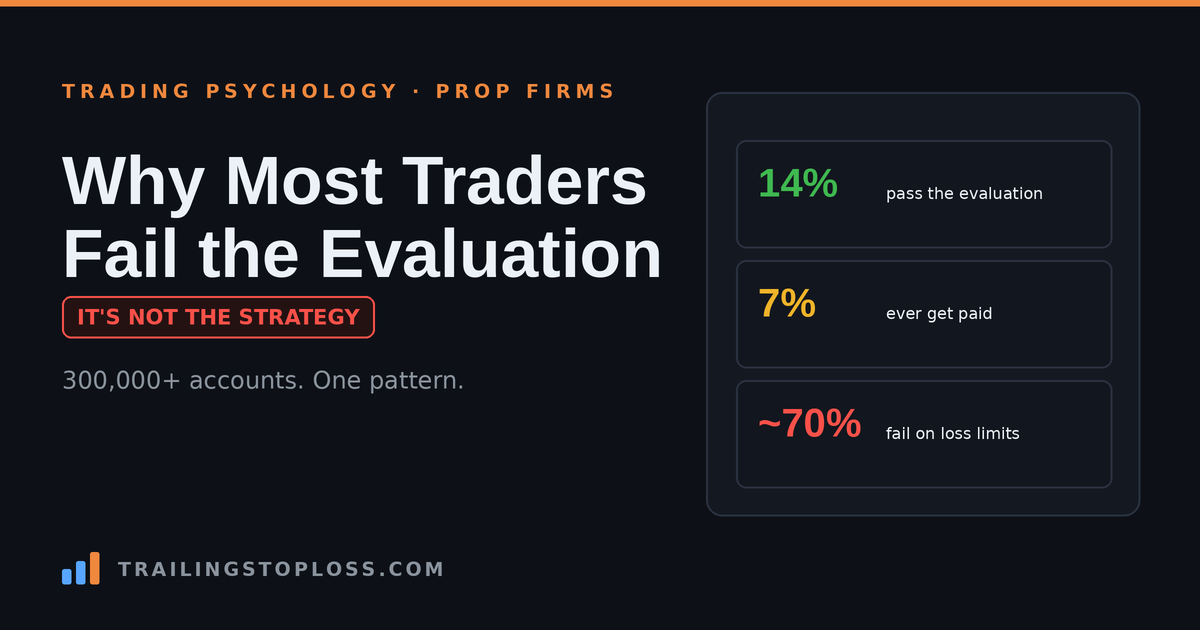
Start with the most credible dataset available. FPFX Tech analyzed more than 300,000 prop accounts from roughly 100,000 traders across 10 firms. Only 14% passed a challenge, and just 7% of all traders ever reached a single payout. That second number is the one that matters — because passing isn’t the finish line, getting paid is. (Pipcy: FPFX Tech, 300,000+ accounts)
(FPFX, 300k+ accounts)
single payout
loss-limit breaches
And here is the finding that should reorganize how you think about the challenge entirely: roughly 70% of failures come from loss limits — maximum drawdown or daily loss — not from running out of time or missing the profit target. Traders don’t fail because their edge was too weak to reach +8%. They fail because they hit −5% first. (Trader’s Second Brain: ~70% of failures are loss limits)
Worse, most of it happens fast. The typical failure pattern is a trader violating the daily loss limit during the first few sessions — not a trader who makes it to day 25 and misses the profit target by a hair. A trader who survives two weeks without a drawdown breach has dramatically better odds than the headline 5–14% figure suggests. The evaluation isn’t a marathon most people lose at the end. It’s a minefield most people step on in the first hundred yards. (The Prop Firm Guide: most failures happen in week one)
The structural trap: your account is smaller than you think
Here’s the mechanism behind nearly every one of those breaches, and it has a name: drawdown distraction. A trader buys a $50,000 account and starts sizing positions as if they’re managing $50,000. They’re not. They’re managing the drawdown buffer — the $2,000–$5,000 loss window between their balance and the breach line. Everything else is scenery. Size against the headline number instead of the buffer and a perfectly ordinary market swing ends the account. (Apex: drawdown distraction)
The geometry is also stacked against you in a way most people never check. Across 2026 evaluation dashboards, the profit target sits at roughly twice the distance of the loss limit — you need multiple good sessions to pass, but a single bad one can end it instantly. That asymmetry isn’t a scam; it’s the product. But it means any risk-per-trade number you’d use on a personal account is probably lethal here. (Apex: target is ~2× the loss limit)
Run the arithmetic yourself, because it’s the whole game. Risk 3% per trade and a four-trade losing streak — utterly routine in any strategy — puts you at 12% drawdown, which breaches most absolute limits. Cut risk to 0.5% and the identical streak leaves you at 2%: nowhere near the rule, still trading, with your edge given room to mean-revert. Nothing about the strategy changed. Only the survival math did. (Pipcy: 3% vs 0.5% risk math)
The five behaviors that actually end accounts
Strip away the excuses and the failure modes are boringly consistent across every dataset — and every one of them is behavioral, not analytical. You’ll recognize all five from elsewhere in this guide. (Pipcy: the seven common failure reasons)
Notice what isn’t on that list: “my strategy stopped working.” Traders fail evaluations for behavioral reasons under pressure — loss-limit breaches, oversized positions, emotional revenge trading, treating the challenge like a lottery ticket — not because their setups suddenly lost their edge on the day they paid the fee. (Velotrade: failures come from rule breaches and behavior, not strategy)
The part nobody warns you about: passing is not surviving
Here’s the statistic the prop firms’ own blogs tend to skip, for obvious reasons. Of the small group who pass, roughly 40–50% lose the funded account within 90 days. The pattern is depressingly precise: the trader passes in a few weeks, gets the funded account, and then changes behavior. The discipline that got them through the evaluation evaporates because the “real” account feels different — even though it’s still simulated. Size creeps. The consistency rule, often stricter on funded accounts than on the challenge, catches them. The news restriction they ignored harmlessly during the eval suddenly kills the account. (Pipcy: 40–50% of funded accounts lost within 90 days)
⚠ The consistency-clause ambushMany firms bury a consistency rule — no single day may exceed 30–50% of your total profit — in the payout terms rather than on the evaluation page. Traders pass the challenge, then discover that their best day made the payout ineligible. Read the payout conditions before you buy, not after you pass. This is exactly the kind of rule we surface firm-by-firm on our true-cost hub.
The cost of learning this the expensive way
Failure isn’t free, and the fee on the checkout page isn’t the real price. Community data consistently shows the average trader takes 2–4 attempts before a first funded account, with the median trader spending well over a thousand dollars on evaluations before they ever see a split — roughly $800 in fees per trader in the FPFX sample, and far more at pricier firms. Your first profit split has to clear all of that just to break even. (Trader’s Second Brain: the multi-attempt cost reality)
Which leads to the single most useful question in this whole article, and it’s an uncomfortable one: do you have a journal with 100+ trades showing consistent profitability — profit factor above ~1.3, max drawdown inside your target firm’s limit? If yes, the evaluation fee is a reasonable investment in accessing capital. If no, you’re paying a prop firm to tell you your strategy needs more work, and a demo account would deliver the same verdict for free. (Trader’s Second Brain: the 100-trade test)
How the 14% actually do it
The traders who pass aren’t running secret strategies. They’re running ordinary ones inside a survival framework built for the specific structure of an evaluation. (Velotrade: what separates the minority who pass)
- Size against the buffer, not the balance. Your account is the drawdown window, not the headline number. Risk 0.5–1% of the buffer per trade so a normal losing streak can’t end you. This single change fixes most of the 70%.
- Know your exact numbers before every session. Current balance, distance to the daily limit, distance to the max drawdown, and whether that drawdown trails intraday or end-of-day. If you can’t recite those four, you’re trading blind inside a minefield.
- Cap the day, then walk. Two losses or −X R, and the session is over — no exceptions. The daily loss limit is a cliff; your personal cap should sit well in front of it, so that the firm’s rule never gets to be the thing that stops you.
- Read the payout terms before you pay the fee. Consistency clause, minimum trading days, news windows, drawdown mode. The rules that end most accounts are printed, in advance, and skipped by most buyers.
- Slow down the target. There’s no prize for passing fast. Aim to reach the profit target over many small, boring sessions — the profit target is patient, the loss limit is not.
- Don’t change a thing after you pass. Same size, same rules, same cap. The 40–50% who die within 90 days almost all did the opposite — they treated funding as permission to trade bigger.
🧠 The reframeStop thinking of the evaluation as a test of whether you can make money. It’s a test of whether you can not lose money in a specific, structured way, for long enough that your ordinary edge shows up. The profit target is the part you can be patient about. The loss limit is the part that kills you — and it kills nearly everyone in the first week, for behavioral reasons, at sizes they chose themselves.
The bottom line
Fourteen percent pass. Seven percent ever get paid. Around seventy percent of the failures are loss-limit breaches, most of them inside the first few sessions, driven by traders sizing against a $50,000 headline instead of a $2,500 buffer — then compounding it with revenge trades, widened stops, and post-streak size creep. None of that is a strategy problem, and no amount of new indicators will fix it. The challenge is an actuarial filter for behavior under pressure, and the firms designed it that way because they’ve watched hundreds of thousands of people fail it the same handful of ways. Fix the sizing, honor the cap, read the rules, and change nothing after you pass — that’s the entire difference between the 14% and everyone else.
Before you buy another challenge: check the real all-in cost (including resets) on the True Cost hub, compare drawdown types rule-by-rule with the comparison tool, see which firms we’d never fund an account with, and pick the right size in our 150K ranking. Part of our trading psychology guide.
FAQ
What percentage of traders pass prop firm evaluations?
FPFX Tech’s analysis of 300,000+ accounts across 10 firms found about 14% pass a challenge, while just 7% of all traders ever reach a single payout. Most firms self-report pass rates between 5% and 15%, varying with rule strictness — looser rules mean higher pass rates, trailing drawdowns and daily limits mean lower ones.
Why do most traders fail prop firm challenges?
Roughly 70% of failures are loss-limit breaches — maximum drawdown or daily loss — not missed profit targets. The root cause is almost always oversized risk: traders size positions against the headline account balance instead of the much smaller drawdown buffer, then compound it with revenge trading, widened stops, and size creep after a good run.
How much should I risk per trade in a prop firm evaluation?
Roughly 0.5–1% per trade, sized against your drawdown buffer rather than the headline balance. The math is decisive: risking 3% per trade means a routine four-trade losing streak puts you at 12% drawdown and breaches most limits. At 0.5%, the identical streak leaves you at 2% — still trading, with room for your edge to work.
Is it worth paying for a prop firm evaluation?
Only if you have a track record. If your journal shows 100+ trades with consistent profitability (profit factor above roughly 1.3, and a max drawdown inside your target firm’s limit), the fee is a reasonable cost of accessing capital. If you don’t have that, you’re paying a firm to discover your strategy needs work — a demo account tells you the same thing for free. The average trader takes 2–4 attempts and spends four figures before a first payout.
What happens after you pass the evaluation?
Passing isn’t surviving. Roughly 40–50% of funded accounts are lost within 90 days, usually because the trader changes behavior after funding — size creeps up, and the consistency rule (often stricter on funded accounts than during the challenge) or a news restriction catches them. The traders who last are the ones who change nothing at all after passing.
TrailingStopLoss publishes independent, funded-trader analysis of prop firms, strategy, and trading psychology. Pass-rate figures are self-reported by firms or drawn from third-party datasets and are not independently audited — treat them as directional. Educational content only, not financial advice. Trading futures involves substantial risk of loss.


