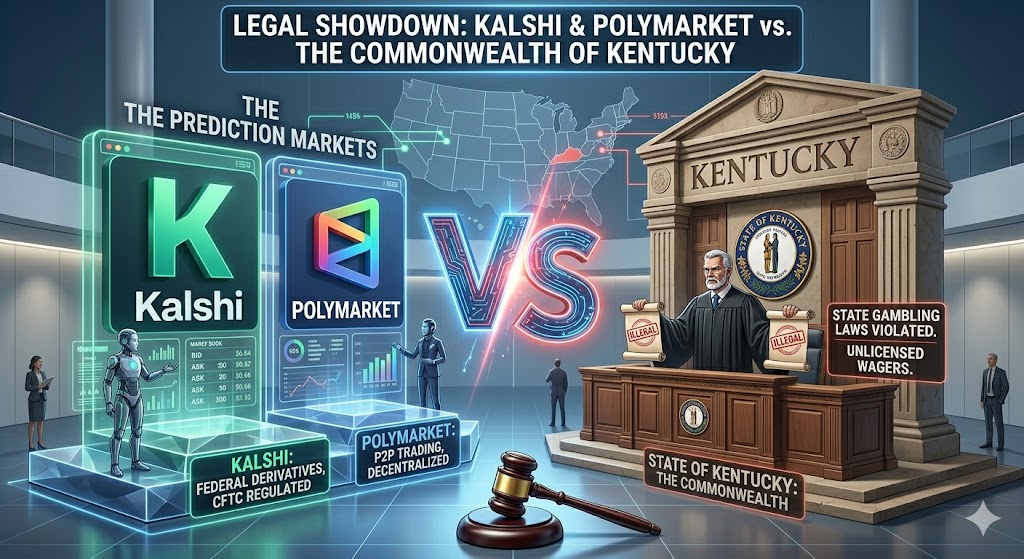
Kentucky just sued Kalshi and Polymarket for running what it calls illegal sportsbooks. Their defense? They aren’t sportsbooks at all — they’re federally regulated derivatives exchanges, governed by the same agency that oversees the NQ contract you scalp at the open. Welcome to the weirdest jurisdictional turf war in finance, where whether a bet on the Super Bowl is “gambling” or a “swap” is currently being argued in roughly a dozen courtrooms at once.
On June 17, 2026, Kentucky Attorney General Russell Coleman filed three lawsuits in Franklin Circuit Court — against Kalshi and its affiliates (Coinbase included), against Polymarket and its affiliates, and against sweepstakes operator VGW — alleging all three run unlicensed gambling operations in violation of the state’s consumer protection and gambling laws. The complaints ask a judge to declare the companies in breach and order penalties of up to $2,000 per violation, rising to $10,000 where the conduct harmed someone over 60. Daily Gazette
Coleman’s framing was about as subtle as a duck call. He said the platforms offer the same money lines, spreads, totals, parlays, and prop bets a licensed sportsbook would, just wearing a “sports event contract” name tag, and that their “legal fictions don’t pass the sniff test.” It’s good copy. It’s also, as of this spring, on the losing side of the most important appellate ruling so far. Louisville Public Media
What a “prediction market” actually is — and why a futures trader should care
Strip away the branding and a prediction market is an exchange where you buy and sell binary contracts that settle at $1 if an event happens and $0 if it doesn’t. Kalshi operates as a CFTC-licensed designated contract market, the same regulatory category that governs the futures exchanges where index and commodity contracts trade. The contracts are pitched as derivatives — instruments whose value derives from an underlying outcome. JURIST
That’s the crux of the whole fight. If a sports event contract is a “swap” under the Commodity Exchange Act, it falls under the CFTC’s exclusive jurisdiction and states can’t touch it. If it’s just a sports bet wearing a derivatives costume, it’s gambling, and gambling has been a state-regulated activity since long before anyone tokenized a coin flip. The statutory definition of “swap” is broad enough to make this a genuinely hard question rather than a slam dunk for either side. Paul, Weiss
The ruling that put states on the back foot
On April 6, 2026, a divided panel of the Third Circuit Court of Appeals became the first federal appellate court to rule on the question, holding 2–1 in Kalshi v. Flaherty that the Commodity Exchange Act likely preempts state gambling law as applied to sports event contracts. The majority found those contracts qualify as swaps, and that both field preemption and conflict preemption shield them from New Jersey’s enforcement. It affirmed an injunction blocking the state from shutting Kalshi down while the case proceeds. Skadden
It’s worth keeping the asterisk in view: this was a preliminary injunction, meaning the court found Kalshi likely to win, not that it has won on the merits. The dissent was pointed — Judge Roth noted she could go on Kalshi’s page and bet on a game winner or whether a specific receiver scores a touchdown, products she called functionally identical to a sportsbook, and argued the presumption against federal preemption should hit hardest exactly in the field of gambling. The merits fight, and the appeals stacked behind it, are still very much live. Holland & Knight
Kentucky is one square on a very messy board
This is the part that matters for understanding why Kentucky’s suit is a skirmish, not the war. Different courts have been reaching opposite conclusions on identical questions. The Ninth Circuit declined to block Nevada’s enforcement action, letting that state secure a restraining order, while federal district courts in Tennessee and elsewhere sided with Kalshi. Massachusetts won at the trial level before an appeals court stayed the injunction. The map genuinely looks like someone spilled coffee on it. Holland & Knight
The federal side has gone on offense, too. On April 2, 2026, the CFTC — joined by the Department of Justice — sued Arizona, Connecticut, and Illinois, arguing those states’ enforcement actions are preempted. When the agency that supposedly has “exclusive jurisdiction” starts suing states to prove it, you know the question is headed somewhere with marble columns. Legal analysts increasingly expect the Supreme Court to settle it. Paul, Weiss
The political weather (it’s relevant, unfortunately)
This isn’t being decided in a vacuum of pure statutory interpretation. The Trump administration has thrown its weight behind the CFTC’s position, rolling back rules designed to curb event-contract markets and proposing a framework that would let sports-related markets largely continue. Donald Trump Jr. advises both Kalshi and Polymarket, and his venture firm is a major Polymarket investor — a detail that makes the “neutral federal derivatives exchange” branding land a little differently. Louisville Public Media
Congress is poking at it from the other direction. A bipartisan bill — the Prediction Markets Are Gambling Act, introduced by Senators John Curtis and Adam Schiff — would explicitly classify these contracts as gambling and pull them out of CFTC jurisdiction, which would flip the entire board in one stroke if it ever passed. Don’t hold your breath, but don’t ignore it either. PlayUSA
There’s also a tax fight hiding underneath
Kentucky’s lawsuit didn’t come out of nowhere. Less than a week earlier, on June 12, the Coalition for Fair Markets — representing Kalshi and Polymarket — sued to block Kentucky’s new 14.25% excise tax on prediction-market transactions, calling it unconstitutional and discriminatory. Their angle: horse-race wagering in the state is taxed at just 9.75%, so the higher rate looks like a deliberate shot at out-of-state operators. Coleman’s enforcement suits are partly a counter-punch. Kentucky New Era
What this actually means if you trade futures
Here’s the practical translation for anyone running a funded account. The entire reason this fight exists is that sports event contracts live in a legal gray zone — nobody can tell you with certainty today whether they’re a regulated derivative or an illegal bet in your state, and the answer might literally depend on which circuit you’re sitting in. Traditional futures — the NQ, ES, CL, GC contracts that prop traders actually live on — have none of that ambiguity. They’ve been squarely inside the CFTC’s exclusive jurisdiction for half a century, traded on established designated contract markets, with no state attorney general drafting duck metaphors about them. CoinDesk
If you came to this article curious about event contracts as a sandbox, fine — just understand you’re trading an instrument whose legal status is being decided in real time. If you’d rather put your capital somewhere the regulatory ground isn’t actively shifting, that’s the case for plain futures, and increasingly the case for trading them on someone else’s capital through a prop firm rather than your own. We break down the real economics of that route in our prop firm True Cost hub, and you can compare the actual futures shops in our futures prop firm directory. For traders who want a funded futures account with a clearly regulated underlying market, TradeDay is the partner we currently feature.
Bottom line: Kentucky v. the prediction markets isn’t really about Kentucky. It’s the latest test of a question — is a sports event contract a swap or a bet? — that’s splitting courts, pulling in the CFTC, the DOJ, Congress, and the White House, and heading toward a probable Supreme Court showdown. Until that lands, the only thing you can say with confidence is that the people running these platforms are very good at lawyers, and the regulators are very good at duck jokes. Spectrum News