In a market that just decided a strong jobs report is a four-alarm fire, Monday gave traders a moment to breathe. The chip stocks that got dragged out behind the woodshed on Friday staggered back to their feet, the major averages clawed back a fraction of the damage, and everyone pretended the Israel-Iran headlines weren't still blinking on the ticker. Whether that counts as a recovery or just a pause before the inflation prints land on Wednesday is the open question heading into one very loaded week.
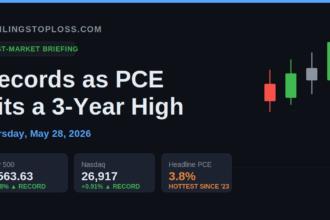
The damage being repaired was severe. Friday's session was the worst day for the Nasdaq Composite since the tariff chaos of April 2025, a 4.18% rout that erased more than 1,100 points after a blowout May payrolls number reset the entire rate-cut narrative and chip stocks got hit with aggressive profit-taking. The S&P 500 shed 2.64% and the Dow gave up nearly 700 points on the same day, leaving the bulls to spend the weekend re-reading their own thesis. For anyone wondering why a good economy tanked the market: 172,000 new jobs against an expected 80,000 is the kind of "good news" that makes the Fed reach for the rate-hike button instead of the cut button (CNBC).
Stocks: chips lead a half-hearted bounce
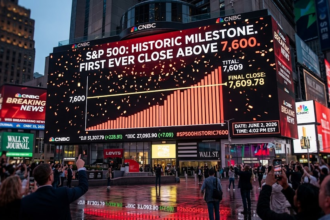
Monday's tape was a tale of two markets. The S&P 500 added 0.30% to close at 7,405.73 and the Nasdaq Composite gained 0.86% to 25,929.66, while the Dow Jones Industrial Average sat out the party, slipping 0.16% (about 81 points) to 50,786.01. The small-cap Russell 2000 tracked the rebound with a 0.85% gain. Calling it a recovery is generous; calling it a dead-cat bounce is rude but not necessarily wrong (CNBC).
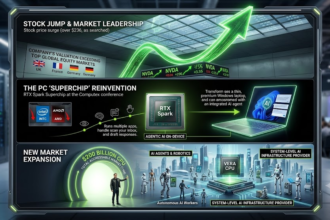
The engine, predictably, was the same semiconductor complex that did the breaking on Friday. Micron led the charge with a gain of roughly 10% after dropping 13% to end last week, and Nvidia and Broadcom both finished higher as the semiconductor ETFs recovered a chunk of their losses. The broader chip group remains the standout of the quarter even after the wobble, which is exactly the setup that makes profit-taking so violent when it finally arrives (CNBC).
Away from the chips, the dispersion was telling. Corning surged more than 9% after Amazon announced a multibillion-dollar deal to buy optical fiber for its expanding U.S. data-center buildout, a reminder that the AI capex story keeps minting winners in unglamorous corners of the materials sector. Apple, meanwhile, drew a shrug for its latest AI push and slipped more than 1%, because nothing says "muted investor response" quite like a stock going the wrong way on its own announcement day (TheStreet).
Futures, yields and the oil problem
The bond market is where the real story is being written. The 10-year Treasury yield ticked up to 4.564% as a stronger labor market pushed traders to price in a meaningfully higher chance of a Fed rate hike this year rather than the cuts they were counting on a week ago. Rising yields are kryptonite for high-multiple growth names, which is a polite way of explaining why the AI trade keeps getting yanked around (TheStreet).
Crude is the wildcard. WTI hovered in the low-$90s and Brent pushed back toward the $97 area as weekend missile exchanges between Israel and Iran kept the Strait of Hormuz premium alive. For futures traders this is the uncomfortable feedback loop of 2026: every escalation that lifts oil also lifts inflation expectations, which hardens the Fed's hawkish stance, which pressures equities — geopolitics laundering itself into a monetary-policy problem. If you trade the NY open, this is the macro backdrop you're scalping into, and our free trading tools and dashboards are built for exactly this kind of session (TheStreet).
Crypto: a relief rally after the bleed
Crypto finally got a green candle worth talking about. Bitcoin opened around $63,310 on Monday, up roughly 4% from Sunday and clawing back above the $60,000 level it had briefly lost during last week's risk-off purge. By mid-morning it was trading near $63,560, with a market cap hovering around $1.33 trillion (Fortune).
Ethereum did even better on a percentage basis, opening near $1,690 for a gain of about 7.7% on the day. The bounce comes after a brutal stretch in which money rotated out of crypto and into AI, energy-driven inflation fears mounted, and large holders dumped into the weakness — the kind of confluence that turns a correction into a faceplant. One green day does not undo that, but it does give the bulls something to point at (Yahoo Finance).
Metals: gold's safe-haven badge is malfunctioning
Here is 2026 in one data point: there is an active Middle East conflict, missiles are flying, and gold fell to a more-than-two-month low. Spot gold traded around $4,313 to $4,332 per ounce, down roughly 0.4% on the day and about $76 below Friday's level. The metal that is supposed to rally on geopolitical fear is instead getting clubbed by the second-order effect of that fear (Fortune).
The mechanism is the same yield story haunting the equity desks. Stronger jobs data plus war-driven oil prices equals higher inflation expectations, higher rate-hike odds, and higher Treasury yields — and non-yielding bullion can't compete when cash pays more. Silver held up better, trading near $67.60 to $68.70 an ounce, roughly flat to modestly higher, leaving the gold/silver ratio around 64 (Fortune).
The week ahead: inflation, AI earnings and a $1.8 trillion debut
If last week was Jobs Week, this is Inflation Week, and it is front-loaded with risk. The May Consumer Price Index lands Wednesday morning, with consensus looking for headline CPI around +0.5% month over month (down slightly from +0.6%) and core CPI near +0.3%. The year-over-year picture is the scary part: headline is seen climbing to roughly +4.2% as higher energy prices feed through. The May Producer Price Index follows Thursday morning as the wholesale-side confirmation (Yahoo Finance).
On the earnings side, two AI bellwethers report into a jumpy tape. Oracle is expected Wednesday with consensus near $16.91 billion in revenue and $1.70 EPS, and investors will dissect cloud-infrastructure growth and the duration mismatch between its long data-center leases and shorter customer contracts. Adobe follows Thursday at roughly $6.46 billion in revenue and $5.83 EPS — a stock down around 30% this year on the theory that AI design tools are coming for its lunch. Across the Atlantic, the European Central Bank is expected to hike 25 basis points Thursday (Kiplinger).
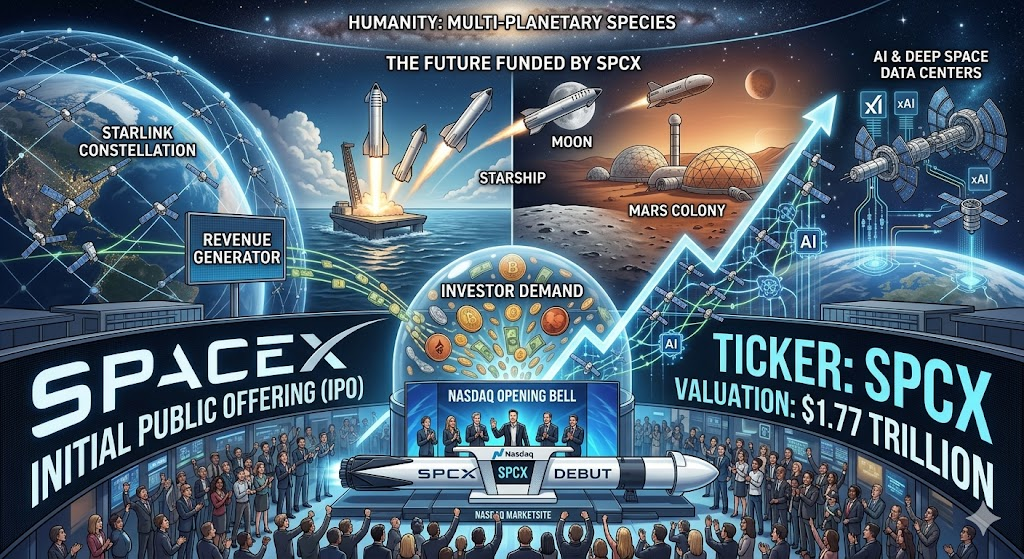
And then there is Friday's main event. SpaceX is targeting a public debut on the Nasdaq under the ticker SPCX at around $135 per share, a deal that could value the company near $1.75 to $1.8 trillion and reportedly stands to make Elon Musk the world's first trillionaire. Beyond the spectacle, there is a real mechanical risk for everyone else: an IPO of this size can force a selling event across the market as institutions raise cash to buy in, dislocating prices in unrelated names. The week closes with the University of Michigan consumer sentiment reading, which printed a record low of 44.8 in May (Yahoo Finance).